
About our guest
François Bohyn serves as the Chief Revenue Officer at Prismic, a headless CMS platform favored by modern B2B teams. His work sits at the intersection of AEO, website infrastructure, and Account-Based Marketing. François helps companies build websites that deliver speed, flexibility, and performance in a zero-click world.
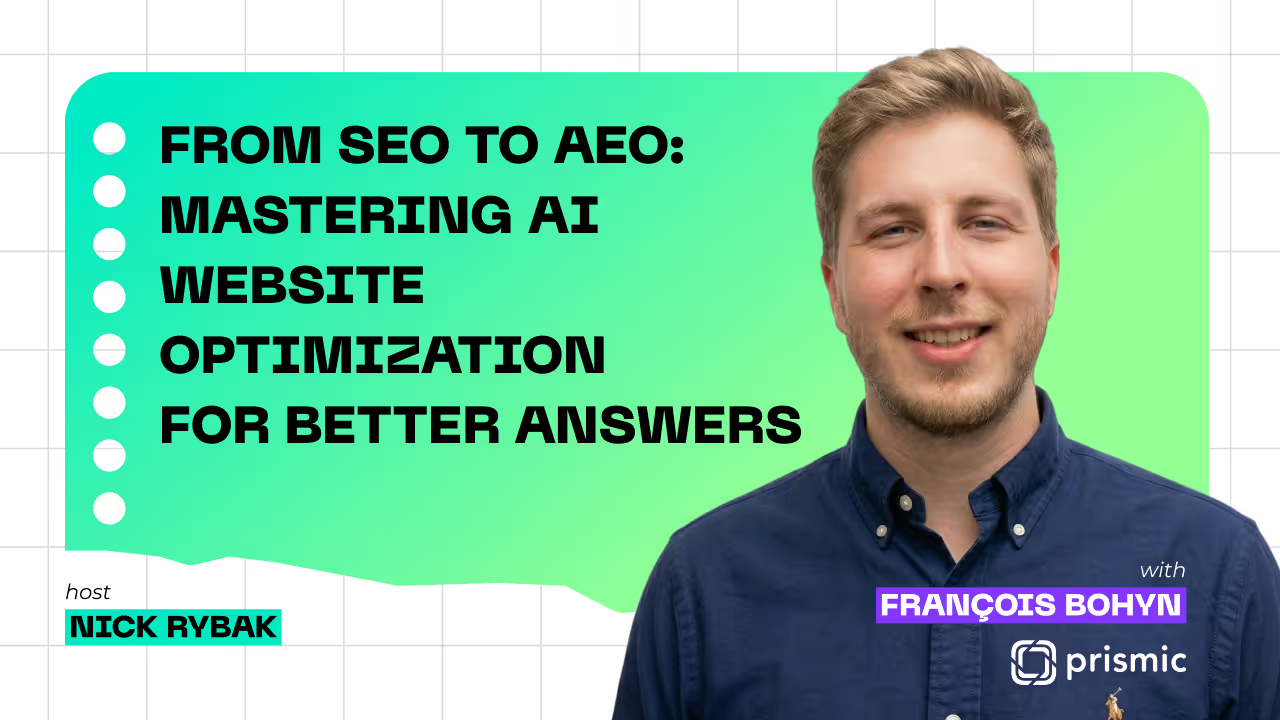

Traffic volume is dropping, yet website importance is skyrocketing. This paradox defines the modern B2B landscape. In this episode, we explore AI website optimization strategies that turn your site into a primary source for LLMs and high-intent buyers. Watch the full episode on YouTube to future-proof your digital presence.
- Traffic Quality Over Quantity: While overall search volume drops, the intent of visitors arriving from AI sources is significantly higher.
- AEO is the New SEO: Shift focus from keyword research to dominating semantic spaces and supplying comprehensive answers to specific questions.
- Speed is Critical: AI crawlers ignore slow sites. Technical performance is a prerequisite for AI website optimization.
- Personalization at Scale: Use modern tools to create unique landing pages for target accounts, aligning sales and marketing efforts.
- Metric Shift: Stop obsessing over clicks. Measure success by pipeline influence, engagement depth, and revenue generation.
Summary
The era of chasing raw traffic volume is ending. François Bohyn joins Nick Rybak to discuss why the B2B website is recovering its status as the number one marketing asset. They explore the shift from traditional SEO to Answer Engine Optimization (AEO), explaining why AI SEO optimization for website strategy requires a fundamentally different approach. François shares useful insights regarding aligning technical performance with marketing goals, leveraging websites for hyper-personalized ABM campaigns, and measuring success through pipeline rather than clicks. This episode is your blueprint for building a high-performance website in 2026.
The Zero-Click Paradox: Why Your Website Counts More Than Ever
Marketers are witnessing a decline in organic traffic. Search engines and AI platforms now provide answers directly on the results page, eliminating the necessity for users to click through. Many assume this makes the corporate website obsolete. François argues the opposite is true.
While top-of-funnel, educational traffic might decrease, the quality of the remaining visitors increases significantly. Users who click through today are highly educated. They have done their research via generative AI or AI search tools and land on your site with high intent.
“When you are going to get people on your website, they are very educated. So there are people who already did a lot of their research.”
This shift demands a change in strategy. You are no longer building a site just to capture casual browsers. You are building a conversion engine for serious buyers. The 70% of the buying journey that happens off-site is now influenced by how well your brand appears in LLM answers. Your website is the source of truth that feeds those answers.
From Keywords to Semantic Spaces: The Core of AEO
Traditional SEO focused on keyword research and ranking for particular terms. AI website optimization requires a wider approach. You must move from optimizing for strings of words to optimizing for “semantic spaces” and comprehensive answers.
LLMs look for authority on a topic. To succeed in website optimization for AI search engines, you must create content that answers specific questions in depth.
“You don’t optimize for keywords anymore, you optimize for answers and for a semantic space…”
Concrete Steps for AEO:
- Structure Data Clearly: AI crawlers need to parse information quickly. Use lists, tables, and distinct headings. Structured data helps machines understand the context of your content.
- Focus on Specificity: Generic “Ultimate Guides” are less effective. Create content which addresses niche, complex problems your product solves.
- Build Off-Site Authority: Link building is evolving into “brand citations.” Being mentioned in authoritative sources helps LLMs associate your brand with specific topics, even without a direct link.
Designing for Two Audiences: Humans and Machines
Modern web development requires a dual mindset. You are building for two distinct users: the human buyer and the AI crawler.
For the AI Crawler: Speed and capability are non-negotiable. AI powered search engines and crawlers have limited resources. If your site takes five seconds to load or render, the crawler moves on. Technical performance, specifically Core Web Vitals, becomes an essential factor in search rankings. A fast, lightweight site guarantees your content gets indexed and ingested by machine learning algorithms.
For the Human: Once the user lands on your page, they expect immediate value. They have bypassed the fluff via AI summaries. Your site must deliver a premium brand experience, clear value propositions, and a frictionless path to conversion. High engagement metrics, such as time on page and scroll depth, signal to search engine algorithms that your content is valuable.
Using the Website for Large-Scale ABM
One of the most powerful applications of a modern website is Account-Based Marketing (ABM). Personalization has proven to increase conversion rates, but it was historically too expensive for most companies.
François details how Prismic uses AI tools to scale personalization. Their stack includes Clay for data enrichment and Prismic for dynamic page generation.
The Workflow:
- Identify Target Accounts: Marketing defines a list of high-value accounts.
- Enrich Data: Tools like Clay gather particular data points about the company’s challenges and tech stack.
- Generate Assets: The system creates personalized advertisement creatives and unique landing pages for each account.
- Align Sales: SDRs contact the same accounts, using the data from the personalized campaign.
“We’re going to generate landing pages that are specific for that organization and that specific problem… The engagement that we have with these leads is way higher.”
This approach makes certain that when a prospect from a specific company visits, they see content customized to their industry and pain points. It transforms the website from a static brochure into a dynamic sales tool.
Technical Debt: The Silent Killer of Marketing Agility
A major hurdle for many B2B teams is technical debt. Marketers regularly struggle to own the website because it is locked behind complex code or managed by engineering teams with different priorities.
Legacy CMS platforms were built to build websites, not to run them. This distinction is vital. When marketing teams cannot create new landing pages or update content without a developer ticket, agility dies.
To execute how to optimize b2b websites for AI-driven search, marketing teams need a modern tech stack. A headless CMS like Prismic separates the content from the code, letting developers to ensure performance and security while giving marketers total freedom to create campaigns. This cooperation is necessary for maintaining the high search visibility required in the AI era.
Measuring Success in a Zero-Click World
If traffic is declining, how do you measure success? The dependence on vanity metrics like “sessions” or “pageviews” must end.
New KPIs for 2026:
- Pipeline Generation: Does website activity correlate with new opportunities in the CRM?
- Engagement Quality: Are visitors spending time on high intent pages like pricing or product demos?
- AI Visibility: Tracking how often your brand appears in AI generated answers. While SEO tools for this are still emerging, monitoring brand mentions in LLM outputs is becoming a standard practice.
“We can’t just look at traffic and expect it to go up… It’s about how your website is bringing pipeline.”
By focusing on revenue outcomes rather than volume, marketing teams can prove the ROI of their website investments even as organic traffic patterns transform.



.avif)
.avif)


.avif)