Nick Rybak (00:00)
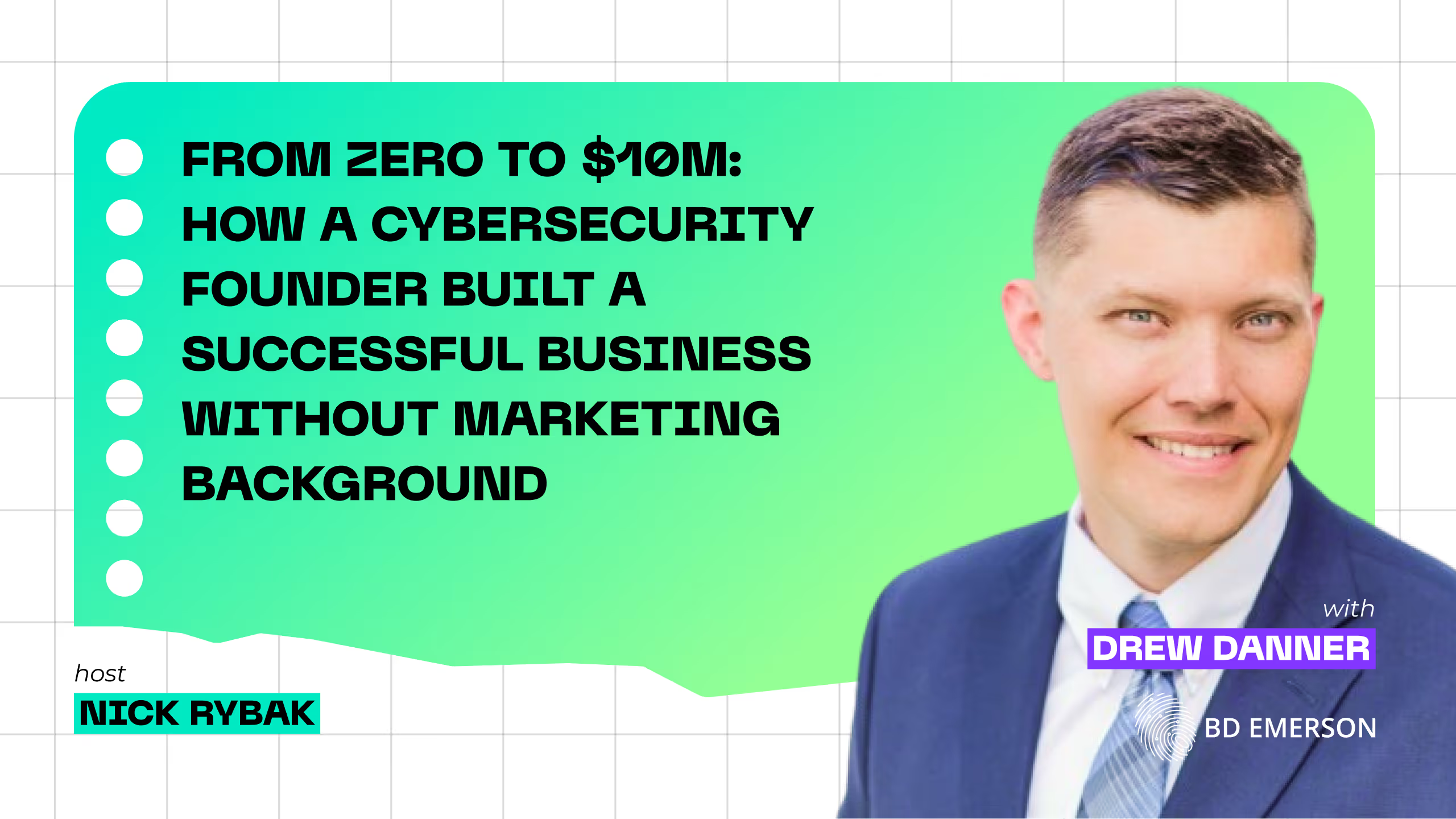
Many B2B founders think you need a marketing degree or a sales background to grow a company. Today's guest proves that is not the case. Drew Danner started a cybersecurity and compliance firm, BD Emerson from scratch, scaled it to 10 millions in revenue in less than six years. And he did it all without the marketing degree, without the sales playbook and in one of the most competitive industries out there, he has closed nine and even 10 figure clients using digital channels like SEO, smart partnerships, and building authority online. In today's episode of B2B Marketing Flywheel podcast, we are going to unpack exactly how he did it. I'm your host, Nick Rebak, founder of Foreset. So let's jump right in.
Nick Rybak (00:46)
Drew, thank you so much for joining me today. It's an honor to kick off the show with you. could you give a quick intro, who you are, what you do and how you get started?
Drew Danner (00:56)
Sure, ⁓ I'm Drew Danner, I'm the Managing Director of BD Emerson. BD Emerson is a consultancy that does cybersecurity, GRC, engineering, technology, and we are also a CPA firm. So in short, we're boring. We do security, tech, and audit.
accidentally started the business. I can tell you a little more if you want to know.
Nick Rybak (01:17)
Yeah, absolutely. So take us back to the beginning. So I know that you didn't have any marketing degree or like a new sales sexy playbook. So how did you start it?
Drew Danner (01:30)
So I started my career in the Army, which I started enlisted in infantry and then I went and got a couple degrees in math and computer science and I started writing really bad code and building garbage applications for the government.
I would do the code reviews. I would do the security requirements. So when I left the government, actually took a job in digital transformation at a public company
So I did through my career learn a little bit about the value of marketing, but no marketing degree. Definitely, definitely. Here's the part that was hard
me started a business. I never sold anything in my life. Anything. I never sold anything. I mean people say you sell yourself but learning to sell I think was one of the most challenging things for me as someone who's you know this fresh entrepreneur. I started the business
We won some large enterprise clients to start the business because the practice, you know, the area of cyber and privacy was really booming. But then there was this lull. There was this, you know, outside of the direct connections and word of mouth relationships with the people that were at BD Emerson, I didn't know how to do business development. And this was before...
I can just ask a machine to tell me what to do. I did a lot of research. What I didn't like was there were these outsourced sales orgs that would do emails and cold call and they would sell.
What I realized, we did use a firm and I liked them. They weren't successful at all. I paid them a lot of money over the course of four months and they produced zero actual work. They did work. They sent things to leads. I didn't ever have a sales call. Not one in four months. Not from lack of effort on my part or their part. It's just what we do, my practice, my firm.
You have to trust us and there has to be trust before we ever speak or I can't sell you anything. I can't solve your problems because you don't think I could solve your problems. If I go to someone and say, hey, we can solve these complex issues. There's no truth. There's no value out in the ether for them to know that I can do something. So.
I set out that you have to have a website. I went and built our first website, It served its purpose because we did. We had some leads. I think we averaged about one lead that was a real lead per month. It's getting about one lead per month from my website.
and never did paid search, didn't really know anything about SEO, like I had googled it and it sounded like black magic. ⁓
Nick Rybak (04:04)
Yeah,
sorry for interrupting. I just wanted to like, briefly elaborate on the topic of cold outreach and all of that stuff that you've like kind of spend money on without any results. from my background, I see that, working in marketing and sales, ⁓ with clients, it's also a problem when they cannot position their services and company and so on.
Don't you think that the problem with this outreach can be for business owners is that because of their lack of marketing expertise and they simply cannot like position themselves like somehow in the market so they can stand out Don't you think that that can be the part of the problem?
Drew Danner (04:48)
I I think that's one part of the problem, but I actually what I've learned is I think outreach, cold outreach, outreach has to happen after a certain level of maturity. If you're Microsoft.
and you send someone a cold outreach who is a Google customer and you know this because you can look at their DMS records and you see they're a workspace customer and Microsoft says, want that customer and Microsoft says, hey, we're going to offer you one free year of all your licenses for your business and we'll throw in copilot, but you have to sign a five year contract.
If that wasn't Microsoft, you'd be laughed out of the room, If Drew's Business Services sent you that email and said we'd give you one free year of our services and our fake AI tool, right? Like, you have to be trusted before cold outreach works. You have to be able to be recognizable. So I think when I did it, I didn't have a brand, right? I had a brand, but I didn't have a brand that people knew.
I didn't have a domain authority as marketers as you guys say. I didn't have it. So I think there's an evolution where once you're established and once you do work on building a brand that's recognizable, building content, investing in SEO, once people know who you are, yeah you could do cold outreach because it's never really cold is it? It's coldish. They don't want your services but they know who you are and what you do and
You have some case studies out there or they know clients that you've worked with or there's the Kevin Bacon effect. Within seven degrees of separation, a customer knows of BD Emerson. So we could do cold outreach, but when we started, it didn't work.
Nick Rybak (06:26)
Mm-hmm.
So you think before doing any cold activities like cold calling, cold emails, LinkedIn, wherever, you have to build trust and you have to build brand, right?
Drew Danner (06:45)
Yeah.
Nick Rybak (06:45)
And I see that many founders, start they're selling basically their services when they start with
referrals, they're like coworkers, just basically people that they can be introduced to. And I see that the problem is that they kind of do not really understand or have time to make this transition where it doesn't serve them anymore. Like they continue getting some leads from referrals, but you cannot build the system out of that. Right. And do you think there is a right time
to start building some marketing and sales system? And if so, what's the right time to do that?
Drew Danner (07:31)
man, I think my answer would empower founders but also scare people. So consultancies, right, service businesses are really fortunate. App companies are a little different but I still think it's similar but it's different. Services businesses, we're revenue generating the second you start the company. You go in work with, again, like a trusted connection, a friend of a friend. However, you have an expertise.
What I did not realize is why do I have an expertise? You, you and your team, man that was the worst, that was the most painful exercise of my life and it was so valuable. When you guys said what's your taxonomy? What's a taxonomy? What do mean? Do you mean like genus phylum species? do you mean taxonomy? And then you said well what are the services you offer? And I said well.
We do engineering, we do cyber, and we do assurance. And you're like, well, what does that mean? Break that down. Why? Because that's how a customer breaks it down. Because you have to document your services the way that people will find you. That seems simple, like if you think about it. I had never taken that perspective, ever. I never even thought about it. Someone is going to search exactly what I say I do. They're not. They won't.
They won't. The right time to make an investment in SEO is do you do SEO? Big companies. There are companies on the market today, $500 million in revenue, billion dollar in revenue that don't do SEO. They only do paid search or they only do, you know, they have huge sales orgs and they're leaving money on the table and what you've showed me.
is how the little things can just add up to this big picture. So I set my website, the site that I originally developed, one good lead a month. We typically get between 60 and 100 good inbound leads a month. Now, good and
Nick Rybak (09:30)
So yeah, that's really impressive. But you know, like building the marketing system requires an investment. for first time founders, it's not that obvious when is the right time to like start making these investments because it's simply like, imagine you founded a company, you sell services, you have some customers and...
a company somehow grows, months over months. But then like, Miracle isn't happening anymore. Like you cannot double your company anymore because you simply have not enough, worm referrals that can, can be that like a drive of the growth of the company. how do you think should approach the stage where.
They kind of mature enough to have clients like case studies, testimonials and all of that stuff. But they are simply afraid of spending dollars on marketing because it's also like a long-term game. You won't like get leads tomorrow if you spend money today, right?
Drew Danner (10:37)
Yeah, such a good question. I'd like to think I'm a very analytical person. My wife would sometimes argue the opposite, but in general, I like numbers. I like numbers to make sense, and I like to be able to show value. Everything I buy for a business, I'm doing ROI math in my head. I'm doing like, what is this actually gonna get us?
I quickly abandoned cold outreach and outbound because I believe that in this field the numbers don't make sense because you have to be trusted. No one is going to trust you if you're just blowing up their email and they've never heard it.
⁓ So I got to the point where I was you know, I'm I'm becoming a better seller as a founder, right? So, you know, I I know in the industry I'm learning some of the term right? I've never really called myself a founder, but I am I guess I'm a founder so founder led sales, right? We went from we went from zero to ten million in revenue and really under five years and it was founder founder led sales But the big but here was
When we were north, we were over a million in revenue, I was really, really keen to hire someone for sales, either outsourced or internal, and really structure it so they make most of their money in commission, right? Like this works for companies, you hire a salesperson. I hired a salesperson who by all accounts, very competent, very good at...
sales, had worked in services, had worked in selling cyber, it didn't work out. know, great guy, wish him well, didn't work out, and it was clear it didn't work out pretty quick. Three months in, four months in,
didn't, you know, asking me what to do, right? Like, I need independent thinkers. I need people who can solve problems bespoke me giving direction. I can tell you exactly what we did. I can give you working sessions and tell you how to sell, but you're the salesperson, you have to sell. I'll close it. We get on a call, I'm Mariana Rivera, right? Like, I know that we can close a client's business because we can do the work and I know it'll be quality. And that's it.
When you're at a point where you're going to hire a salesperson or outsource sales, that money, what I've realized, if you spend that money to get people to come to you, the multiple on the dollars you spent, they were just better. The cost of acquisition is just better. Here's an example. And this is in the past, so we're getting great inbound leads today. But when we started this SEO project with Four Sets,
I never rushed it. I assumed that I was just taking a gamble and it wouldn't work out, right? just like that cold outbound, right? Like you're founders. You to figure things out.
⁓ But what did work for me is you guys sent eight experts to me who all have different backgrounds who said I need this from you. I need this from you. I need this from you. And there's a lot of work up front. Your team really sought to understand everything I did, the competitive analysis, the services that I have to offer because everyone does. And we do it. It's unusual to describe it. We won't sell a contract the way it's described on our site.
No one does but what I learned was you have to put things on the site the way your customers find them, right? So You speak to us
Nick Rybak (14:12)
Yeah, you should speak their language, basically.
Drew Danner (14:15)
We invested and the cost of the project that we started out to do the initial SEO project was less than half of hiring someone over that time frame. even hiring someone for a year. I think we paid 50 % of a monthly salary to kick off this SEO project of what we were paying the original salesperson, total comp. So we kick it off, we build the content, we build the pages.
And it was like right on time at like day 60. We kicked this project off two months ago and I see the web form come in from HubSpot for someone asking for exactly what we know how to tackle. There's urgency in it because in cyber and engineering lots of things have urgency. It says a budget is approved. They need someone who can move rapidly. They like what they see on our site. Can we schedule a call? And I'm over here like...
This looks legit. We started doing the research, like how did they find us? And then I could see from analytics, like what they queried, how they got to us. Google's telling me I ranked number one for a query in 60 days was crazy.
was crazy.
man the difference in scale between outreach and people coming to you, people coming to you with trust to solve their problems, your field goal percentage just goes through the roof. Cold outreach, you get what? What's the odds? It's like one in a thousand people respond or something crazy in general?
Nick Rybak (15:47)
Yeah, it's usually like below the percent
Drew Danner (15:52)
So we're talking, you send a thousand emails, you get one person who's getting on a call. They have a problem. Now your percentages of closing come in. So maybe you only close 30 % of your pitches.
Nick Rybak (16:05)
Yeah, that's a good, that's a good, good percentage. I think.
Drew Danner (16:08)
So we're
30 % of our pitches and for us to have just three out of 10, to get 10 now, we have to send 10,000 targeted outbound messages. We have to have 10 wholesale cycles. I'll tell you that I think my close rate is between 65 and 75%. If they come to us and we pitch a project, we close the project. Now...
Nick Rybak (16:36)
That's impressive.
Drew Danner (16:38)
It has nothing to do with me and I'm firmly aware that while I'd love to say it's I'm God's gift to humanity, I'm not. It's because when you're looking for a tool to handle a specific task,
and the first thing you look up is the exact tool with a high five-star rating, reasonable pricing, and the people who make the seem credible, then when you put that tool in your cart, you don't have hesitation. You just check out. So what I realized is if I have to force the tool on you and I say, hey, buy my tool. It's great. My kitchen aid is better than kitchen aids and it'll blend your stuff.
Your question is like, can you prove that? We don't get questions. where we're still a small firm in the grand scheme of things, there are billion dollar companies that do what we do. Why do you trust me instantly?
It's because we have content around what we do. We're seen as thought leaders. Once the credibility is there and the customer sees it,
Your percentages for closing go up, people are coming to you, and you're driving revenue.
Learning how to sell when someone trusts you is just a completely different experience than trying to cold sell or to sell a solution from a services perspective and say, yeah, yeah, we do that. We've done this for a couple of customers. Here's some logos.
People don't even ask us that anymore because of the content, because of the marketing, because of the website, because of the case studies, which I never even thought to do a case study. I remember you were like, just put it your contract, right? Tell your customer that if the project is successful, that you'll give them a discount if they do a case study. And now we have all these case studies and we have happy clients and we have happy prospects that see happy case studies and we do good work, show it off. I never even thought to do that.
off good work, but even our case studies are SEO optimized. That way when people search for specific things we do, they see that there's a proof point that we've done it. We've done it for a company they know and recognize. We're trusted and they bounce for us. Like it?
I know, I'm probably the worst person to have on your first podcast I used to think that marketing was madman.
My site could be the ugliest site on the internet. How did you find it? You Googled it? Or better yet, when I see that we have 500 leads per month come to us from chat GPT or Gemini or Claude because the SEO content that we wrote.
when people come to us they're like, we've already told our management that we'd love to move forward with you.
Nick Rybak (19:18)
Yeah, that's actually you've that that point founders usually do not think of that, but the 90 % of sales happens before they reach out, not after, because you can't really estimate the amount of leads that.
do not come to you because you simply lost before they even reach out to you.
So what I see in B2B space is usually founders rely heavily on not only referrals, but also
kind of B2B events, conferences, and all of that stuff where you can build actual connections, have discussions and everything. So why did you decide to rely heavily on content and digital instead of this traditional way?
Drew Danner (20:02)
we wanted to go to the conference with a specific intent not on selling our services.
but on focusing on one single service line that we offer at the lowest part of the taxonomy. So if you offer a top level service and then a sub level service and sub level, we were going to the conference with this tiny, tiny little specific thing because research said that this mattered to the people we were at the conference with. So I said, yeah, I just want to make a post that we're going.
it was such a well-written post, that the
at a publicly traded multi-billion dollar company that hosts a big event. won't say their names so they don't get mad. They sent me an email and then called me and then called one of our clients who is a partner in their ecosystem and said, can you take this down because it's scaring people.
My little firm wrote a blog post that scared a publicly traded company because we heard through the grapevine that they were requiring stricter controls from their partners who were going to service their customers. What it did is it led so many of those firms at that event to seek us out, engage with us.
And I think we closed from that event like 10, 15 people. Now, your question was, why did we not just invest in doing more events? If I go to an event and I don't have SEO and I didn't have a content strategy and I didn't have a message to tell those people that they can look up without me on the interwebs, we don't close those deals.
We go, we meet people, the sale cycle's long, we might develop a relationship that might lead to one or two projects. We closed, we closed dozen projects instantly because they had an active need that we were actively requiring they had to meet, and they had heard of one company that did this today. So they met with us. Our pitch is reasonable, our team is great.
and we have all of them are happy customers and they all had successful projects. All of that happened because I invested in SEO
We had an intelligent conversation with our marketing team. We had a goal to build content because we're seeing things in the market. All service companies see things in the market. You're working in the field. What do you see? Build content around it. Why? Because if you're seeing it, people are going have questions. And that content is going to give them answers and bring them to your site where they look at your services and they say, hey, we can use them. That doesn't happen unless you do the SEO.
Nick Rybak (22:57)
So you think of SEO more, not only like as a driver of traffic, but also as a tool for building trust with your prospects, right?
Drew Danner (23:07)
100 % and it's funny, I would say that we work in the same business, security and marketing.
Security and marketing work in the same business. Their goal is to keep companies safe and build trust. say marketing keeps companies safe. Marketing steers people away from bad marketing, which can impact brands. We've seen that a lot lately. But growing trust, right? Like people don't trust you because you say, hey, trust us.
You have different kinds of trust. They trust your expertise because you're a thought leader because they read rich content on your site.
I'm the biggest fangirl of SEO.
Nick Rybak (23:51)
Okay, got it. So happy to hear that. Let's move forward with that. And I have a question if you were advising another founder, and I know that you are kind of advisor for early stage founders. So if you were advising another founder right now with no marketing background, what should they do first? What should they focus on?
Drew Danner (24:17)
Do they have a budget or no?
Nick Rybak (24:20)
Let's say they have like a couple of thousands a month, but they are not like able to invest a year or two without any results. So for these folks, like that's the typical situation, right? When you have some money that you just earned with clients, like from referrals and you want to give it back to the business. So you generate new sales, but you are not ready to like wait for.
two years until it
Drew Danner (24:49)
I think for a budget of like $3,000 a month for three months.
I think that you could close enterprise leads if you do content creation and SEO correctly. So start to finish. Say I start a services company today that anyone can understand, any lay person. I just got my journeyman plumbers license. I'm a plumber. I work in pipes, toilets, plumber, sewers. Very great career. We need more plumbers on the planet. So I just started a plumbing business.
The only way that I get clients today is I drive around in my plumbing truck and I say I do plumbing and eventually my number will get called because people remember it or see it or take a picture. Like that's how those services businesses get work. But then if you have that $3,000 a month for three months,
and you go to a firm and say, I don't want you to build me a website. I want to buy a templatized website that you're going to hate and you're going to beg me to replace after we become successful, you can spend $100 on the template. Fine.
Go to YouTube. Nowadays, you even need to go to YouTube. Go to an AI platform and say, okay, how do I buy a domain if you're non-technical? How do I stand up my domain? How do I host my website? How do I put it in draft status? No one's going to find it, so it impact my brand.
So $3,000 a month for three months. You've bought a site. You've stood it up. You work with a firm to decide what is your service offering. And that's why I think it's not marketing. It's like business consulting. It's product market fit.
What are the things that you're competent in doing? Don't choose the world. Choose the things you're great at to start. What is the founder great at? If it's going to be a founder led service, because I talk to founders all the time, ⁓ app companies as well. If your app solves one problem primarily, what is it? How do we define it? Hand that to a team that's going to go do research. Market research.
What are other tools on the market? How did they rank? What queries do people use to find their products? How do we steal that? What queries are we never going to rank for because the top of the market purchases them? Where is there opportunity for us to get someone to our site that trusts us enough to have a sales call? Because we know what we do, right? A founder knows what they do.
I just need to be on the phone with someone. I need to have the call. I need to show that we can solve the problem. So $3,000 a month for three months gets you services pages that are defined, a process to capture inbound leads, a web form from a templatized website, a CRM. You can go freemium, you can go legacy, you can go modern. It doesn't matter.
Have a method to track customers, have a method to follow up, have a sales cycle, have a loop, have a defined contract. I advise startups all the time and I tell them exactly how we did it. There should be no secrets. I'm a huge believer of knowledge should be free. You want to know exactly how I did it? I will be prescriptive. I will tell you exactly what we did. This part is critical.
It is cost effective. I'd say it's cheap. And even if you don't continue on that service, that $9,000 to me, that's worth the value of closing probably five service contracts a year. Now, depending on a company's margin and the revenue from their services, I assume that 99.9 % of all founders, that $9,000 pays for itself within three months.
You continue that service and you do it for a year, right? That's $36,000 US for a year, which is cheaper than hiring someone. It's cheaper than most apps that say they do things. It's collaborative. And that's, yes, that is a lower end to expect. I think it's a reasonable end to expect for like a founder, a five person, 10 person, 20 person team. The return on investment there.
an investment in SEO for a year, I guarantee you, I will bet money, a gentleman's bet of $1, anyone can reach out to me on LinkedIn and make this bet. I bet you that you will multiply your revenue.
by a factor that is 10 times the cost of the service you paid. It's not linear. Once you get traction, is wild how fast things happen. There's this growth scale where you're going like this for a second and steady and then it just upticks and Google is saying, hey, you had 10,000 clicks this month or whatever the crazy metric is.
It's SEO. They don't come to us because they know who we are. There's analytics. can see. can prove beyond a reasonable doubt. I can substantiate that the reason that people find our site and pay for our services is because they searched a word that we ranked for because of our marketing firm and then they engaged. That's the longest-winded answer, but that's my answer.
Nick Rybak (30:04)
I think that it's insightful for people that are starting out and especially I like the part where you tell that the moment that you want to hire a salespeople is a good time to invest in marketing. with that, have a question. So do you think that early stage founders ever should hire like a salesperson to replace themselves in the sales cycle?
Drew Danner (30:30)
⁓ I think there's a natural point where that happens. It's probably close to that like 10 million in revenue. Well, I won't say that number. Founders come from everywhere in the world. I think when your time is better spent with solving problems with the team, solving human problems, building like bigger strategic initiatives, building good partner channels,
⁓ There is a time where you do you you hand off sales to a sales org
I get on a call with a junior sales person who just has a question. I don't go in and say, hey, I'm the managing director and founder of BD Emerson. I just go in. Most of the time, I'll be on a sales call and the person on the other end thinks I'm an associate, thinks I'm someone who just solves problems.
So last week, Rafael was on a call and added me in and client had some technical questions about how to do something. And I not only told them how I would do it, I provided written documentation from a very, very trusted source with explicit instructions for how they could do it, which.
I researched in the call with them after hearing the exact use case and strange, it matched exactly what I said, which gave me some credibility. And then I got an email back from the guy who was like, it really helpful for you to come. We're definitely going to close with you guys. You know, it's so crazy to see your expertise. You didn't even know who we were before the call. And then I reply and it has my signature. And then the guy emails back, like, oh, I had no idea that, you know, you run the company. I was like, oh, no, no, no,
I don't run the company. I started the company. The team runs the company. Everybody runs the company. I would never be able to advise someone when the transition should happen from founder-led sales to sales team. I assume it's when you just can't handle the volume. I went from doing two sales calls a week
to one a day to now multiple a day. I organized my day around sales calls.
Nick Rybak (32:36)
So you're still basically a salesperson, right?
Drew Danner (32:39)
I think we're all, all founders will always be salespeople. And when you get to the point where you're not supporting your sales org, what value are you bringing? There's a level of like, I'm doing strategy or hey, I'm supporting with client deliverables. At the end of the day, I think we'll always be salespeople. Do you have to be involved in every sale? No. We have whole services where I never meet the client.
I don't need to, right? The sales team can handle it. The big hairy enterprise client comes with a very large problem. I'm in those calls. I'm in those calls because you have to do a little bit of problem solving to even start the sale. You have to sell how you're going to fix their issue. Now,
you shouldn't solve an issue on a sales call, but you should have a direction that you can articulate in a statement of work. And for me to do that, I have to be there.
Nick Rybak (33:40)
Yeah, I actually agree with that, with the point that like founders should be involved and also that one of the most important tasks for founders is to sell because nobody will get more credit and trust except for founder, I think.
Drew Danner (34:00)
Yeah, I think what also even before the hiring sales team our senior folks close deals, right? Like so they know what they do so we can have we can have a sales cycle where I have a Privacy attorney join a call and the privacy attorney right? You know, we have a PhD privacy attorney She's on the call and she's describing to a client how to solve their issue. That's the sale We actually didn't sell anything. We didn't pitch anything. We told them how to solve it
And they said send us your terms and send us a statement of work for you to solve this and we'll agree to it if it's reasonable so having experts in sales cycles It's why app companies have sales engineers and solutions engineers because they're product experts They can solve the clients problem and the call for surfaces business if you look at the big tax firms or big Law firms who's in the sales cycle. It's a partner partners are in sales cycles
At a legal law firm, a partner will close most deals. Associates might work on them, they're, right, and I took that approach of, you know, from my, me doing it personally or from a partner level, someone closing the sale, like that's how it's done. Eventually they transition, but it is a difficult thing to say when that happens.
Nick Rybak (35:19)
Okay, I got it. think you gave a good answer here is that it depends on the volume, I think, because if your service costs like 2000, you can be on every sales call if you have like hundreds of leads every month.
Drew Danner (35:31)
Yeah, that's a great point.
That's a great point. I think it's less about revenue and more about volume.
If you can't do the other things, hire a sales team. When I was doing one sale, two sales calls a week, I'm still the prime, I was the highest billing person in the company. I billed more hours than anyone. At a 10 person company, I was working, I was probably working between 60 and 70 hours a week. I was probably billing 45 to 50 hours a week.
And then I slowly transitioned to billing less and doing more sales, doing more strategy, doing more partnership, doing more things like this.
Nick Rybak (36:16)
Got it. All right, so.
Last question, what do you think is the one thing in B2B marketing that you think people are getting completely wrong right now, especially founders like you?
Drew Danner (36:33)
is not going to be popular.
Nick Rybak (36:34)
Alright.
Drew Danner (36:35)
Stop using AI to write your services pages, your website blog posts, and your damn LinkedIn posts. Trust me. Trust me. Everyone knows that it's AI. Everyone knows that it's AI. I don't have AI fixed grammar. I don't care. If I have a misspelling, it proves I'm human. I'm trying. My job as a founder
My job is to make people trust me and my brand. Trust we can handle your most complicated projects. We can handle your big hairy migration project. We can handle your $500 million revenue manufacturer and you're terrified of a new ISO requirement because you're not mature enough and all this. We're there. My team will handle that.
because we're experts, not because we're going to use a bot to tell us what to do, because we've done it. Still, Allstate's line, Allstate, insurance company says, we know a thing or two because we've seen a thing or two. You don't come across as genuine if all of your content is curated by a machine. It's clear. And by the way, your results are worse. Google won't index those. Another thing that I learned from you and it's...
Because whenever I do put effort into writing, I want the world to know I wrote something like,
generate content. It sucks. It's like exercising. You exercise because you want to feel good, you want to look good, but sometimes exercising is tedious and you don't want to do it today and your knee hurts and you don't want to do cardio, you didn't sleep well. You have to. It's the grind. The grind in running a business isn't doing the work. The grind in running the business for me was getting people to know who you are.
Because once people know who you are, work is a lot easier. So you invest on this front end, way selling's easier, service delivery's easier. We had a client tell us, so we closed a multi-billion dollar retailer who sells mattresses.
The person who signed the contract said, I don't want to feel as if I'm risking my job by choosing you guys. When people are buying your services, if they go with the name brand top 100 consulting firm, no one's going to fire them if that consulting firm does poorly. It won't impact them whatsoever. If you hire EY and EY does a bad job, that doesn't look bad. That doesn't even look bad on EY at this point.
global brand. it's the team, it's the circumstances, it's you. You don't look bad for choosing EY, it's EY. If you choose BD Emerson and the project doesn't go well and you took a risk on us, not a good look. People lose their jobs for that.
What I realized is we got to a point where people were confusing us between BDO, which is a global player, and Emerson, which is a global company, which is nice. It's a nice issue to have, right? That people think we're this big old company, big mature company. But what I realized was we have enough of a digital footprint and they see us enough and we don't do paid search at all. We're not redirecting anybody.
Nick Rybak (39:28)
Haha
Drew Danner (39:41)
content. They want to search for things. They look, they find our content everywhere. I was told they were like, you guys are named brand. You know it's not like I'll lose my job by choosing you. When I heard that, everything like I just felt this warmth of happiness. Like my decision to invest in marketing, it not only has paid off, it has made me look like an absolute genius. Like I look so smart and I did nothing. I took someone's advice.
Nick Rybak (40:05)
That's truly inspiring. So Drew, thank you so much for sharing your story. And I know so many founders and maybe even marketers listening are going to take something away from this. Thank you for sharing the story. So it was really, really interesting to hear.
Drew Danner (40:23)
Thank you so much for having me, Nick. I can't wait to see future episodes. I will never watch this episode because I hate the sound of my voice. ⁓ But next time have someone on more interesting and hopefully I can gain from any knowledge you share. Huge, huge, huge fan of Four Sets, huge fan of what you do personally and this podcast is going to be successful because I think you share a lot of knowledge that not everyone has.
Nick Rybak (40:32)
Ha ha.
Drew Danner (40:49)
and you do so without asking for anything in return. It's huge. You're a thought leader and I appreciate everything you've done for our business.
Nick Rybak (40:57)
Thank you so much. Nice to have you.











.avif)


.avif)