Nick Rybak (00:00)
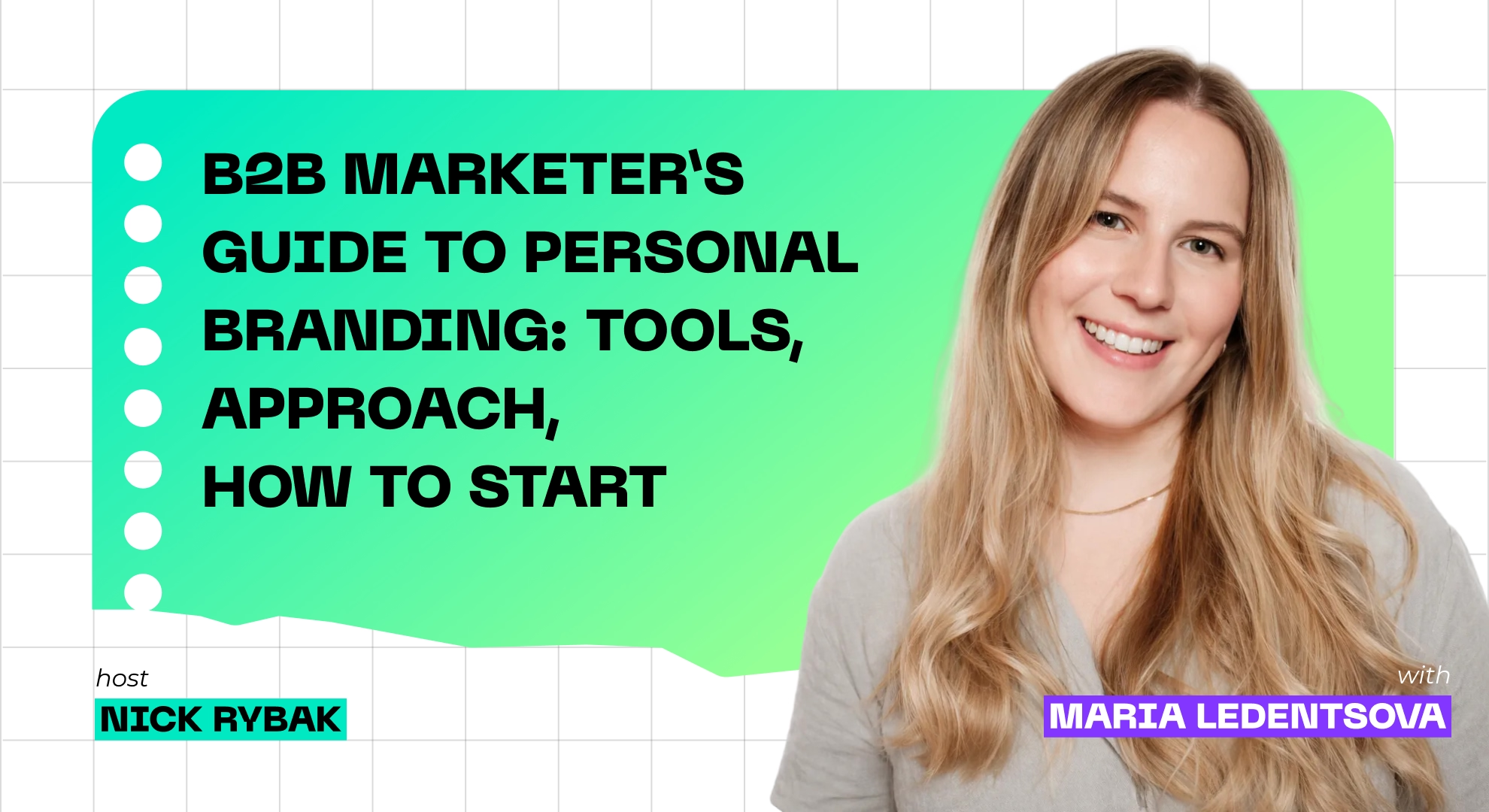
Marketers say personal brand matters, but how do you start building it while being a 9-to-5 marketer? How do you get approvals to do that during working hours? What are the benefits for the company, and which tools should you use? How do you actually start doing that? Today’s guest knows all the answers. Maria Ledentsova built the entire content engine at Magier from scratch, starting with strategy, messaging, and distribution.
While growing her own LinkedIn presence into a trusted voice among B2B marketers, she used team members’ personal brands to bring actual clients to the company, influence decision-making, and support fundraising and sales. So today, we’re unpacking a simple but very uncomfortable question: Is building a personal brand worth it for a full-time B2B marketer, or is it just another unpaid side hustle?
We will dig into why a personal brand has become a competitive edge for marketers, the real opportunities it brings, and the challenges that you will definitely face on that journey.
So if you’ve ever wondered whether it’s worth the time, this episode is for you. This is the B2B Marketing Flywheel Podcast. I’m your host, Nick Rybak. Let’s dive in.
Nick Rybak (01:21)
Maria, welcome. I’m really excited about this episode because you’re one of the few marketers who actually do what most only tweet about. You built your own personal brand and managed to build both brands at the same time: a content machine for Magier and your personal one. The sign of your huge success, I think, is me seeing Magier’s posts all over my feed, which I secretly envy since Magier is a competitor, as we are both in the Webflow space. I’m joking, of course. It is a real pleasure to have you here. How are you doing?
Maria Ledentsova (01:57)
Thank you so much for the kind words. I’m very excited to be here. I’m also excited to see Magier continuing to be present on LinkedIn after I worked there as a founding marketer to build up the content engine. Now I’m working for myself, but I’m very excited to talk to you about everything: LinkedIn, marketing, and personal branding.
Nick Rybak (02:31)
Same here. I’m really excited to talk about the huge success you’ve accomplished at Magier and with your personal brand, and some strategic insights, tactics, tools, and everything related to personal branding. I think we’ll be able to cover all of that here today. With that, I have a first question: what do you see has changed in B2B marketing in terms of personal branding? Is it more important now than it was before?
Maria Ledentsova (03:06)
I would say personal branding is for sure more important right now than it used to be. I’ve noticed this trend, and I think a lot of people are noticing it: buyers are trusting people so much more than they trust brands. It’s always been the case, but now more than ever.
With AI developments, with so much generic content, with so many brand accounts over-promising and with no faces behind them, how can you trust an entity? It’s really hard to do. For me as a person, and for everyone I talk to, you can also see this in practice. For example, Microsoft has a certain number of followers on LinkedIn, but the CEO of Microsoft has many more followers because people follow people; people trust people.
That is a general trend in B2B. You can also see it in the organic reach for company pages—it’s terrible. Personal accounts always outperform them. Algorithms are starting to favor storytelling based on experiences much more than generic content that AI can spit out in seconds. Some people do this to shortcut content creation, but it doesn’t always work. People want authenticity and to see actual humans behind the screens and connect with them. I think that’s a general trend and a welcome development in my eyes.
Nick Rybak (04:40)
I agree with that, especially with the new job postings you see all over LinkedIn. PayPal is hiring a head of SEO content, OpenAI is hiring a head of content, and so on. Especially in the age of AI, these are signs that it’s becoming more important, not less.
Nick Rybak (05:09)
Taking all of that into account, why do you think so many marketers still treat a personal brand as an optional thing? They mostly focus on the company’s LinkedIn pages and the company’s brand, rather than their personal ones or even thought leadership from people within the company.
Maria Ledentsova (05:21)
I think there are two things. The reason marketers don’t build a personal brand or are still resisting this change is that they still treat LinkedIn as a CV. They see it as a place for their experience, where they can just apply for jobs, and that’s enough. LinkedIn has changed a lot over the years from a CV platform to a creator platform. It used to be so boring to be on LinkedIn, but now if you follow the right people, you can have a great time. It can be a bit addictive, not as much as TikTok and Instagram, but it’s getting there. From what I’ve read, LinkedIn is also moving more into the video direction in the future because video content is very engaging and keeps people on the platform longer.
But why marketers still resist building a personal brand is perhaps because they underestimate the importance of LinkedIn and the impact their account can have on the opportunities they get. The CV is the first impression; the recruiter sees the CV, then they go to your LinkedIn profile or Google you. Your LinkedIn account should act as your landing page. It should show that you’re human and an expert. Ideally, it should have some content where you talk about your expertise, your opinions on the industry, what you do, and why you do it. As a recruiter, if I were to see two potential candidates and one has a very generic, bland LinkedIn account while the other is opinionated and interesting, I would for sure go for the person who is opinionated, outgoing, and passionate.
So, underestimating the importance and impact it can have on your life is one reason. They think a CV provides enough visibility. Then there’s the leadership aspect. I’ve talked to a lot of marketers who are worried that their employer will think they want to quit if they start posting on LinkedIn and getting out there. Their employer might assume they want to leave the company and get other jobs.
There has to be a conversation between founders or leaders of companies and their employees to empower them to post, to tell them that personal branding is good for everyone, and to teach and support them in doing it. If there is no support, if there is no trust, if employers are trying to control what their employees are saying online, it’s not a very good environment. It might mean you’re hiding something. Of course, there can be guardrails, like not disclosing revenue or saying you’re losing revenue or something dramatic. But generally, you should trust your employees to act in your interests and give them the freedom to share what they’re thinking online.
Nick Rybak (09:00)
Let’s talk about the benefits for the company a bit later. For now, I’m more interested in what kind of opportunities opened up for you because of your personal brand. Getting a new job is the most obvious one, but many people are happy with their jobs. Are there any opportunities that can help you with your current one, maybe get more results for the company or negotiate a better salary?
Maria Ledentsova (09:36)
So many, it’s hard to even count. It opened so many doors for me. First of all, invites to speak on podcasts like this one, which I’m very grateful for. Interesting speaking opportunities. I’ve met so many incredible people and made so many new friends from LinkedIn, which I never would have thought would happen.
I got to collaborate with tools. I grew my account as a creator on LinkedIn, and now I get sponsorship deals with brands that I’ve been admiring or using for a very long time. I can create content for them, and it’s super fun for me to do. And they get visibility because they get in front of the audience they want to reach: marketers and founders.
Once I did quit my job, you mentioned job opportunities as the obvious thing. Of course, once I quit, I also got multiple six-figure, full-time opportunities that I could have accepted if I wanted to. I decided to continue on my solopreneurship journey for now, but just knowing that there are people who would be willing to hire me and pay me really well if I wanted to accept those opportunities was a very good feeling. It’s good to know that I am safe if I want to go back to a 9-to-5 job.
And of course, while I was at Magier, because of the audience I was building, I was seen as the content expert. I could prove that I am good at what I do because we got leads and clients for Magier. So it wasn’t just in my interest that I was building my personal brand. I could really demonstrate that through my personal brand, we could also get clients for the company. And I was supporting the team in posting on LinkedIn as well. So it wasn’t just about me and my account; it was also about the company, and I’m really happy with how that turned out.
Nick Rybak (11:52)
Would it be fair to say that a personal brand would be like a shield for a B2B marketer, especially with the fear of AI? Content creation is the first thing people usually think of replacing with AI, and many content marketers are simply afraid of being replaced. Would a personal brand be a shield against that?
Maria Ledentsova (12:33)
That’s a good question. I think generally, content marketers who don’t know how to use AI will probably be replaced by people who can. You need to know how to use it well and without creating generic content that nobody needs, but rather to speed up your workflows.
As for whether there’s less of a chance you’ll be laid off if you have a personal brand, I find it hard to tell. It really depends on if the founders support personal branding and see it as a valuable asset. I think many founders do, but some are still on the fence.
But I would say that maybe that shouldn’t be a concern. If you do get laid off and you have a personal brand, then at least you have a personal brand to get more opportunities. So it’s not something to be afraid of. I would be more nervous about getting laid off if I didn’t have my personal brand, because then I’d be competing with so many other marketers based only on our CVs. That’s the challenge, because right now the market is oversaturated. Every job you apply to has 300, 400, 500 applicants, especially for junior roles, but also for senior ones. So I would say it’s not really a shield from getting laid off, but it gives you confidence that you will get other opportunities and have a higher chance of landing them. Does that make sense?
Nick Rybak (14:32)
Yeah, I love that. Just a quick summary: you think that having a personal brand helps you be more competitive on the job market. It also gives you the opportunity for partnership deals, which is basically a second income stream for people who work nine-to-five. Anything else?
Maria Ledentsova (15:00)
That’s already a lot of points. You’re building your audience, you have more opportunities, and you’re able to grow, learn, and test a lot of ideas with your own account. For example, at Magier, whenever I had a content idea or a campaign idea, I could test it with my account. It’s very low-stake. I could test new content formats, new hooks, and new approaches. It was really cool to have a channel that is your own that you can use for experimenting.
Nick Rybak (15:45)
Yeah, absolutely. That’s a great point that no one talks about. Alright. So those are the benefits and opportunities for B2B marketers. To prove the value of that, they have to somehow show how it benefits the B2B brand’s marketing strategy. So how do you actually prove that to stakeholders? What are the pros you can bring as a nine-to-five marketer to the company so they allow you to grow your personal brand while you’re working?
Maria Ledentsova (16:30)
So many benefits again. For example, if your employees are posting online and talking about what it’s like to work at the company—a “day in the life” or about a team event—then whenever you’re hiring, you’re going to automatically attract more of the right people. They’ll already be knowledgeable about what it’s like to work there and if they’d be interested in the remote culture or the open-minded environment. Your employees can talk about what it’s like to work with you, and that will attract more people who want to work with you. When you’re hiring, that’s a good selling point because your company has a very positive sentiment online.
Another thing is, if you have one founder posting, they can get anywhere from 100 to maybe 100,000 impressions a month. But imagine if you have 20 or 30 people posting. Even if their reach isn’t super high, all of them posting every month gives you more credibility because it’s not one person talking about the company, but 20 people. The trust is distributed among different people, and together they can bring you a lot of awareness and humanize your company.
It attracts great talent to your company. It’s easier to hire and convince people to join because they see amazing people working there, their future colleagues, who they feel like they already know. When we were hiring for the new marketer at Magier, I got so many messages like, “I’ve been following your journey, and it would be an honor for me to take over as the marketer at Magier. It would be amazing to step into your shoes.” People were saying, “I would love to learn from you during the handover.” So people trust your employees and the team, and they want to be a part of that. If the sentiment is positive, people want to join the movement. That’s beautiful and something to support, not suppress.
Nick Rybak (19:35)
Absolutely. So those are the benefits for the HR brand, which are really helpful in building the general brand and getting trust and better talent at your company. Magier’s target audience is marketers. Do you think this will work if your company’s target audience is not marketing-related people, but let’s say, CTOs or some really deep tech people?
Maria Ledentsova (20:12)
Yeah, I think it will work. It’s not only about the marketer posting about the company; it’s the whole team. Every person on the team can post, from the most technical IT person to the designer, the web developer, the founder, or the head of a department. If the target audience is very technical CTOs, the founder can build trust. The founder is always a great profile to have in the arsenal of personal brands. Then, if you have a CTO, that person posting would make sense because they understand the pain points of the target audience. And of course, anyone else. The more people who post, the more trust you get, the more you can feel the energy of the company, and the more people you reach. So I’d say it’s possible with any company and any target audience, as long as they’re on LinkedIn. You can reach them and build trust. You just need a good strategy.
Nick Rybak (21:39)
That sounds fantastic. On the other side, these are all good things to have. Are there any downsides that no one talks about or something that isn’t obvious?
Maria Ledentsova (21:54)
I wouldn’t say it’s a downside; it’s more of a challenge. It can be tricky to motivate people to post. You may need a few tries to activate your team. It can feel like an ongoing battle because you need to motivate, educate, and support people, and that can be very challenging. You might need a few different angles or challenges to motivate them. I guess the pressure to stay consistent is a bit of a challenge. You may feel like you don’t want to post, you don’t have any ideas, and then you feel like, “But I already started, and I need to continue.” I’ve heard this from team members at Magier when they were talking about their challenges, like, “I want to post, but some days I don’t feel like it, or I’m stuck with so much work.”
It’s a solvable challenge. There are tactics, AI tools, and practices that can help you come up with ideas. Sometimes it can be hard to decide what is oversharing versus providing value. Again, that’s more of a challenge. In terms of direct downsides, I don’t think there are any if you’re doing it well, with a strategy, and not just random, generic posting. If you have a strategy, you’re following it, you’re being authentic, and you’re writing valuable posts yourself, I think there are no downsides, just a few solvable challenges.
Nick Rybak (23:58)
Let’s imagine a situation where no one at a company posts on LinkedIn. A B2B marketer like you decides to start, believing it can be a great strategy for the company. You’ll be the first one. There can be fears of being judged internally for being visible, or that your coworkers will think you’re just trying to pump your personal brand and then leave, or that you’re not doing your actual work and just allocating company resources to your personal brand. How do you address those fears and topics inside the company?
Maria Ledentsova (25:03)
I’m a huge proponent of transparency. If you have all-hands meetings, as the first marketer posting in the company, I would mention that LinkedIn is a key channel for us and that building trust, even through my account, will have benefits for the whole company. I would say the whole thing: people trust people. “I am one of the people representing the company, and through my personal brand, I will be sharing stories from my experience, my lessons, and my mistakes. I will be teaching, providing value, and mentioning the company. It’s all part of my strategy.” I would just communicate that it’s all strategic and that I’m not randomly posting to leave the company soon.
I think transparently sharing your plan is key. If people are starting to get worried, confused, or judgmental, it’s just a lack of understanding of the platform and what you’re doing. If you have a strategy, talk about that strategy. I think that will bring the clarity people need so they don’t feel the need to control you or watch your every step. Does that make sense?
Nick Rybak (26:30)
Yeah, that’s a brilliant answer. Alright, so let’s say we’ve agreed to do that internally and addressed all the fears. Some people will say, “I don’t have time to post,” especially B2B marketers. It’s easier to post on someone else’s behalf, like on a company page. When you post from your own perspective, it can be scary, and I would assume it’s easier to procrastinate. What is your response to people who say they don’t have time or resources to do that?
Maria Ledentsova (27:26)
It’s a challenge, of course. I guess it’s about priorities. You don’t need 10 or 40 hours a week to post on LinkedIn. One of the first things I teach is that you need to write as you speak. There are tools that can help. With ChatGPT, you can just talk to it, ask it to clean up the text, and then you have a post that sounds like you. Or you can use tools like Whisper, which lets you speak your content instead of writing it, saving time.
You don’t need an hour for a LinkedIn post. Maybe initially it will take some practice because you’re overthinking and questioning every word, and you don’t have a strategy. It can feel overwhelming, and you’re like, “What should I even post about?” But there are tactics for it. I follow a specific strategy where you have some content aimed at attracting new people, some content for educating and building trust, and some promotional content to tell people how you can help them. Once you know the subtopics for each part of the strategy, it’s much easier to come up with content. I recommend three posts a week so your content isn’t just attracting people but also converting and growing your account.
“I don’t have time to post” is a very common thing I hear. Again, there are tools. Allocate one or two hours a week. Everyone has one to two hours a week. If you don’t, you need to take a look at your calendar. Stop scrolling on Instagram and allocate the time to writing. In one to two hours, you can pre-write three posts for the week with different goals in mind. Schedule them for the week. In terms of visuals, if you don’t have time, spend more time on writing than on visuals. The visual can just be a picture. You don’t have to spend three hours editing a carousel, which can happen quickly. If you don’t have time, focus on the text and the value in the written post. The visual can be a secondary thing.
Nick Rybak (31:06)
You’ve mentioned some of the tools you’re using. Could you share the exact workflow that you’ve mastered over the last couple of years? The exact steps you follow to produce the high-quality content you share on LinkedIn?
Maria Ledentsova (31:11)
Of course. I always start in Notion. I have an ideas bank, a database where I collect all my ideas. I have a free Chrome plugin called “Save to Notion.” You can scroll LinkedIn or any website, click the button, and add a content idea or write a note and save it to your content calendar.
I don’t always pre-schedule; I’m quite spontaneous with my posts nowadays. Sometimes I pre-schedule if I know I’m going to be out for a week on vacation, but I post six to seven times a week. It doesn’t take me that long to write a LinkedIn post anymore. It used to take me much longer. I have my content bank and my content strategy.
I have a template that helps me follow this strategy. One post a week (or more) is to attract new people: a hot take, trending content, a story, or a free resource. Then I have two or three posts a week that are more about my mistakes, lessons, a pain point of my audience, or a quick screen-share tutorial—something to build trust. The last pillar is posts about who I help and how people can work with me. That’s the same strategy I used when I was working at Magier. I was posting about who we help, the benefits of working with Magier over other agencies, or the difference in our model. The last pillar is about being very direct with your calls to action, like “book a demo call” or “DM me a keyword.”
I draft the content in Notion. I have my own custom GPT in ChatGPT, which is trained on my tone of voice, previous posts, some consultation calls, and my LinkedIn strategy. It knows everything I teach. Sometimes I ask for feedback and refine the post with it. Then I plan it out in Notion. I design visuals, typically with Canva, using simple templates for my carousels. Oftentimes I post pictures or record a quick screen-share video with Screen Studio.
Then I schedule the posts in Metricool. I can add visuals and decide if I want to cross-post to Instagram or YouTube. Once it goes live, I engage on LinkedIn and reply to comments quickly. Whenever I do lead magnet posts where I ask people to comment a keyword for a free resource, I use a tool called Lead Shark. It lets me automatically send links to people who comment, because doing it manually used to take me ages—sometimes eight hours a day. That’s typically my workflow.
Nick Rybak (36:02)
That’s crazy. What do you think? How do you address the popular opinion, “I have nothing to say”? People are in the trenches, they have experience, but they still have this imposter syndrome and think they have nothing unique to say. That resonates with me because sometimes I think the same. How do you overcome that state and start producing content?
Maria Ledentsova (36:51)
That’s a very valid question. I used to feel like an imposter too. There are so many people with 20 years of experience, and I don’t have that. I was questioning if people would listen to me or if what I’m saying is valuable. But the thing is, your content is valuable if you’re speaking from your own experience. If you’re sharing how you approach topics, your opinion on the industry, or how you do something, that is very valuable because people want to see how other people do things. How I approach scripting a video or posting on LinkedIn might be different from how other people do it, and different approaches resonate with different people.
Because you’re sharing your own experience, your own lessons and mistakes, and how you do something, that makes you the expert on what you do and how you do things. And that is very valuable for other people to learn. You might help them with your experience. Just focus on the value you provide. If you’ve designed so many landing pages, what did you learn? What did you notice leads to conversion and what doesn’t? If you write from your experience, there’s nothing you can say that is wrong; it’s just your observations. You are obviously an expert if you’ve done it so many times.
I would say switch the mindset from being an “expert” and “guru” preaching that this is the only right way, to: “this is my experience, this is how I do it, these are the results it brought me, this is what I learned.” You basically just document what you’re doing at work. You’re sharing your processes, how you approach challenges, what you’re learning, the behind-the-scenes, the tools that help you, the mistakes you’ve made. You cannot be wrong about your own opinion or experience. Share your templates. If you have a certain system, you can share it with others, and they will be very grateful. If you focus on adding value to your target audience’s lives, they will trust you.
I think “I have nothing new to say” is just untrue. Every one of us has something to teach and knowledge that other people don’t have. It would be a disservice to others not to share it. I would love to learn from others. There’s not enough educational content online because every single person has something to teach from a new angle that may resonate better with me than someone else’s content.
Nick Rybak (41:02)
That’s a brilliant thought. To overcome imposter syndrome, if you position your content as an observation, not as expert content, it makes it feel different internally. It would be easier to start if you think of it that way. Thank you for sharing. What skills from personal branding translate directly into being a stronger B2B marketer?
Maria Ledentsova (41:42)
That’s a good one. One of the key skills you learn while building your personal brand is how to write clearly, how to communicate your ideas in a way that is well-structured, resonates, reads authentically, shows your personality, but also hooks people in. You really learn how to write.
Writing and copywriting are the foundation of all marketing. I think it’s not taught well enough, especially now with GPT. The content is becoming more generic, and we really need to go against the grain and focus on how to communicate an idea in a way that doesn’t sound generic, boring, and complicated.
That’s the number one thing: writing clearly. Also, because it’s a personal brand, you’re writing for humans as a human. You get direct feedback from your audience. They can comment and let you know if they’re struggling with something. It makes you understand that there are actual people facing very specific challenges, and you can help them with your content. The same applies to marketing for a company on any other channel. You’re helping solve challenges that your target audience is facing.
I think it really grounds you. Having a personal brand and learning from your audience reminds you there are actual people there who need help. They are not just personas. In marketing, we use these fancy words like “target audience,” “persona,” and “ICP,” and it really dehumanizes the people who actually need your help. Personal branding, because you can write to people directly, makes you feel like you’re having an impact and reminds you that there are people there.
And, of course, storytelling, understanding your audience’s pain points at a deeper level, communicating complex ideas simply, and also testing messaging. If you post every day on LinkedIn, you test so much more for free than you ever could on ads and other channels.
Nick Rybak (45:46)
Absolutely. Alright, let’s quickly summarize. If someone is starting from scratch today, what should their first 30 days look like?
Maria Ledentsova (45:49)
If you’re just starting out, I would say you start by optimizing your profile, because that’s what people will see. It needs to be up to date. No pictures from 20 years ago. Update your text, your tagline, and your experience section. One of my biggest pet peeves is when people in their experience section list the company but don’t say what the company does. As a reader, you have to click on the company account to understand what they do. Why not just write, “Magier is a design agency,” or “HubSpot is a CRM tool that helps…” and then say what you did? Add a link to the website in the experience section. It’s such an easy thing to do and makes everyone’s lives easier.
Then, you need to get clarity on who you’re writing for and what your goals are with LinkedIn. Potentially, you need to discuss it with your employer to see if they support your personal branding journey. If they say no, it’s fine. You can focus on attracting new people by sharing stories, opinions on the industry, your lessons, and your mistakes. You don’t need to mention the company if they aren’t supportive.
And then, start drafting your first content ideas. I always like to say, a lack of content ideas is a lack of reflection. You need a reflection practice to have consistent content ideas. Every Friday, I review my week and ask myself, “Did I learn something new this week?” I check my analytics, reflect on my processes, and see if there’s any tool that helped me. For example, today I started using a tool called Cap, which is like an alternative to Loom but 20 times cheaper. Something like this could be a post idea, a lesson I learned, or something I read. Start reflecting on your week, every week, and you’ll connect your life and lessons to your work and find value to share with your audience.
And build a habit. You won’t build a personal brand overnight. It’s like building friendships; you need time with people to trust them. It’s much easier to make friends in school because you spend every day together. The same goes for personal branding. If people see you multiple times a week sharing behind-the-scenes, your mistakes, your lessons, and value, they will trust you more. You will find new friends, partners, and clients organically because you show up consistently.
Nick Rybak (51:12)
I love that. The quote, “A lack of content ideas is a lack of reflection,” is an excellent idea. I really like that. Alright.
Nick Rybak (51:39)
What do marketers get completely wrong about personal branding?
Maria Ledentsova (51:43)
They think people care so much about their products and what they post that everyone is judging them and observing them. But the thing is, it’s already hard to get people’s attention, build trust, and stop the scroll. Most people don’t even get to the point of reading your post and judging you. You need to first stop the scroll, then they need to read the post, and then they judge you. To get to that point, you already have to be an amazing marketer, so it’s going to take some practice.
When you’re starting out, just assume no one is judging you. And if they are, they might not be your target audience, client, or potential friends. They’re not very relevant to you anyway. So just be yourself. You only live one life. No stranger, colleague, or ex-boss cares that much about what you’re doing. We’re all living our own lives. If you reflect on your own life, when you see posts on LinkedIn, do you really judge someone for 10 minutes? No one does this.
Nick Rybak (53:00)
And if you do, you probably have enough time to write content yourself.
Maria Ledentsova (53:06)
Exactly. Are the people who judge you actually showing up? Because you’re showing up, you’re attracting people, you’re building a personal brand, you’re doing the work. You’re going to get so much further in life than people who judge you and do nothing. So live your life, do your thing. What’s the worst that can happen if someone judges you? It’s not going to impact your life in any way.
Nick Rybak (53:34)
I love that. Thank you, Maria, so much for joining. You’ve dropped some wisdom bombs here, I believe. I think many B2B marketers will get a ton of value out of this episode from a real practitioner like you. So guys, if you enjoyed this episode, go follow Maria on LinkedIn. We will drop a link in the description. She shares sharp, tactical insights for B2B marketers on how to overcome competition, get a new job, write content if you work nine-to-five, and build a personal brand. So thank you for joining, Maria.
Maria Ledentsova (54:17)
Thank you so much, Nick, for having me. It was very fun. Thank you.
Nick Rybak (54:21)
Thank you, everyone, for listening. And while you’re here, follow me on LinkedIn if you want to get some deep dives into B2B websites, and of course, subscribe to the podcast. New episodes drop every two weeks. So leave us a like, and see you next time. Thank you.
Maria Ledentsova (54:39)
Thank you so much.










.avif)


.avif)