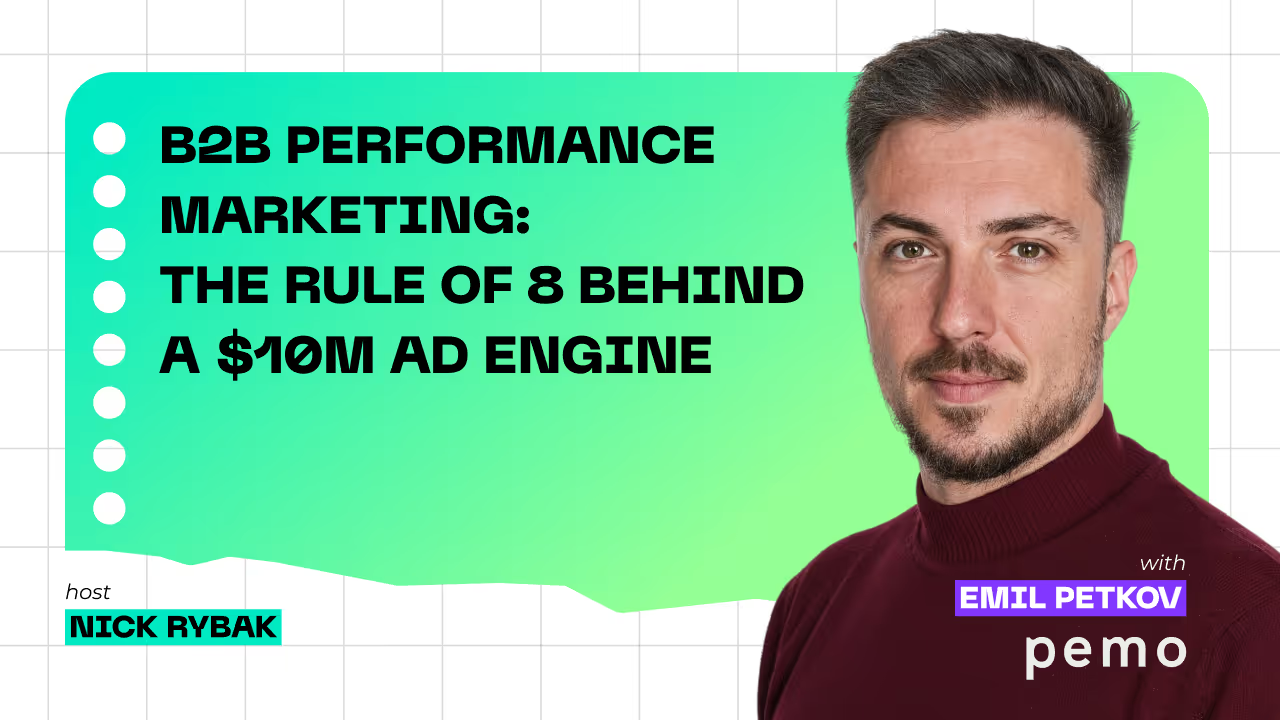
Nick Rybak (00:00)
Emil, thank you for being here. Welcome to the B2B Marketing Flywheel podcast. I’m really, really excited to have you here. Thank you for joining.
Emil (00:13)
Thank you for inviting me, Nick. Excited to be on the podcast.
Nick Rybak (00:17)
You are one of the few B2B marketers I know who can confidently say that they have mastered performance marketing, and you are the first guest who will be talking about this topic on the podcast. So I’m really, really excited about that. Thank you for being here.
Emil (00:37)
Yes, I do feel like I have a lot to share when it comes to performance marketing. Adding to that, I feel like I’m one of the few B2B growth marketers who really loves creating cool, fun, and of course, converting video ads for our “boring” B2B. In our case, this is a fintech. It’s not boring at all, and the content doesn’t have to be. I’d love to speak about that.
Nick Rybak (01:13)
Everybody is striving for converting ads, but “fun” is a top-notch goal, I think, because everything in B2B is so boring. Fun should be an essential part of B2B marketing, at least.
Emil (01:29)
I feel I’m one of the first to really crack the fun, cool angle of how you should do B2B ads, which boils down to one sentence: make ads with people who do cool stuff with your product. That’s how I summarize it. Because people go on social media, they consume visual content, and they’re mostly interested, I would argue, in seeing other people.
Nick Rybak (02:00)
With that, let me ask the first question. You’ve seen Pemo, the company you are currently working for, grow from zero to tens of millions in revenue, with performance marketing as a core engine for that growth. What did you get right early on that most B2B teams get wrong? I know that many state that performance marketing is overrated, expensive, and so on. What do you think helped you get that right so early?
Emil (02:40)
Well, it was video content. Back in late 2021, when we first started gaining traction at Pemo, the first thing I, as head of marketing, set out to do was build a performance marketing team with really strong ideation, video editing, and of course, campaign management, because we had lofty goals, which we are hitting.
So that was the first thing. We really wanted to succeed with video content for Pemo, which is a corporate spend management fintech startup. Video content is not the first thing a lot of my colleagues in B2B do, but it was the first for us. And it was the single most successful, the biggest driver of acquisition for our company. I mean, from zero to north of 10 million dollars of ARR in less than three years—I think most people will agree that is quite fast growth and quite the achievement.
Nick Rybak (04:22)
Yeah, I think anyone would agree with that. There’s no reason to doubt it because those are outstanding results, especially with performance as the main driver.
Emil (04:36)
Well, it’s not a single channel, not really. We have one big one and multiple others when it comes to inbound. You have Meta, which is, to this day, the biggest channel for qualified lead generation. But there are so many other channels that you need to do. You have your Google Ads, you have your TikTok. I am proud to say that we are one of the few B2B fintechs that have really cracked TikTok as a viable, cost-efficient channel for acquisition.
It wasn’t that difficult to imagine, seeing as most of our ads that we were already rolling out on Meta were inspired by a lot of TikTok trends. So the transition wasn’t that difficult when we did it, probably a year and a half after we started our performance marketing machine. And of course, you have your organic channel, which we also consider inbound because we have very concentrated efforts on generating leads through organic content. So it’s a mix of channels. I wouldn’t call it one channel; it’s quite a few.
Nick Rybak (06:16)
And how did you come to the conclusion to test TikTok? It’s not that intuitive for a B2B brand. And maybe that’s the reason it works. But I can already imagine the conversations with stakeholders when you tell them, “We should get on TikTok,” and they say, “No, TikTok is for dancing, music, and teenagers. A serious B2B audience in the C-suite doesn’t hang out there.”
Emil (06:50)
Well, TikTok has seen tremendous growth over the years. In the beginning, it was mostly very young audiences, but now it’s much more than that. Also, the young ones grow up, right? Which is important for us, as our ICP is typically 28 years old and above. Our ICP is mainly decision-makers in finance departments, C-suite, and these are typically 30-plus-year-old people. And you have a lot of them on TikTok these days.
So again, for someone like me who tries to do very cool and fun ads—for example, with fully clothed people in button-down shirts, fully submerged in a swimming pool, doing manual reports only to resurface on top of a huge 3D-printed Pemo corporate card as their lifeboat—these are the types of ads you can expect from us. And of course, they’re going to work on TikTok. They feature people doing fun stuff. Your audience doesn’t necessarily want to see dancing when thinking about business, but when they see something business-related and watch it because the hook is fun, you get their attention. We have an incredible thumb-stop rate. We pride ourselves on the great hooks we make. Once you’re entertained and you stop watching, we show you the benefits later in the video, but we already have your attention. I believe this is why it works for us—because our ads were already TikTok-inspired.
Nick Rybak (09:09)
I like that so much. I’m not someone who says TikTok doesn’t work for B2B. I just think it can be hard for a marketer to prove to stakeholders that it’s worth a try. I’ve read multiple posts from the ClickUp team, especially their CMO, about how they cracked TikTok organically with funny situations their clients face. The tricky thing is that it probably works precisely because not every company thinks it might. So, I’m just curious: how did that conversation go at your company when you brought up TikTok and these kinds of funny ads?
Emil (10:10)
First of all, I have the privilege of having full creative freedom. Yes, of course, you earn that. You earn that by starting more conservatively; you don’t do your crazy ads with raccoons and memes from the start. But you earn that, and I’m happy that I have a leadership team who is wise enough to give me this free rein.
So there was never really a discussion. I fully believed adding TikTok was the next natural step, seeing how successful our crazy video ads were on Meta. And let’s not forget, the big game-changer in video came from TikTok and was then followed by Reels on Instagram. We were already creating for Reels first and foremost, and the content on Reels is already influenced by TikTok. So if our content was native on Reels, it was kind of already native for TikTok. There was very little adaptation needed to launch on TikTok, so there was no reason not to do it. Very little risk. It was more or less the same ads.
And mentioning ClickUp, we did actually team up with one of their leading content creators, Luke. We teamed up to do some ads together, both as stitch ads where we stitch their amazing content to ours because a lot of their content was very relevant to what we do. For example, when a finance department meeting goes too crazy because somebody was overspending, you just stitch to that. In this case, it was me as the actor, saying, “No, no, no, just use the Pemo card. It comes with built-in spend limit controls.”
Nick Rybak (12:39)
I can’t believe I didn’t come across this ad, and honestly, I didn’t know that you partnered with ClickUp. I should have prepared myself a bit better before the podcast.
Emil (13:07)
Yeah, we did. Not a lot of people know that. Those ads were great, but there’s also a fine line between comedy and performance. You have to do the comedy part sparingly, not to cross the line where people might laugh and then just move on without converting. What ClickUp does amazingly well with their organic content is creating really fun, viral content. But fun content is not always converting content, right? You’ve got to strike a good balance. That’s why we were involved with Luke on other projects where he generated performance content that was still really cool to watch. That led to us receiving the only ad not done in-house that, for a good period, outperformed our in-house ads.
Nick Rybak (14:36)
We briefly touched on the topic of channels. What advice would you give a B2B company just starting with performance marketing? Would you recommend they start with one channel, like Meta, master it, and then scale to others? Or spray and pray across different channels and then double down on what works?
Emil (15:20)
If a company is just starting, the first advice I would give them before anything else is to get a great performance marketer. A lot of companies get that wrong. They belittle the significance and impact of a great performance marketer, which is not your off-the-shelf marketer. A performance marketer’s job, at the end of the day, is to generate clients and revenue. My targets are purely unit economics targets and KPIs that lead to more revenue.
Going back to your question, I’ve worked with a lot of B2B companies—small ones, huge ones, the likes of Fiverr, PLEO—and we always see the same picture: Meta works really well, mostly for SMEs. So there’s no reason not to launch with Meta, especially if you’re after significant, large-scale growth. That would be my advice. Build traction, do Google Ads, and then branch out to whatever makes sense, whether it’s LinkedIn or TikTok. For us, LinkedIn didn’t make a lot of sense, so we went with TikTok. I would start smaller; don’t spray and pray. Just start with Meta, get some good results, and then branch out.
Nick Rybak (17:43)
Got it. And do you think there is a minimum budget for ads that should be in place when you’re just starting? Or is there a threshold where if you have a lower budget, you will just spend it because the algorithms won’t work properly?
Emil (18:09)
Yes, there is, and it’s simple math. Ideally, you want to be optimizing for your money-making events. With B2B, this is typically very difficult because sales cycles are much longer, and Meta’s algorithms don’t work great if that event takes more than a day or three—maximum seven days—to happen. So what you have to do is pick the closest event to that money-making event that still happens within a day or two.
Nick Rybak (18:55)
I’m sorry, but what do you mean by a “money-making event” in this context?
Emil (18:59)
A company closed, for example. Acquired. That’s where the money happens, when you activate the customer. You want to be optimizing for revenue, not just for leads. The business doesn’t care about leads; the business cares about leads that convert into customers. But again, it’s very difficult because getting to that paying customer, especially with B2B, takes time. D2C is easy and quick.
So you need to be really careful how you pick this event that is a really good predictor of revenue.
Nick Rybak (20:07)
So it’s basically some kind of signal that indicates your ICP is in the market for your solution right now.
Emil (20:18)
It’s a signal. I’ll give you an example. A lot of companies have a form they want a lead to fill out. They optimize for when someone fills the form and presses the button. But then there’s the next step, which is maybe scheduling a demo call with your sales team. And then after the demo, there’s another step where your sales team decides if this is a sales-qualified lead. If these actions can happen within a fairly short period, you can send all of these signals back to Meta.
So Meta knows it’s not just after people who fill the form or book the demo, but can actually optimize for people who do all three events. That gives Meta a really good understanding of who you’re after. This is very important to nail from the beginning. So, going back to your budget question, this is where the math kicks in: find that good predictor event that happens within ideally one day, find out how much it costs you, and multiply by eight.
Nick Rybak (21:50)
Got it.
Emil (22:15)
Because Meta typically needs at least eight of these events on any given day to be able to find the common denominator between these people and optimize delivery. They say you have to have a minimum of 50 of these conversions on a weekly basis. From my experience, if I’m getting anything below eight—seven is stretching it, six is rarely enough—then the algorithm is dry and starts under-delivering. So that’s your math. That’s the minimum budget. Eight conversions, eight times the average cost of that good predictor event. And then times 30 to get to the monthly budget.
Nick Rybak (23:13)
Okay. And can that event be an outside signal, like a fundraising round or a new office opening, something that happens before they’re in your sales cycle?
Emil (23:46)
So if I understand your question right, you’re asking if you can tell Meta to go after people who have just opened a new office or raised funds. You can, but this will mean narrowing your audience a lot. It’s high-profile criteria, not high-frequency criteria, and it’s not great for machine learning. Any Meta engineer will tell you that the algorithm loves working with huge audiences, and big enough typically means over one million.
Nick Rybak (25:09)
That’s a lot. What should people do if their total addressable market is, say, 5,000 companies?
Emil (25:13)
Then you should invite another marketer to your podcast. I have no idea. I specialize in high-scale acquisition, hundreds or thousands of customers per month. I have no experience with this. I’ve actually tried working with companies targeting huge corporations—1000+ employees—and my campaigns failed miserably. It’s very hard to optimize for this relatively small audience.
The algorithm does not like this. So the company needs to show flexibility. That’s what I always advise. Try to find a way to get the big fish but also optimize for the medium ones. If it’s super niche and still a small audience, then I would tell you not to do paid Meta. Try Meta organic, maybe some LinkedIn, and definitely Google Ads. I’ve seen good success with Google Ads when it comes to business-to-enterprise.
Nick Rybak (27:19)
Got it. How does performance marketing in the United Arab Emirates differ from Western markets when it comes to buying behavior, costs, and conversions?
Emil (27:41)
That’s a good question. The UAE is an increasingly expensive market. Your CPMs are not that far from Western Europe CPMs. Still not as high as San Francisco CPMs, which are typically the highest in the world, but it’s pretty on par with Western Europe in terms of CPM and CPC.
In terms of buying behavior, it’s not that different. I’ve worked with Pemo in the UAE and before that with PLEO in Europe, which has a similar product. Honestly, conversion rates are quite similar. You need to be a tad more conservative in what you show in your UAE ads. We always try to be respectful of the culture. There are small nuances, but I think the underlying winning strategies apply.
Nick Rybak (29:16)
Got it. That’s interesting that this market is almost as expensive as Western Europe.
Emil (29:51)
It’s booming. A lot of capital is flocking to the UAE. A huge SME sector, lots of investors, a good investment climate. It’s seeing tremendous growth, and with growth, everything goes up.
Nick Rybak (30:19)
What do you think separates ad content that looks good from content that actually converts? Is it true that unpolished, “ugly” ads usually convert better than polished, branded ones?
Emil (30:56)
It used to be true that “ugly ads” won, but I’m seeing a shift away from that. Two or three years ago, we were doing these very unpolished ads that would convert massively. One of them even went viral. It’s our top-performing ad ever, and it’s so simple: an angry, bearded guy in an office throws petty cash and receipts in the air and says, “Bye-bye.” Zero cost, great talent. That generated a huge pipeline for us over a long period.
But lately, I am seeing a bit of a shift, probably due to the advance of AI and YouTube. Also, I work in a market, the UAE, where people love polished things. But it’s not just the UAE. I see polished, good-looking ads that are starting to win. Of course, they have to be at the intersection of being performance-y and polished. In the end, you’re fighting for thumbs to stop scrolling, and that is typically a combination of things. It has to be visually appealing.
Emil (33:36)
I created this brilliant-performing ad where the intro is purely AI. It’s the hot summer in the UAE. What can we show our audience to get their attention? A lot of marketing teams would say, “Let’s do beach ads.” But I thought, let’s do the opposite. Let’s do a wintery ad. Let’s show our Pemo corporate card in an ice cube.
Nick Rybak (34:19)
That’s literally what I thought. I just didn’t want to interrupt you.
Emil (34:32)
And we did that with a voiceover saying, “This is the coolest, most used, most wanted corporate card in the UAE,” and the ice breaks to show the card. This ad became a huge success. I guess you have to give your audience what they crave, and during a hot summer, they don’t want more beach content. They crave an ice cube. As some trivia, I think our colleagues at Revolut, who entered the market not long ago, followed suit with their card in an ice cube. And good on them for paying attention to what works.
Nick Rybak (36:17)
That’s an interesting thought. During summer, they are probably on the beach themselves, and their feed is full of it. So the least expected thing would be something cool that grabs their attention.
Emil (36:44)
Yes. I’ll give you another quick example. During the holy month of Ramadan, which is known for fasting, people don’t eat from sunrise to sunset. What did I do? I wrote an ad about shawarmas and how it shouldn’t take more than two minutes to expense one. And they loved it. A lot of hungry people clicked on that and booked a demo.
Nick Rybak (37:20)
I can relate to that, as I’m hungry myself. I would definitely be down for shawarma ads right now. You’ve had great success with video ads. Why do you think they work so well in B2B?
Emil (37:57)
You’ve got to fight for people’s attention where they are already giving it. And everybody’s on Reels and TikTok these days. Again, I’m a mass marketer. My goals are very, very high. And the result is that we have maybe three times more customers than our largest competitors. My biggest strength is just finding what works for your largest possible audience that can convert.
Nick Rybak (38:49)
You’ve mentioned that you use AI in content creation for ads. Are there any specific use cases where AI is good, and maybe some that are really bad?
Emil (39:11)
Yes, I have a few AI winners already. The Ice Cube ad I told you about is one of them. What works here is a visually impressive intro. It had maybe a 30% thumb-stop rate, which is well above our benchmark of 20%. So, stunning visuals that are related to what your audience cares about work well, and AI facilitates that.
Comedy is the second thing that should work because it doesn’t have the pretense of an authentic user testimonial done by an AI avatar, which always feels a bit off. I did this ad with a grandma who is a retired CFO, riding in her expensive car and giving sage advice. It’s funny, not super salesy, but still connected to the product.
A bad use case for me is doing these AI avatars who are selling your product. For me, that didn’t work. But also, remember that in my niche, trust is very big. So if you do that, people will not trust you and will not convert. That said, I do know of a very successful AI ad where a woman was selling an e-commerce product. I think it’s a matter of time before it becomes indiscernible from what’s real.
Nick Rybak (43:28)
So, to summarize, you can use AI in video ad creation, but you might want to avoid the feeling that you’re trying to trick your audience because that can backfire by losing trust, right?
Emil (44:14)
Yes, and it depends on the vertical. I have another example from a company that does female cosmetics on a huge scale. A peer there showed me batches of ads and asked me to tell which one was an AI avatar and which was a real human. Every time, I was able to tell which was the AI. But the twist is that the AI ad was the winning ad.
Nick Rybak (46:08)
Got it. When it comes to ads, you move traffic to a landing page. Why do you think most B2B websites fail at converting traffic from paid ads?
Emil (46:52)
I think most of them fail for several reasons. I see the following mistakes a lot: the page is not optimized for mobile. You scroll a little bit, and then your “Book a Demo” button is not even visible. Go check Wix’s page on mobile; their sign-up CTA is not only visible at all times, but they have it twice.
Another thing is getting into the rabbit hole of creating a lot of landing pages when your low-hanging fruit is simply to optimize your homepage. So, optimizing for mobile is a big one. And then, for a dedicated landing page, have as few elements as possible—just what people need to convert. No outbound links whatsoever. Start with a clean, minimalistic hero section and then build on that. And go for a medium-to-long landing page. For us, in the beginning, a very short landing page worked very well. But over time, we had to test longer landing pages, and we eventually found a sweet spot and even doubled our conversion rates on some of them.
Nick Rybak (50:05)
So it’s the obvious things that people still don’t think of, like running a mobile ad but not checking how their website looks on mobile.
Emil (50:23)
I guess it’s obvious for experienced marketers like yourself, but I see a lot of landing pages that are not optimized that well. I still see a lot of Meta lead-gen form ads, which can work well, but that’s a different topic.
Nick Rybak (50:48)
What metrics do you actually trust when judging performance success, and which do you actively ignore?
Emil (51:00)
It’s typically the cost per result, especially if I know that result is a good predictor for revenue. If you’re getting enough results per day at the target cost, there’s very little else you should worry about. Even if your click-through rate is very low, if the ad is generating results at a good cost, you don’t care about CTR. That said, CTR is actually a good predictor. I wrote a post about this; I saw the highest correlation between click-through rate and a good cost per result. The higher the CTR, the better the cost per result on a statistically significant scale.
Nick Rybak (52:48)
And what metric do you think people are obsessed with but is a vanity metric?
Emil (52:55)
CPM. Including myself, I fall into this trap a lot of the time when things are not going well. I start obsessing over my CPMs. And then I’ll roll out a new ad where the CPM is maybe very high, but the conversion rate and click-through rate are great, and ultimately it has a really good cost per result.
Nick Rybak (53:26)
What do you think is the most common performance marketing mistake you see B2B marketing teams repeat, even experienced ones?
Emil (53:40)
Relying on static images, not experimenting enough on Instagram and TikTok, not investing enough in a creative strategist. I see CEOs or decision-makers in big B2B companies laugh at our ads and say, “This works for you?” Then they see our numbers and they’re mind-blown. I would encourage them to be braver when it comes to video content. Your audience is not that boring. Entertain them, and then you get a chance to convert them.
Nick Rybak (54:52)
That’s really great advice. Last question: if you had to summarize your performance marketing playbook for 2026 for B2B teams, what are the non-negotiable principles?
Emil (55:15)
Generate more video, experiment more with AI, try more channels that you haven’t even thought of testing, and make sure that your organic content supports your paid activity. They go hand-in-hand. Yes, these would be my main pieces of advice.
Nick Rybak (55:50)
I like that. Emil, thank you. This was super insightful. And thank you for being so open and transparent about your results and failures as well. If you enjoyed this episode, go follow Emil Petkov on LinkedIn. He shares a lot of sharp insights on performance marketing. And while you are there, add me on LinkedIn as well. Don’t forget to subscribe to the podcast and don’t miss new episodes. See you next time. Thank you, Emil, for being here.
Emil (56:41)
My pleasure.










.avif)


.avif)