B2B search is changing fast. Buying journeys are getting longer, AI is reshaping search results, and proving marketing ROI is harder than ever.
Yet SEO remains one of the highest-return channels available to B2B companies. The teams that execute it will continue to outperform competitors in visibility, pipeline, and revenue.
To build this collection, we relied on primary research from trusted sources including Google, Gartner, Forrester, McKinsey, HubSpot, BrightEdge, and others. No recycled statistics or outdated blog roundups.
Whether you're building a 2026 SEO strategy, justifying budget, planning content, or preparing a leadership presentation, these B2B SEO statistics give you the numbers worth citing.
Top B2B SEO Stats
- Average SEO ROI is estimated at around 22:1. That's roughly $22 returned for every $1 invested (10).
- SEO delivered nearly 5x more return on ad spend than paid media in 2025, at a fraction of the cost (30).
- Positive ROI in a SEO campaign is achieved over a 6-12 month period, with peak results in the second or third year (20).
- According to First Page Sage, a typical B2B SEO campaign generates +$385K in gross organic revenue in Year 1, +$1.2M in Year 2, and +$3.3M in Year 3, when content quality holds and customer lifetime value is $10,000 or more. Best-fit verticals: financial services, industrial manufacturing, real estate, and B2B SaaS (20).
- SEO ROI by B2B vertical: Medical Device 1,183% (13-month breakeven), Higher Education 994% (13-month), Oil & Gas 906% (10-month), Industrial IoT 866% (7-month), B2B SaaS 702% (7-month), Construction 681% (5-month), HVAC 678% (6-month), E-commerce 317% (9-month) (10).
- 96% of B2B prospects research companies and products before engaging with a sales representative (13).
- Two-thirds of US B2B buyers look for products online before purchasing them. Online channels are key in the product discovery phase regardless of where the purchase is finalized (49).
- Over 1 in 5 B2B businesses now have six or more people involved in their buying group (23).
- Dentsu's 2024 Superpowers Index, which surveyed 3,500+ buyers across Europe, North America, and APAC, found average B2B decision time grew by 54 days between 2021 and 2024 (23).
- More than half of large B2B transactions (US$1 million or greater) are forecast to move through digital self-serve channels, including the vendor's website or marketplace (23).
- 72% of B2B buyers encounter AI Overviews on Google, and 90% of them click through to cited sources (41).
- Google's AI Overview coverage in B2B technology queries grew just 7% in Google's late-April 2025 expansion, versus 175% for entertainment and 108% for travel, according to BrightEdge data reported by Search Engine Land (59).
- AI Overview citation overlap with organic results for B2B Tech grew +32.4 percentage points between May 2024 and September 2025, reaching 71% overlap. E-commerce was the only industry where AI Overview coverage actually shrank (36).
- "Raising brand awareness and top-of-funnel performance" jumped from the 6th most important B2B brand-strategy priority in 2021 to the 1st today. "Demand generation and converting leads" dropped from 3rd to 7th (23).
- In 2025, 39% of global B2B ad budgets went to LinkedIn, 37% to non-branded keywords on Google Search, and just 7% to branded Google search terms (52).
- 40% of B2B marketers will increase budgets specifically to prepare for AI-driven generative search, 50% plan to increase their SEO budgets in 2024, and 43% plan to maintain the same SEO budget (11).
- In Stratabeat's 2025 study of 300 B2B SaaS sites, the top 10% grew Google organic traffic by 112.3%, while the average across all sites grew only 16.3%. The gap between elite and average performers is 6.9x (56).

📖 Looking for SEO stats beyond B2B — across e-commerce, SaaS, and local?
See the full picture in our Complete SEO Statistics for 2026 →
B2B Search Engine Market Share
- Global search engine market as of April 2026:
- Google: 90.02%
- Bing: 5.14%
- Yahoo: 1.5%
- Yandex: 1.19%
- DuckDuckGo: 0.71%
- Baidu: 0.46% (48).

- According to First Page Sage's 2024 B2B Search Engine Market Share Report, US B2B search engine share (18):
- Google: 84.9%
- Bing: 3.7%
- Yahoo: 2.3%
- DuckDuckGo: 1.9%
- Brave: 0.3%

Every search engine a B2B buyer uses is growing, except Yahoo - AI platforms B2B market share:
- ChatGPT: 3.2%
- Perplexity: 1.1%
- Claude AI: 0.6%
Full breakdown including annual user growth is in the table below.
| # | Search Engine | Specialty | B2B Market Share | Annual User Growth |
|---|---|---|---|---|
| 1 | General B2B | 84.9% | +5% ▲ | |
| 2 | Bing | General B2B | 3.7% | +12% ▲ |
| 3 | ChatGPT | General B2B | 3.2% | +14% ▲ |
| 4 | Yahoo | General B2B | 2.3% | -4% ▼ |
| 5 | DuckDuckGo | General B2B | 1.9% | +8% ▲ |
| 6 | Perplexity | General B2B | 1.1% | +21% ▲ |
| 7 | Claude AI | General B2B | 0.6% | +16% ▲ |
| 8 | Brave | General B2B | 0.3% | +18% ▲ |
Table 1: Top B2B search engines in the US, 2024, by market share and annual user growth. Source: B2B Search Engine Market Share — 2024 Report, First Page Sage. (18)
- Google.com receives 3.16 billion unique monthly visitors. Bing recorded more than 1.4 billion monthly visits in May 2025 (15).
- Google processes more than 5 trillion searches per year (27). It is Google's first official update of this figure since 2016, when it was 2 trillion.
- According to First Page Sage's analysis, Google has less room to grow in B2B than AI upstarts (Perplexity, Claude, ChatGPT) and privacy-focused search engines (Brave, DuckDuckGo) (18).
- Bing's share of global search engine referrals grew from 2.76% in April 2023 to 5.14% in April 2026. Over the same period, Google's share of global search engine referrals declined from 92.82% in April 2023 to 90.02% in April 2026 (48).
- On desktop, where a large share of B2B professional and business activity is concentrated, Bing's presence is even more noticeable. In May 2026, Bing held 9.93% of the global desktop search engine market and 13.16% of the desktop market in the United States (22, 21).
- Microsoft Advertising's own audience data shows 52% of the B2B audience on Bing are business decision makers, with 26% holding senior decision-making roles (1).

- 46% of the B2B audience on Bing have household income in the top 25% (the highest-earning quartile of US households) (1).
- AI tools held 0.64% of total user panel digital activity in the US by April 2025 and 0.85% in the EU and UK by June 2025, up from 0.24% and 0.26% in April 2024 (16).
- As of April 2026, ChatGPT was the most popular AI application worldwide with approximately 957.8 million monthly active users (50). First Page Sage measured the 3.2% B2B share (18) two years earlier in early 2024, so that figure likely understates ChatGPT's current B2B presence.
- Deepseek briefly spiked to roughly 6 to 7% AI tool usage share in both the US and Europe in February 2025 following its January 2025 launch, then dropped back to approximately 3% by June 2025 (16).
- Per Rand Fishkin (SparkToro / Datos), only about 1 in 8 AI prompts has search-like intent; most AI use is for generative tasks (16).
- Google sends 345 times more website traffic than ChatGPT, Gemini, and Perplexity combined. AI represents roughly 0.1% of all web referral traffic (3).
What this reveals
Google still holds the largest share of B2B search but at a lower level than on the consumer web. Bing's audience skews toward business decision-makers and the engine has grown its global referrals over the past three years. AI tools account for a small but growing share of activity, with most AI prompts used for generative tasks rather than search-style intent. For 2026, optimize for Google first, prioritize Bing for B2B-specific reach, and monitor AI search visibility as the emerging layer.
B2B Buyer Behavior Statistics
The B2B buyer has shifted from passenger to driver. Research happens before a sales call, across platforms you do not measure, and inside a buying group that does not take meetings. Here is what the buying journey actually looks like in 2026, and why the old top-of-funnel-to-MQL-to-SQL framing keeps missing the mark.
- In any B2B category, only about 5% of potential buyers are in-market at any given time. The remaining 95% are out-of-market: people who could need you months or years from now (24).
- 75% of B2B buyers prefer to gather information about products on their own, and 57% purchased a tool in the last year without ever meeting the vendor's sales team (54).
- 58% of B2B buyers seek expert input before making a decision, and the number of touchpoints has ballooned alongside it (41).
"There's no longer a direct path to purchase. Buyers might see a social post, do a Google search, ask a peer, and then come across a video, all before even engaging with a brand."
— Kelsey Voss, Principal Analyst at EMARKETER, in Demandbase × EMARKETER's "From Ad Waste to ROI: How B2B Marketers Can Do More with More" (54)
- McKinsey's 2024 B2B Pulse Survey found B2B customers use an average of 10 interaction channels in their buying journey, up from 5 in 2016, and 42% used more than 11 different touchpoints (40). The top three most-used channels: company website, in-person sales, and video conference.
- According to Shelley Walsh in SEJ's SEO Trends 2026, channels such as Reddit, Quora, TikTok, and YouTube have become platforms with direct influence on purchase decisions, with TikTok especially driving research gathering (42).
- The buying journey rarely ends on the same screen where it started. A B2B manager might discover your brand in an AI-generated snippet on desktop, send themselves the link on Slack, and call your sales team from their iPhone after revisiting the content on mobile (41).
"My company got a lead from ChatGPT a few months ago, and we could see that they visited our site seven times from ChatGPT in the process before eventually filling out our form. This is not user behavior that we would have planned for or anticipated just a few years ago."
— Corey Morris, VIP Contributor at Search Engine Journal and B2B agency owner, in Search Engine Journal's "The B2B SEO Trap: Why High-Intent Visibility Can Still Underperform" (44)
- B2B buyers typically consume between 3 and 7 pieces of content before speaking with a salesperson, and 73% say they have less time for reading and research than the previous year (19).
- Forrester's 2025 research finds 95% of B2B buyers plan to use generative AI in at least one area of a future purchase, and over half say GenAI led them to consider more or different vendors while saving them time in the process (38).
- The top three B2B growth challenges are not about tools or tactics. They are about visibility: lack of brand awareness (47%), competition in the market (44%), and difficulty reaching decision-makers (42%) (32).

- Demandbase × EMARKETER's January to February 2025 survey of 231 B2B marketers worldwide found 50.2% say reaching the right buying group is the top challenge in maximizing ROI. Another 39.0% say their current advertising is only somewhat or not at all effective at reaching the right audience (54).
- Only 17.3% of B2B marketers have fully mapped their customer journey stages (54), yet 73% of B2B marketers say they understand the customer journey their leads take (11).
"Not all high-intent visibility translates to sales-ready traffic, especially in long sales cycles or complex buying journeys."
— Corey Morris, VIP Contributor at Search Engine Journal and B2B agency owner, in Search Engine Journal's "The B2B SEO Trap: Why High-Intent Visibility Can Still Underperform" (44)
- 47.2% of B2B marketers currently use a group-based (buying group) targeting approach. Only 28.1% plan to adopt it, and nearly a fifth (19.5%) of current users are dissatisfied (54).
- Trendemon's 2024 B2B Buyer Journey Report found basic content personalization with recommendations produced a 448% increase in goal conversion rates for B2B buyers (33).
What this reveals
The B2B buyer in 2026 is mostly out-of-market, self-educates across platforms you do not measure, consumes 3 to 7 pieces of content before any sales call, and arrives at the conversation already informed inside a buying group. Visibility is the foundational marketer pain, the MQL/SQL gap is a buyer-readiness reality, and personalization is one of the few things that demonstrably moves the needle. Build for research, design for buying groups, and accept that high intent does not equal sales-ready.
B2B SEO ROI Statistics
Here is what organic search actually returns for B2B, how it stacks up against paid channels, and where attribution breaks down.
- Average SEO ROI is estimated at 22:1, one of the highest return-per-dollar ratios among major marketing channels (10).
"SEO and content, however, when done well and unlike most marketing channels, can actually decrease CPL 5-10 years from now."
— Brad Smith, contributor to Search Engine Land, in Search Engine Land's "3 common B2B SEO mistakes sabotaging cost per lead" (May 2024) (24)
- Positive ROI in an SEO campaign is achieved over a 6-12 month period, with peak results in the second or third year (20).
- According to First Page Sage, a typical B2B SEO campaign generates +$385K in gross organic revenue in Year 1, +$1.2M in Year 2, and +$3.3M in Year 3, when content quality holds and customer lifetime value is $10,000 or more. Best-fit verticals: financial services, industrial manufacturing, real estate, and B2B SaaS (20).

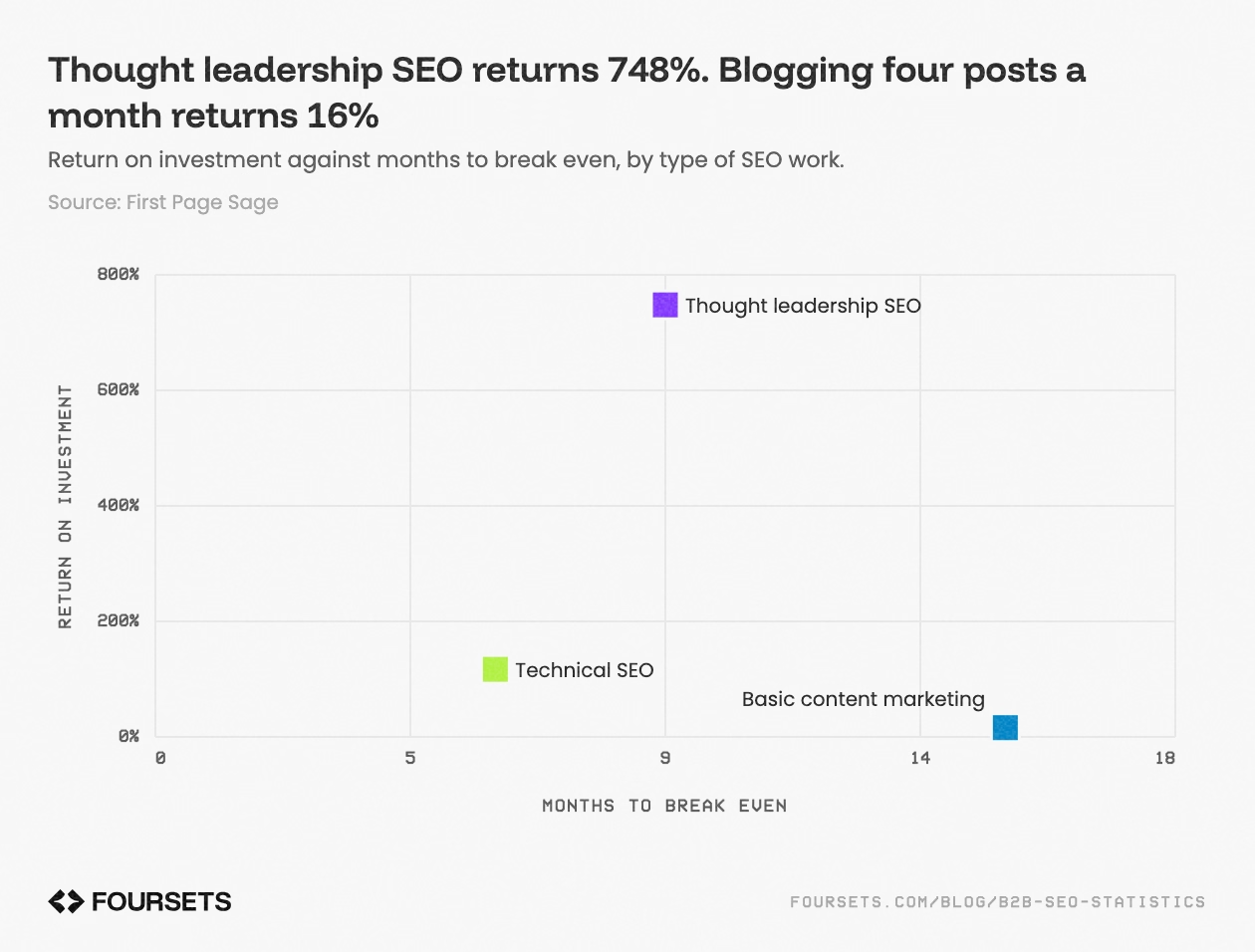
- According to First Page Sage's "SEO ROI Statistics 2026" report, the ROI an SEO campaign returns depends heavily on the type of service. The three most common SEO services break down like this:
- Technical SEO is when an SEO consultancy fixes technical issues on your website (typically speed, security, and mobile optimization), performs keyword research, and rewrites your title tags based on that research.
- Basic content marketing SEO is when an SEO agency does cursory keyword research using a tool like SEMrush and produces around four blog articles per month at average quality relative to your competition.
- Thought leadership SEO is when an agency builds a strategic SEO plan that rank-orders keywords by value into hubs and spokes, researches your target audience's needs, pain points, transactional behavior, and search intent, and produces 6-8 high-quality SEO-optimized content pages per month aimed at generating MQLs. Thought leadership SEO campaigns also include generative engine optimization, helping companies rank on AI platforms like ChatGPT alongside traditional Google search (20).
Below are the three most common SEO services with their ROAS, ROI, and time to break-even.
| SEO Service | ROAS | ROI | Time to Break-Even |
|---|---|---|---|
| Technical SEO (technical fixes, keyword research, title tag rewrites) | 1.35 | 117% | 6 months |
| Basic Content Marketing (average-quality keyword research and ~4 blog articles per month) | 1.05 | 16% | 15 months |
| Thought Leadership SEO (strategic planning + GEO + 6-8 high-quality content pages per month, MQL focus) | 9.10 | 748% | 9 months |
Table 2: SEO ROI by service type. Source: SEO ROI Statistics 2026, First Page Sage. (20)
- For B2B SaaS specifically, SEO shows roughly 702% average ROI with about a 7-month break-even across a 3-year window (4).
- A 2025 CI Web Group study found SEO delivered nearly five times more return on ad spend than paid media at a fraction of the cost (30).
- Across industries, the average conversion rate is 3.75% for organic search results versus 1.77% for display ads. Organic converts more than 2x better than display (19).
- 30% of B2B marketers rank SEO as their most effective marketing channel, with content marketing (13%) and social (14%) rounding out organic (32). Organic collectively outperforms paid alternatives in perceived effectiveness.
- Lead generation and conversions ranked as the fourth-biggest outcome SEO teams improved over the past 12 months, at 34.0% (57), behind organic traffic growth (60.6%), keyword rankings (57.7%), and brand visibility (34.8%).
- The average AI search visitor is worth 4.4x more than the average traditional organic search visitor based on conversion rate (45). AI channels are projected to drive economic value comparable to traditional search by the end of 2027.
- Ahrefs data shows AI search visitors convert 23x better than traditional organic search visitors. AI traffic generated 12% of signups while representing only 0.5% of total traffic (3).
- 29% of marketers report a significant ROI increase from using AI in SEO and 39% a moderate increase; only 1% say AI reduces SEO ROI (10).
- Top performance measurement priorities for SEO teams: organic traffic 74.9%, qualified leads or sales conversions 60.4%, keyword visibility 56.9%, ROI 21.8%, on-page engagement 20.8% (57).
- 60.4% of SEO teams prioritize qualified leads and sales conversions for measurement, but only 33.7% plan to invest in conversion-focused SEO (57). 28.6% struggle with ROI measurement (57), and 36.9% cite ROI attribution as a strategic risk to their programs (57). Teams measure business impact without investing proportionally in driving or proving it.
- Buyers are finding answers in AI Overviews, completing voice searches without clicking, and making purchase decisions offline (41). If attribution does not account for zero-click behavior and offline touchpoints, the model is structurally blind during the highest-intent moments.
"The real value lies not only in the conversion event but in how SEO, content, and wider brand touchpoints shape awareness, preference, and credibility over time. Success should be measured by how present and valuable the brand is at every stage of the funnel, and across every pain point, benefit, and concern, not just direct last-click conversions."
— Dan Taylor, Partner & Head of Innovation at SALT.agency, in Search Engine Journal's "SEO Trends 2026" (42)
- Enterprise B2B teams are reframing SEO as a RevOps lever, moving beyond web traffic and rankings toward pipeline contribution, lead quality, and customer lifetime value (37).
What this reveals
SEO is the highest-ROI channel B2B has, but only if measurement keeps up with where buyers actually convert. Last-click attribution misses zero-click answers, offline touchpoints, and the brand exposure that decides who makes the shortlist months before the lead arrives. Treat SEO efforts as a pipeline input, not a traffic line item, and the 22:1 number stops looking like marketing's fairy tale and starts looking like the math.
B2B SEO Investment & Budget Statistics
Here is where B2B marketing budgets are going in 2026, what share of that goes to SEO, and where the spend pressure is coming from.
- Businesses in the US spend approximately $119.4 billion annually on SEO and digital marketing consulting (10).
- 82.5% of marketers increased their SEO budgets in 2024 (25).
- 65% of SEO professionals expect stable or increased SEO investment in the next 12 months, and only 13.5% expect to reduce it (57).
- High-growth SaaS companies spend more than 50% of their revenue on sales and marketing, making organic search one of the few acquisition channels that scales without a proportional cost increase (47).
- 24% of businesses working with agencies spend $10,000 to $25,000 annually on SEO, compared with just 2% of those working with freelancers (10).
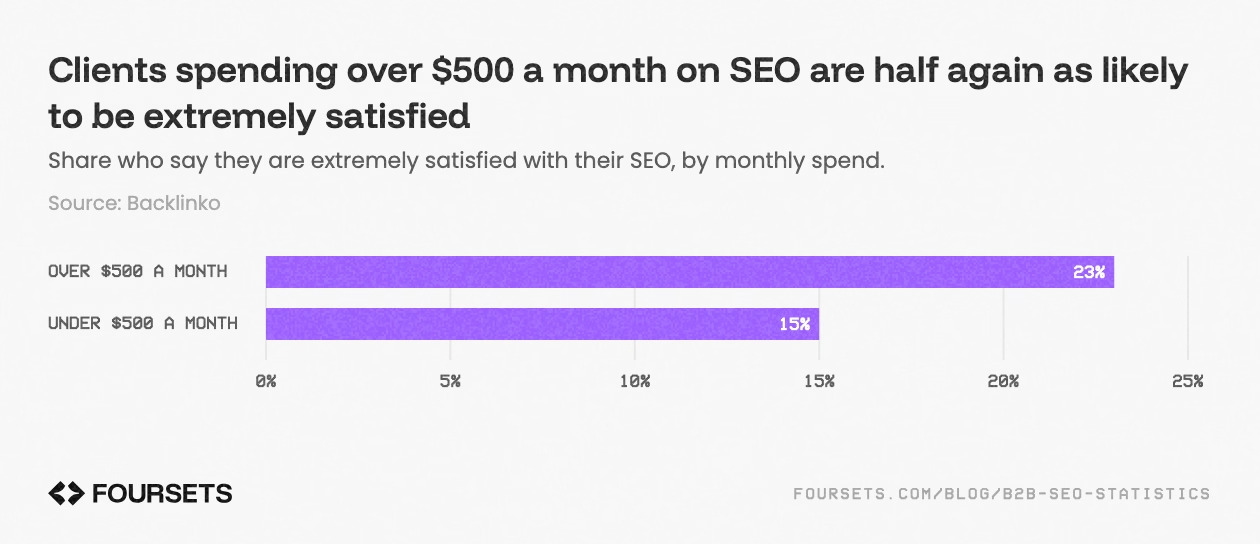
- Clients spending over $500 per month on SEO were 53.3% more likely to be "extremely satisfied" with results, and those spending under $500 per month were 75% more likely to be dissatisfied (10).
- B2B marketing spend by category in 2025: marketing technology 54%, direct marketing 36%, content marketing 34%, branding 29%, artificial intelligence 22%, SEO 11% (55).
"You spend 10% of the paid budget this year on SEO. Not really enough to move the needle for next year's results to roll in and give your team (and bean counters) the certainty that it'll overtake ads anytime soon (as your primary method to generate customers). So what happens? They cut budget in year two and de-prioritize SEO/content/etc. And you're back on the paid media hamster wheel in no time."
— Brad Smith, contributor to Search Engine Land, in Search Engine Land's "3 common B2B SEO mistakes sabotaging cost per lead" (May 2024) (24)
- 64.9% of B2B marketers worldwide report their overall advertising budget increased in 2025, with 27.3% seeing increases in the 11% to 50% range and only 11.7% reporting a decline (54).
- Up to 59% of CMOs report having insufficient budget to execute their marketing strategy in 2025 (30).
- Paid media dominates marketing spend at approximately 31% of the total marketing budget, or 2.4% of company revenue. Gartner notes CMOs are "getting less for every dollar spent" on paid due to media price inflation (30).
- B2B ad budget allocation by network in 2025: 39% to LinkedIn, 37% to non-branded keywords on Google Search, only 7% to branded search terms on Google (52).
What this reveals
B2B SEO budgets are growing, but still claim a fraction of what paid media absorbs. The bigger story is the pressure on the paid side: inflation, CMOs running short, and a non-trivial chunk of every ad budget leaking on irrelevant accounts. Each of those forces reframes organic search from "the cheap alternative" into the only acquisition channel that scales without a proportional cost increase.
📖 Looking for statistics beyond SEO, across paid, social, email, and content?
See the full picture in our Complete Digital Marketing Statistics for 2026 →
B2B Organic Traffic & Ranking Performance
Here is what B2B organic traffic and rankings actually look like in 2025 to 2026.
- Google CTR by position (2025):
- Position 1 captures 39.8% of clicks,
- Position 2 captures 18.7%,
- Position 3 captures 10.2%.
- Featured snippets achieve a 42.9% average CTR (31).
- HubSpot's 2025 Web Trends Report shows the average SEO click-through rate is 13% (median 8%), with an average bounce rate of 37%, 7 page views per visit, and a median of 20,000 monthly visitors (14).
- Ahrefs' analysis of approximately 14 billion pages in their index found 96.55% of all pages get zero organic traffic from Google. Another 1.94% get between 1 and 10 monthly visits (5).

"Your 'pretty good' rankings are actually lying to you. Based on SERP CTR averages, it means you're unlikely to ever see anything greater than ~5% of the potential traffic."
— Brad Smith, contributor to Search Engine Land, in Search Engine Land's "3 common B2B SEO mistakes sabotaging cost per lead" (May 2024) (24)
- 51% of all websites rank on page two or beyond, and 39% of SEO specialists find ranking in the top 10 "somewhat" or "extremely" difficult, up from 35% in 2023 (14).
- 43% of websites reported year-over-year organic traffic increases in 2024. 44% remained stable. 14% experienced decreases (14).
- Stratabeat's 2025 B2B SaaS SEO Performance Report, based on an analysis of 300 B2B SaaS websites and 15,000+ data points, found the top 10% increased their Google top-10 ranking keywords by 84.7% on average in 2025, versus 9.4% for the full set, a 9.0X difference (56).
- B2B SaaS sites that segmented their audience by industry grew Google organic traffic 17.3% on average in 2025, versus 11.5% for those without segmentation, a 50.4% higher growth rate (56).
- B2B SaaS sites offering free online tools like ROI or TCO calculators added 24.7% more keywords in the Google top 10 on average, versus 2.0% for sites without tools (56). The same sites also grew Google monthly organic traffic by 20.7% on average, versus 11.5% for those without tools, an 80% higher organic traffic growth rate (56).
- Similarweb's 2025 SEO Benchmarks report shows zero-click rates by industry (US, January to November 2024): Online Marketing 45.3% (lowest), Business Services 48.4%, Finance 53.7%, versus Real Estate 78.6% and Travel 71.7% (53). B2B-aligned verticals consistently see fewer zero-click searches than B2C consumer ones, meaning a higher share of B2B organic searches still result in actual website visits.
- Datos' State of Search Q2 2025 report shows organic clicks remain the most common outcome of a Google search in Europe, holding steady in the 44 to 47% range across Q2 2024 through Q2 2025 (16).
- 94.74% of all keywords receive 10 or fewer monthly searches. Only 0.0008% of keywords get more than 100,000 monthly searches (6).
- According to Backlinko's analysis of over 200 Google ranking factors, the top 8 to focus on first are:
- Quality content: Google's most important factor; the algorithm prioritizes high-quality, informative, and relevant content.
- Backlinks: links from other websites act as votes of confidence; the more high-quality backlinks a site has, the higher it tends to rank.
- Technical SEO: site speed, mobile-friendliness, and crawlability all influence whether Google can index and understand a site.
- Keyword optimization: relevant keywords across page content help Google understand what each page is about.
- User experience (UX): Google favors sites that are easy and enjoyable to use.
- Schema markup: structured data that helps search engines parse a page's content.
- Social signals: likes, shares, and other social interactions on content.
- Brand signals: overall online perception of the brand (8).
What this reveals
Most B2B pages get no organic traffic. The top-decile B2B SaaS sites grow ranking keywords almost 10x faster than the average, driven by industry segmentation, free tools, and content tied to actual buyer queries. B2B audiences also click through to sites more often than B2C ones, with lower zero-click rates across the verticals studied.
AI Overviews, Zero-Click & LLM Visibility
Here is how AI Overviews and LLMs are actually behaving in the B2B SERP, where the click damage lands, and what the new AI-citation layer rewards.

- AI Overviews now appear in over 11% of all Google queries, a 22% increase since their debut, with longer and more complex queries growing 49% since May 2024 (35). As of Q1 2025, AIOs reached 1.5 billion monthly users (18.3% of the global population) and appeared in 16% of US Google searches (3).
- Stratabeat's 2025 B2B SaaS SEO Performance Report found AIOs present in only 17.1% of the keywords ranking in the Google top 10 across 300 B2B SaaS websites studied. 82.9% of those B2B SaaS keywords are still AIO-free (56).
- Of the keywords ranking in the Google top 10 across the same 300 B2B SaaS sites, the website itself appeared inside the AI Overview for only 1.4% of queries (56).
- The top 10% of B2B SaaS performers in the Stratabeat study faced 12.3% greater AIO competition in the Google SERP than the broader 300-site set, yet still achieved 6.9X greater organic traffic growth (56). Strong B2B SEO can overcome AIO headwinds.
- BrightEdge's industry breakdown (September 2025) of AIO citation overlap with organic results: Healthcare 75.3% (highest), Education 72.6%, B2B Tech 71.0%, Insurance 68.6%. Lowest: Restaurants 19.2%, E-commerce 22.9%, Travel 23.6% (36).
- Gartner predicts traditional search volume will drop 25% by 2026, with organic search traffic expected to decrease by over 50% as consumers increasingly embrace AI-powered search (43).
- Semrush projects AI search visitors will surpass traditional search visitors by early 2028 for digital marketing and SEO topics. The transition could happen much sooner if Google Search defaults to AI Mode (45).
- Ahrefs data shows average web search traffic declined 21% over the past year, while AI-driven traffic increased 9.7x in the same period (3).
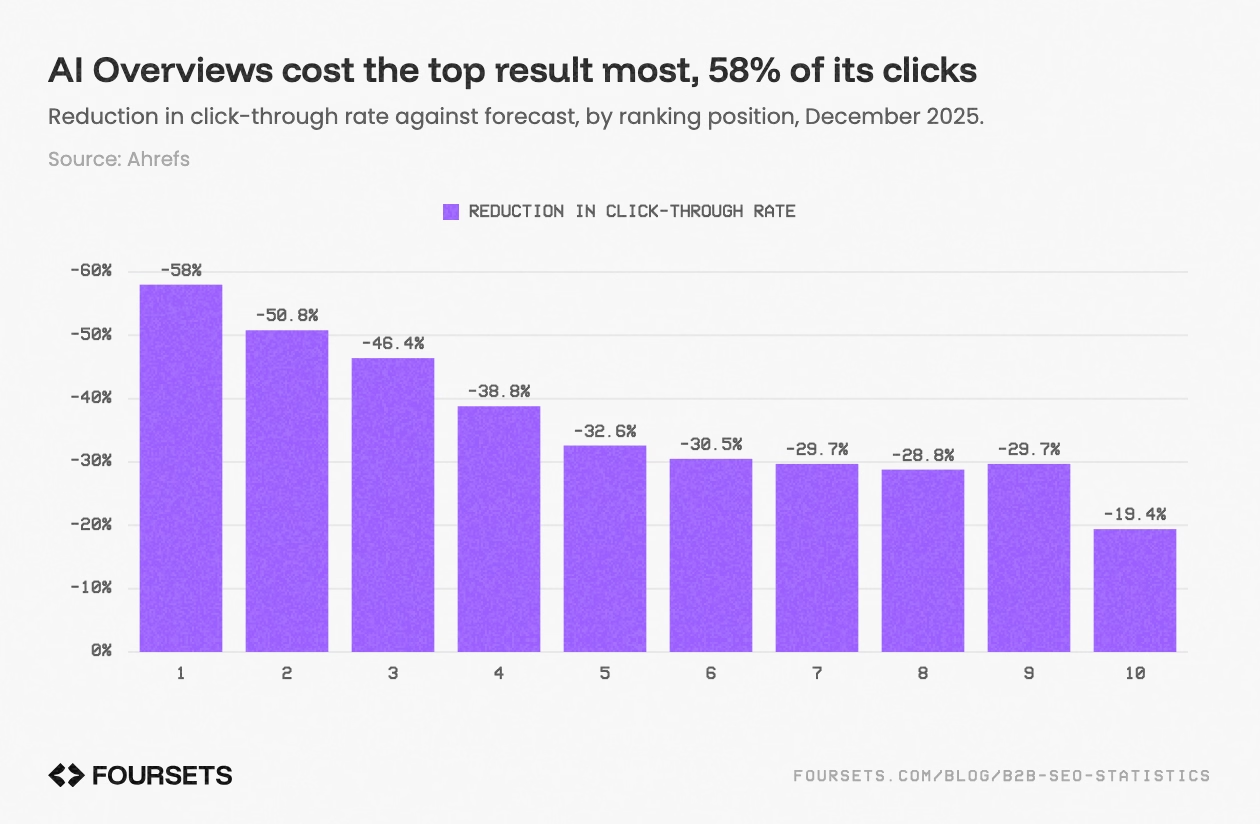
- Ahrefs' December 2025 study found the presence of an AI Overview correlates with a 58% lower average click-through rate for the top-ranking page, up from 34.5% in their April 2025 study (2).

"For every 100 clicks you could historically earn for a top-ranking page, Google now 'keeps' 58."
— Ryan Law and Xibeijia Guan, in Ahrefs' "Update: AI Overviews Reduce Clicks by 58%" (2)
- CTR damage by SERP position when an AIO appears (December 2025): Position 1 -58.0%, Position 2 -50.8%, Position 3 -46.4%, Position 5 -32.6%, dropping to -19.4% by Position 10 (2).
- Search queries that triggered an AI Overview were 9 to 11 percentage points more likely to result in a zero-click search compared to non-AIO queries (51).
- Roughly 60% of searches on traditional search engines yield no clicks. When an AI summary is present, only 8% of users click traditional links versus 15% without an AI summary (46).
- HubSpot's 2025 Web Trends Report found 83% of website owners reported traffic either increased or remained unaffected after AI features were introduced to search. Only 8% reported decreased traffic (14).
- Growth Memo's Kevin Indig found that 80% of users still click through to traditional results to verify information, even when AIOs appear (41).
- In the Ahrefs research summary by Tim Soulo (analysis of 14 studies and 1+ billion data points across 6 months), "Best X" blog listicles emerge as the single most prominent content format cited by AI chatbots, making up 43.8% of all page types cited by ChatGPT specifically (39).
- 67% of ChatGPT's top 1,000 citations come from sources marketers cannot influence: Wikipedia (29.7%), homepages (23.8%), and app stores (6.6%). Only 32.3% are influenceable content like educational pages, reviews, news, and blog posts (39).
- 28.3% of ChatGPT's most-cited pages have zero Google organic visibility (39). They get cited repeatedly by ChatGPT despite not ranking in Google at all, confirming a completely separate AI-discovery layer.
- Semrush data on AI summary behavior: roughly 80% of consumers use AI summaries for at least 40% of their searches, 70% read only the first third of an AI summary, and only 19% click on cited sources within AI Overviews (46).
- Authoritas study found only 1 in 5 links cited in Google's AI Overviews matched a top-10 organic result. 62.1% of cited links or domains did not rank in the top 10 at all (29).
- Semrush analysis of ChatGPT 4o responses: 50% of cited links point to business or service websites. The remaining 50% is distributed across news/media, blogs, e-commerce, forums, and education, each under 10% (45).
- BrightEdge's tracking shows a shift in what AI Overviews cite: Reddit citations dropped 85.71% and Quora citations dropped 99.69% by July 2024, while PC Mag presence in AIOs rose +49% and Forbes +39% (43). AI Overviews now strongly prefer authoritative editorial sources over user-generated forums.
- YouTube mentions have the highest correlation (0.737) with AI brand visibility out of all factors Ahrefs studied, beating conventional SEO metrics like backlinks, page count, and Domain Rating. The pattern held for both Google-owned and OpenAI products (39).
- Adding schema markup had zero meaningful impact on AI citations: AI Overviews dipped -4.6%, while AI Mode (+2.4%) and ChatGPT (+2.2%) showed changes indistinguishable from zero (39).
- For a given query, Google's AI Mode and AI Overviews reach the same conclusion 86% of the time, but cite almost entirely different sources (only 13.7% citation overlap) (39).
- HubSpot's State of Marketing data shows 46% of B2B marketers believe AI will make SEO more effective, 39% think AI will not significantly impact SEO, and 15% believe AI will negatively impact SEO (11).
What this reveals
AI Overviews now reach billions of internet users globally, but the B2B SERP is still mostly AIO-free. When AIOs do appear, they take a meaningful share of clicks from the top result. AI discovery is a separate visibility layer from Google organic: many ChatGPT-cited pages do not rank in Google at all, schema markup does nothing for AI citations, and YouTube mentions predict AI brand visibility better than backlinks.
📖 Worried AI is reshaping how B2B buyers find you?
See how to stay visible in our AI SEO Checklist for 2026: 75+ Prioritized Tasks →
B2B Content Statistics
Here is what works in B2B content for 2026, where the high-impact tactics actually live, and what the data says about AI's role in B2B content production.
- Quality content is Google's most important SEO factor (8). The average first-page Google result is around 1400 words long (8).
- Backlinko's analysis of 912 million blog posts found content longer than 3000 words receives 77.2% more referring domain links than content shorter than 1000 words (7).
- Search Engine Journal's State of SEO 2026 (survey of 371 SEO professionals across 52 countries) ranked the activities with greatest positive impact on SEO outcomes in the past 12 months (57):
- original content creation 66.3%,
- content updates 42.6%,
- technical SEO enhancements 42.3%,
- keyword optimization 24.5%,
- internal linking strategy 22.9%,
- structured data/schema markup 21.8%,
- backlink acquisition 16.4%,
Yet 77.9% of the same group fear AI-generated answers will reduce website clicks (57).
- HubSpot's 2024 Web Strategy Survey shows the most effective SEO strategies are optimizing for search intent (21%), on-page content with keywords (20%), keyword research (20%), mobile optimization (19%), and AI for SEO improvement (19%) (14).
- Looking ahead, 49.6% of SEO professionals plan to invest in E-E-A-T (Experience, Expertise, Authoritativeness, Trustworthiness) reinforcement, and 33.2% are prioritizing topical authority development (57).
"Double down on 'Experience' (the first E in E-E-A-T). AI can summarize facts, but it can't replicate lived experience. Demonstrate first-hand expertise with original photos, detailed walkthroughs, credible author bios, and transparent processes. Authenticity builds trust, both with users and AI systems."
— John Shehata, CEO and Founder of NewzDash, in Search Engine Journal's "The State of SEO 2026: How to Survive" (57)
- The B2B content elements that help answer buyer questions: transparent pricing tables that AI can extract and cite, technical documentation for IT stakeholders, implementation timelines with specific milestones, and ROI calculators with industry benchmarks (41).
- The B2B content formats that reduce friction and build trust during the research phase:
- comparison pages that highlight clear differentiators,
- industry-specific case studies with detailed results,
- integration guides showing how the product fits existing workflows,
- interactive tools (41).
- Middle-of-the-funnel content like comparison pages, niche buying guides, and Q&A pages tends to rank better and convert more effectively than generic blog content. With AI-driven search delivering direct answers, traditional educational blog posts are losing traction (26).
- Briskon's 2025 Enterprise SEO Trends report recommends enterprise marketing leaders adopt content hub strategies that interconnect pillar pages and supporting articles, as search engines prioritize authoritative, in-depth content (37).
- Stratabeat's 2025 B2B SaaS SEO Performance Report (300 sites, 15,000+ data points) found B2B SaaS sites publishing original research grew Google top-10 ranking keywords by 20.9% on average, versus a decline of -10.2% for those without research (56). The same group also grew Google organic traffic by 18.7% on average, compared to 11.2% for those without original research, a 67.0% higher organic traffic growth rate (56).
"To become successful in SEO, source topics to create content directly from customers by actually talking to them, recording the conversations, and using AI to analyze them. Become incredibly good data storytellers. Learn how to source unique data that is relevant for the zeitgeist of a topic, and how to tell an engaging story around that data."
— Kevin Indig, Organic Growth Advisor at Growth Memo, in Search Engine Journal's "The State of SEO 2026: How to Survive" (57)
- From the same Stratabeat study, B2B SaaS sites publishing 9 or more blog posts per month increased Google monthly organic traffic by 20.1%, compared to 16.2% for those blogging 5 to 8 times monthly and only 5.6% for those blogging 1 to 4 times monthly (56). The top 10% of performers blogged 11 times per month on average (56).
- The top 10% of B2B SaaS performers in the Stratabeat study wrote blog posts that were 33.4% longer than those published by the broader 300-site set (56).
- B2B SaaS sites using custom graphics in their blog increased Google monthly organic traffic by 44.7% on average, versus a decline of -2.6% for those using stock images or no images (56).
- Short-form video is the most popular media format for B2B marketing worldwide, used by 30% of B2B marketers. 29% use images, 24% interviews, 23% blog posts, 19% long-form video (54).
- LinkedIn dominates B2B content distribution: 65.4% of B2B marketers use LinkedIn most frequently for B2B marketing, 47.6% say it works better for B2B than B2C, and 68% increased their organic LinkedIn usage in the last year (54).
- 87% of B2B marketers worldwide say content marketing efforts have been successful in creating brand awareness, 74% say it has generated demand and leads, and 62% say it has nurtured subscribers, audiences, and leads (54).
- Forrester research found 92% of companies use personalization in marketing, but only 54% apply it to customer engagement (23).
- 22% of sales professionals use AI tools because they make outreach efforts more personalized. 98% of salespeople still edit AI-generated content rather than copying, pasting, and sending it off (12).
What this reveals
Original content is still the highest-impact B2B SEO activity, and the data sharpens what "original" actually means: research-driven, frequent, longer than average, and visually unique. B2B SaaS sites that do all four pull away from the average. AI accelerates production but does not replace human editing.
Link Building for B2B
- Backlinks act like votes of confidence: the more high-quality backlinks a site has, the higher it tends to rank (8). The number of referring domains is one of the most important ranking factors in Google's algorithm, per Backlinko's analysis of 11.8 million Google search engine results pages (8).
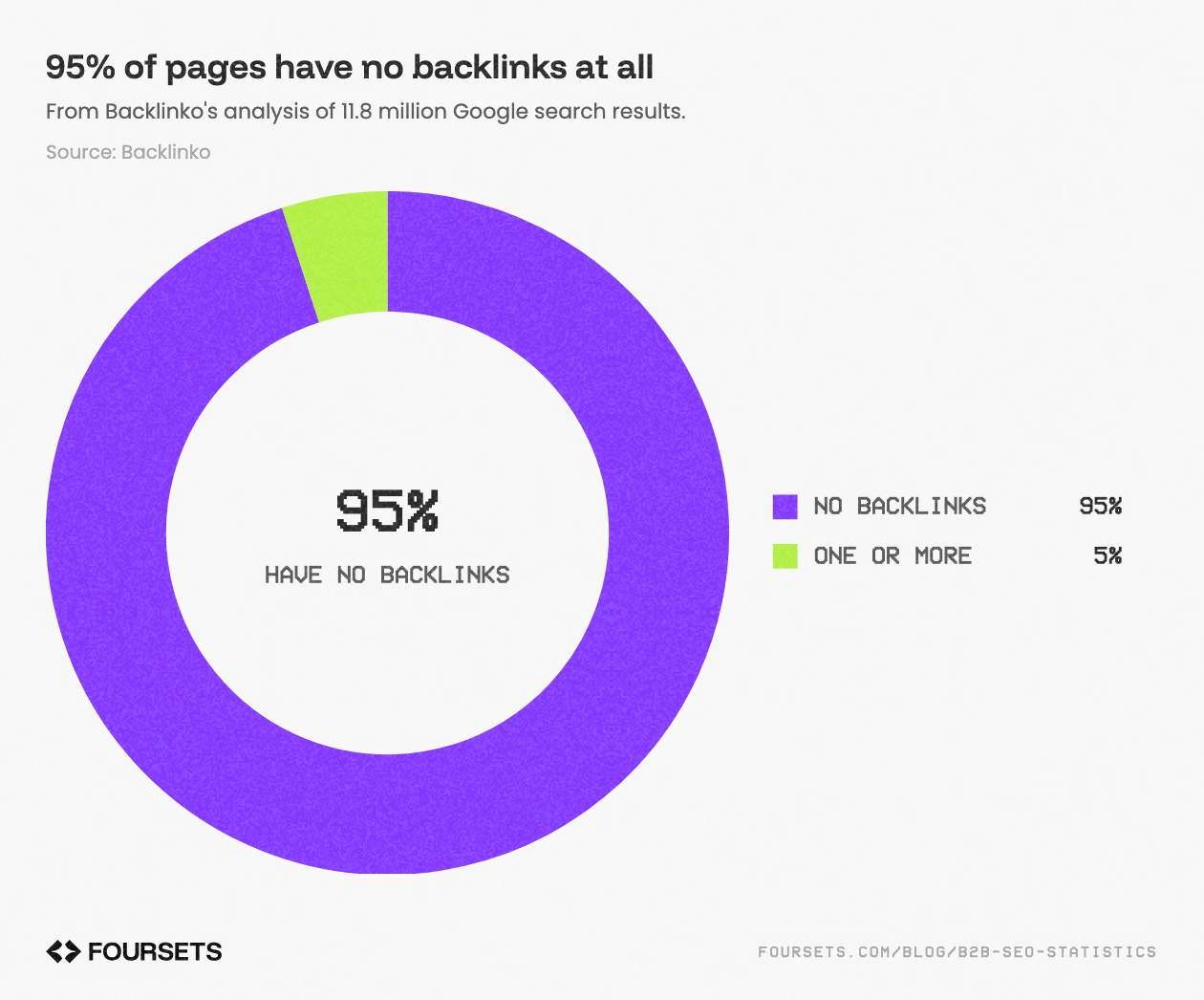
- Approximately 95% of all pages analyzed have zero backlinks (9).
- The #1 result in Google has 3.8x more backlinks on average than positions 2 through 10, and 3x more referring domains (9).
- Backlinko's analysis of 912 million blog posts (with BuzzSumo) found content longer than 3,000 words receives 77.2% more referring domain links than content shorter than 1,000 words (7).
- Stratabeat's 2025 analysis of 300 B2B SaaS sites and 15,000+ data points identified six practices tied to strong referring-domain growth: original research (97.0% of sites gained refdomains, 80.0% avg growth) (56); free online tools like ROI/TCO calculators (93.9% gained, 88.0% avg, 3.5X higher) (56); 9 or more blog posts per month (97.8% gained, 89.9% avg, 3.6X higher) (56); custom blog graphics (95.8% gained, 55.4% avg) (56); blog internal linking (96.9% gained, 60.5% avg) (56); industry-segmented audience content (96.7% gained, 46.5% avg) (56).
- The top 10% of B2B SaaS performers in the Stratabeat study had a lower average referring-domain growth rate (36.3%) than the full set of 300 sites (60.1%), suggesting Google may now give additional relative weight to ranking factors beyond link acquisition (56).
- Google likely treats unlinked brand mentions as a brand signal, even without a hyperlink attached (8).
- YouTube mentions have the highest correlation (0.737) with AI brand visibility out of all factors Ahrefs studied, beating backlinks, page count, and Domain Rating (39).
- BrightEdge tracking shows AI Overviews now strongly prefer authoritative editorial sources over user-generated forums: Reddit citations dropped 85.71% and Quora citations dropped 99.69% by July 2024, while PC Mag presence rose +49% and Forbes +39% (43).
- Academic meta-analysis (Usmany et al., citing Lukito et al. 2015) confirms backlinks from reputable websites increase domain authority, a key SEO ranking factor; first-page rankings also raise perceived trust and credibility (58).
What this reveals
Backlinks still rank, but the link-building game has split. Classic B2B link acquisition rewards original research, free tools, frequent publishing, and useful graphics. AI search visibility rewards a different set of signals: YouTube mentions, editorial citations on authoritative publications, and brand mentions of any kind. The most durable B2B authority strategy now covers both layers.
Technical SEO Statistics for B2B
Here is what the technical foundation of B2B SEO looks like in 2026, what actually drives B2B SaaS rankings, and what Google itself says about AI-specific technical advice.
- Google's official position on technical SEO for AI search: "Technical clarity ensures your content is ready for discovery and indexing, and all existing technical SEO best practices continue to be worthwhile" (17).
- Stratabeat's 2025 B2B SaaS SEO Performance Report (300 sites, 15,000+ data points) found B2B SaaS websites that implemented internal linking in their blog increased Google monthly organic blog traffic by 37.1% on average, versus a decline of -25.5% for those without internal linking (56).
- Google/Soasta research found that as load time increases from 1 second to 3 seconds, bounce probability increases by 32%. At 5 seconds, bounce probability increases by 90% (28).
- Think With Google data shows mobile pages that load a second faster than otherwise-identical pages have 20% more conversions (19).
- Core Web Vitals (CWV) thresholds set by Google: LCP (Largest Contentful Paint) "good" is ≤2.5 seconds, INP (Interaction to Next Paint) "good" is ≤200 milliseconds, CLS (Cumulative Layout Shift) "good" is ≤0.1 (34). A page passes CWV assessment when it meets all three at the 75th percentile of page loads, segmented across desktop and mobile devices (34).
- AI systems prioritize direct answers and structured formatting over narrative. Tables, lists, and schema markup receive higher weight when LLMs extract and cite page content (41). That said, Google officially clarifies that structured data is not required for generative AI search: "there's no special schema.org markup you need to add" (17). Keep schema for rich results; do not chase it as an AI requirement.
- On llms.txt and other AI-specific markup, Google is explicit: "You don't need to create new machine readable files, AI text files, markup, or Markdown to appear in generative AI search" (17).
- 42% of bloggers and SEOs using AI tools automate meta tags, alt text, and link descriptions. Another 42% use AI for website data analysis (11).
What this reveals
Technical SEO is the foundation for both organic and AI search. The site needs good speed, strong internal linking, and to be crawlable and indexable. Everything else is variation on that foundation.
📖 Failing Core Web Vitals on your B2B site?
See the full fix-it guide in our Core Web Vitals Assessment Failed: How to Fix Common CWV Issues →
B2B SEO Trends for 2026
Trend 1: GEO runs alongside SEO, not instead of it
Generative Engine Optimization (GEO) is the new discipline of shaping how LLMs like ChatGPT, Perplexity, and Claude summarize and cite your brand. It is not a rebrand of SEO, it runs in parallel. Classic SEO does not go away: Google's own guide to AI optimization is explicit that "all existing technical SEO best practices continue to be worthwhile" (17). Indexability, content quality, internal linking, and brand authority all stay in play. What is added is a second layer of work focused on AI extraction and citation.
What it means for B2B
72% of B2B buyers now encounter AI Overviews on Google, and 90% click through to cited sources (41). The AI answer itself becomes a first impression of your brand, before the visitor decides which cited source to open. If your brand has not shaped how AI describes the category, AI builds that description from whatever exists about you online: competitor positioning, third-party reviews, outdated information.
What to do
- Keep doing classic SEO. Per Google's own guidance, existing technical SEO best practices continue to be worthwhile. Indexability, internal linking, content quality, and brand authority all still apply.
- Be skeptical of GEO "hacks". Google explicitly debunks several popular ones in its AI optimization guide: no special schema markup is required (17), no llms.txt or AI-specific files are needed (17), and "many suggested 'hacks' aren't effective or supported by how Google Search actually works" (17).
- Make your content easy for AI to read. Use consistent language about who you are and what you do across your blog, product pages, and docs so LLMs pick up clear signals.
- Monitor brand mentions and brand positioning inside ChatGPT, Perplexity, and AI Overviews for the queries your buyers actually ask. Identify gaps where competitors appear and you don't.
"The way Google Search finds and processes your pages remains the core of how our AI systems access your data. Technical clarity ensures your content is ready for discovery and indexing, and all existing technical SEO best practices continue to be worthwhile."
— Google Search Central, "Google's Guide to Optimizing for Generative AI Features on Google Search" (17)
📖 Want a deeper take on actually doing GEO in practice?
Listen to our episode From SEO to AEO: Mastering AI Website Optimization →
Trend 2: Niche depth and AI-resistant formats win
The fundamentals of SEO have not moved. Being found by the right audience with the right answer is still the work. What did move is what AI now consumes from the SERP. AI Overviews answer the easy informational questions, and LLMs reproduce generic content. What still produces traffic and MQLs in B2B is content AI either cannot or has not absorbed: deep work aimed at a defined niche, queries where AIOs do not appear, and formats no LLM can fake.
"Cultivating a niche audience that's hard to access, and getting advertisers to pay a premium to get in front of that audience is a bright spot in the publishing industry, and that's where we are. Publishing for a broad audience for display ads is a struggling business model."
— Jenise Uehara, CEO, Search Engine Journal, in Search Engine Journal's "SEO Trends 2026" (42)
What it means for B2B
B2B is already a niche business. Your real audience is not "all B2B companies", it's a defined group of people in a specific industry, role, and budget range. They are the ones who actually sign deals. Broad top-of-funnel content stops bringing traffic because AI summarizes it directly. What still produces MQLs straight from Google in 2026 is content on queries where AI Overviews do not appear, built on first-hand experience that no LLM can reproduce: video interviews with named experts, opinion pieces with real bylines, original research from proprietary data.
What to do
- Define the audience narrow enough that you can name the specific role, industry, and budget range.
- Identify queries in your topic area where Google does not surface AI Overviews. Build content there because those pages still drive click-throughs and MQLs.
- Invest in content formats AI cannot replicate: video interviews, opinion pieces with named bylines, original research from your own data.
"Right now, what is working for me is to find opportunities that are not being cannibalized by AIOs, and producing content that cannot be replicated by an LLM."
— Shelley Walsh, Managing Editor, Search Engine Journal, in Search Engine Journal's "SEO Trends 2026" (42)
Trend 3: SEO is no longer just Google
B2B buyers stopped relying on Google as their single research surface. By the time they type your brand into search, they may have already encountered it on LinkedIn, in a podcast, on YouTube, in a Reddit thread, or in a ChatGPT answer, depending on the surfaces their specific industry uses. SEO that only optimizes the website is leaving most of those touchpoints unowned.

What it means for B2B
The B2B buying group gathers signals from many places. The company website is still one of the most important channels (McKinsey 2024 puts it in the top three channels buyers use), but many of the other touchpoints are not your site at all. Long-form on LinkedIn, expert interviews on YouTube, conversations in niche communities, AI chat answers, all of these feed the shortlist before the user ever clicks through to your domain. Investing only in the on-site funnel means surrendering the discovery stage to whoever else shows up there.
What to do
- Map the two or three surfaces your specific ICP uses to research. The list looks different for SaaS marketing leaders, enterprise IT buyers, and regulated finance teams. Pick the ones that match yours, not the generic platform list.
- Repurpose your flagship content into formats native to each surface. A YouTube short is not a video version of a blog. A LinkedIn post is not a paragraph from your guide. Native adaptation, not paste-jobs.
- Put off-Google presence on the same editorial calendar as your blog. If only the blog is shipping, you are still running single-channel SEO.
"SEO pros need to shift their focus from driving website traffic to capturing and leveraging customers' attention where it naturally exists."
— Grzegorz Czapik, Founder, MonitLabs, in Search Engine Journal's "SEO Trends 2026" (42)
Trend 4: E-E-A-T becomes a necessity
Google added "Experience" to its E-A-T framework in December 2022, right after ChatGPT launched. The timing was deliberate: AI cannot have lived experience, so first-hand knowledge became the signal that separates human content from AI-generated content. E-E-A-T is not a single ranking factor, it's a concept Google uses to surface content with credibility and real-world expertise.
What it means for B2B
B2B authority already runs on E-E-A-T-type signals: real authors, named case studies, expert credentials, transparent methodology. What's new is that those signals now feed AI evaluation, not just human readers.
What to do
- Add a named author with credentials and a linked bio on every published asset.
- Include first-hand insights from actual project work: case studies with real outcomes, original observations, expert commentary.
- Show editorial transparency: clear policies, AI-usage disclosure, last-reviewed dates.
Trend 5: Brand Authority is the competitive advantage
In an AI-driven search landscape, brand has become one of the strongest levers for visibility. Not as a traditional ranking factor, but as a signal that influences whether content gets trusted, cited, and surfaced. When multiple sources offer similar answers, AI systems lean toward the brands they already recognize.
What it means for B2B
B2B purchasing is recognition-driven, and AI search amplifies the pattern. Brands the B2B buyers can recall are the ones AI is more likely to cite in category answers. In 2026, being mentioned inside an AI Overview can be as valuable as being visited.
What to do
- Invest in digital PR, thought leadership, and expert-led content that earns mentions outside your own site.
- Build branded search through distinctive points of view and memorable campaigns.
- Measure beyond clicks. Track brand mentions and citations across AI search environments alongside organic traffic.
Trend 6: Voice and visual search are growing
Search has expanded beyond text into voice and multimodal queries. Voice search did not take off when first predicted, but AI copilots like Gemini and Siri built into modern phones are bringing it back. Google now blends video, visual, and text answers directly into the SERP.
What it means for B2B
B2B content that exists only as text on a page misses visibility inside video carousels, voice answers, and image-driven results, and the same multimodal assets also feed AI systems when they synthesize answers.
What to do
- Add transcripts, descriptive captions, and structured data to video and image assets so they show up in multimodal results.
- Structure pages for conversational queries: FAQ sections, question-based headings, clear direct answers early.
- Monitor SERPs for video carousels in your target topics and produce video content to fill them.
Conclusion
The numbers across this article point in the same direction. B2B buyers now do most of their research independently and across many channels before talking to sales. Google still owns B2B search, but AI Overviews increasingly sit between buyer and vendor. Generic content is being absorbed by AI; niche depth and first-hand experience are not. Organic search remains B2B's highest-ROI channel, with average returns around 22:1 and roughly five times the return-per-dollar of paid media, but only when the team measures past last-click. Brand recognition increasingly decides whose content gets cited inside AI answers.
B2B SEO did not get easier in 2026. It moved to the center of marketing strategies because AI rewrote how users search. Use these numbers to brief leadership, justify next year's budget, and shape a successful marketing strategy that accounts for the AI layer now sitting on top of Google. Pair the data with your own audit of where your buyers actually research, what AI says about your category, and how your attribution model handles zero-click reality. The math works in B2B SEO's favor, when measurement keeps up with where the buying decision actually happens.
Turn these numbers into your 2026 B2B SEO plan
Reading B2B SEO data is one thing. Translating it into an editorial calendar, a tech-SEO roadmap, and an AI visibility strategy that actually ships is another. The teams that did this work in 2024 and 2025 are now seeing the ROI multiples this article documents. The teams that did not are still arguing with leadership about whether SEO is worth next year's budget.
Foursets has been on the inside of dozens of B2B sites: Webflow migrations, content overhauls, technical audits, internal linking rebuilds. We know which gaps actually move pipeline and which look big on a slide but do nothing.
{{post-cta}}
Frequently Asked Questions
Why is SEO important for B2B?
For B2B, SEO is the highest-return acquisition channel a company can run. Average B2B SEO returns 22:1, and SEO delivers nearly five times the return on ad spend of paid media at a fraction of the cost. 96% of B2B buyers research independently before contacting sales.
How do you create a winning B2B SEO campaign?
Start with a defined niche audience, not a broad TAM. Build content AI cannot replicate (original research, expert interviews, real case studies) for queries where AI Overviews do not yet appear. Distribute across LinkedIn, YouTube, and AI search platforms alongside Google. Measure brand mentions and AI citations alongside organic traffic. Done right, B2B SEO returns roughly 22:1.
Is technical SEO important for B2B websites?
Yes, and Google itself confirms it. The company's AI optimization guide says explicitly that "all existing technical SEO best practices continue to be worthwhile". For B2B SaaS specifically, websites with internal linking saw 37.1% organic traffic growth versus a 25.5% decline for those without.
How do you hire the right B2B SEO agency?
Look for B2B-specific experience and proof of work. 8 in 10 B2B executives say projected ROI dictates SEO fee, not a fixed dollar amount. Clients spending over $500/month report 53.3% higher satisfaction with results. Ask for case studies in your category and how the agency measures pipeline contribution, not just traffic.
What's the average ROI from SEO for B2B SaaS?
For B2B SaaS specifically, SEO shows roughly 702% average ROI with a 7-month break-even across a 3-year window. That puts the category well above the cross-industry SEO baseline of 22:1, driven by high LTV per customer and low marginal cost of serving organic traffic.
What SEO tools are helpful in B2B marketing?
B2B SEO teams typically use four tool categories: keyword research and search demand (Ahrefs, Semrush), technical site audit (Screaming Frog), AI visibility tracking (Profound, Otterly), and analytics (Google Search Console, GA4, Bing Webmaster Tools, Seranking). The right stack depends on whether the priority is content strategy, technical SEO, or AI search visibility.
References
- Microsoft Advertising. Microsoft Advertising Network for Search. https://about.ads.microsoft.com/en/tools/planning/search-data
- Ahrefs. Ryan Law, Xibeijia Guan. Update: AI Overviews Reduce Clicks by 58%. https://ahrefs.com/blog/ai-overviews-reduce-clicks-update/
- Ahrefs. 90+ AI SEO Statistics for 2025 (Fresh and Original Data). https://ahrefs.com/blog/ai-seo-statistics/
- Ahrefs. B2B SEO Statistics. https://ahrefs.com/blog/b2b-seo-statistics/
- Ahrefs. 96.55% of Pages Get No Organic Traffic From Google. Here's How to Be in the Other 3.45%. https://ahrefs.com/blog/search-traffic-study/
- Ahrefs. SEO Statistics. https://ahrefs.com/blog/seo-statistics/#keyword-statistics
- Backlinko. Brian Dean. We Analyzed 912 Million Blog Posts. Here's What We Learned About Content Marketing. https://backlinko.com/content-study
- Backlinko. Brian Dean. Google's 200 Ranking Factors: The Complete List. https://backlinko.com/google-ranking-factors
- Backlinko. Brian Dean. We Analyzed 11.8 Million Google Search Results. Here's What We Learned About SEO. https://backlinko.com/search-engine-ranking
- Backlinko. SEO Services Statistics. https://backlinko.com/seo-services-statistics
- HubSpot. B2B Marketing Statistics. https://blog.hubspot.com/marketing/b2b-marketing-stats
- HubSpot. AI in B2B sales: How it's used in 2026 and the biggest benefits. https://blog.hubspot.com/sales/ai-b2b-sales
- HubSpot. State of Sales Report 2025. https://blog.hubspot.com/sales/sales-statistics
- HubSpot. 2025 Web Trends Report + Website Traffic by Industry. https://blog.hubspot.com/website/web-traffic-analytics-report
- DataReportal / Kepios / We Are Social. Digital 2025 July Global Statshot. https://datareportal.com/reports/digital-2025-july-global-statshot
- Datos (A Semrush Company). State of Search Q2 2025: Behaviors, Trends, and Clicks Across the US & Europe. https://datos.live/report/state-of-search-q2-2025/
- Google Search Central. Google's Guide to Optimizing for Generative AI Features on Google Search. https://developers.google.com/search/docs/fundamentals/ai-optimization-guide
- First Page Sage. Evan Bailyn. B2B Search Engine Market Share — 2024 Report. https://firstpagesage.com/reports/b2b-search-engine-market-share/
- First Page Sage. Evan Bailyn. 2025 B2B SEO Statistics. https://firstpagesage.com/reports/b2b-seo-statistics/
- First Page Sage. SEO ROI Statistics 2026. https://firstpagesage.com/reports/seo-roi-statistics-fc/
- StatCounter. Desktop Search Engine Market Share in United States Of America. https://gs.statcounter.com/search-engine-market-share/desktop/united-states-of-america
- StatCounter. Desktop Search Engine Market Share Worldwide. https://gs.statcounter.com/search-engine-market-share/desktop/worldwide
- Intentsify. Understanding Key B2B Sales and Marketing Trends 2025. https://intentsify.io/blog/b2b-marketing-trends-2025/
- Search Engine Land. 3 common B2B SEO mistakes sabotaging cost per lead. https://searchengineland.com/common-b2b-seo-mistakes-sabotaging-cost-per-lead-442604
- Search Engine Land. Don't kill your SEO budget, shift it. https://searchengineland.com/dont-kill-your-seo-budget-shift-it-459025
- Search Engine Land. Why traditional keyword research is failing and how to fix it with search intent. https://searchengineland.com/fix-traditional-keyword-research-search-intent-451880
- Search Engine Land. Google: 5 trillion searches per year. https://searchengineland.com/google-5-trillion-searches-per-year-452928
- Search Engine Land. Advanced technical SEO tips. https://searchengineland.com/guide/advanced-technical-seo-tips
- Search Engine Land. How to choose a link building agency in the AI SEO era. https://searchengineland.com/how-to-choose-a-link-building-agency-in-the-ai-seo-era-467238
- Search Engine Land. How to justify your SEO budget in 2025. https://searchengineland.com/justify-seo-budget-459284
- SQ Magazine. Google Search Statistics. https://sqmagazine.co.uk/google-search-statistics/
- Surfer SEO. B2B Marketing Stats Every Marketer Needs to Know for 2025. https://surferseo.com/blog/b2b-marketing-stats/
- Trendemon. 2024 B2B Buyer Journey Report: Challenges & Trends. https://trendemon.com/blog/trendemons-2024-b2b-buyer-journey-report-challenges-trends/
- web.dev (Google). Web Vitals. https://web.dev/articles/vitals
- BrightEdge. One Year Into AI Overviews: Google Search Usage +49%. https://www.brightedge.com/news/press-releases/one-year-google-ai-overviews-brightedge-data-reveals-google-search-usage
- BrightEdge. AI Overview Citations Now 54% from Organic Rankings. https://www.brightedge.com/resources/weekly-ai-search-insights/rank-overlap-after-16-months-of-aio
- Briskon Technologies. Top 10 Enterprise SEO Trends for 2025. https://www.briskon.com/whitepapers/enterprise-seo-trends-2025.pdf
- Forrester. Jessie Johnson. From Keywords To Context: Impact And Opportunity For AI-Powered Search In B2B Marketing. https://www.forrester.com/blogs/from-keywords-to-context-impact-and-opportunity-for-ai-powered-search-in-b2b-marketing/
- Ahrefs. Tim Soulo. LinkedIn post summarizing 14 AI search studies (2025). https://www.linkedin.com/posts/timsoulo_in-the-last-6-months-at-ahrefs-we-analyzed-share-7467561526015463424-9suJ/
- McKinsey & Company. Candace Lun Plotkin, Jennifer Stanley, Liz Harrison, Víctor García de la Torre. Five fundamental truths: How B2B winners keep growing. https://www.mckinsey.com/capabilities/growth-marketing-and-sales/our-insights/five-fundamental-truths-how-b2b-winners-keep-growing
- Search Engine Journal × CallRail. Optimizing For Your Real Audience, Not Just Algorithms: The Future Of AI Search (co-published ebook, 2025). https://www.searchenginejournal.com/ai-search-future/
- Search Engine Journal. Shelley Walsh (Managing Editor). SEO Trends 2026. https://www.searchenginejournal.com/seo-trends/
- Search Engine Journal. SEO In The Age Of AI. https://www.searchenginejournal.com/seo-in-the-age-of-ai/
- Search Engine Journal. The B2B SEO Trap: Why High-Intent Visibility Can Still Underperform. https://www.searchenginejournal.com/the-b2b-seo-trap-why-high-intent-visibility-can-still-underperform/551751/
- Semrush. We Studied the Impact of AI Search on SEO Traffic. https://www.semrush.com/blog/ai-search-seo-traffic-study/
- Semrush. 26 AI SEO Statistics for 2026 + Insights. https://www.semrush.com/blog/ai-seo-statistics/
- Semrush. SaaS Statistics. https://www.semrush.com/blog/saas-statistics/
- Statista Research Department. Referral share of search engines worldwide 2015-2026. https://www.statista.com/statistics/1381664/worldwide-all-devices-market-share-of-search-engines/
- Statista. Channels B2B buyers use to discover products in the U.S. 2023. https://www.statista.com/statistics/1454718/channels-for-b2b-product-discovery-united-states/
- Statista. Leading AI applications worldwide 2026, by MAU. https://www.statista.com/statistics/1609163/top-ai-applications-mau-worldwide/
- Statista Research Department. Google search queries with zero clicks Q1 2025. https://www.statista.com/statistics/1620329/google-search-queries-with-zero-clicks/
- Statista. B2B ad budgets worldwide 2025, by network. https://www.statista.com/statistics/1623183/b2b-ad-share-networks/
- Similarweb. SEO Benchmarks 2025: Your Roadmap to SEO Mastery. https://www.similarweb.com/corp/wp-content/uploads/2025/02/attachment-2025-SEO-Benchmarks-report.pdf
- Demandbase × EMARKETER. From Ad Waste to ROI: How B2B Marketers Can Do More with More. https://www.demandbase.com/wp-content/uploads/2025/04/Demandbase-Final-eMarketer-2025-report.pdf
- Sagefrog Marketing Group. 2025 B2B Marketing Mix Report (18th edition). https://www.sagefrog.com/wp-content/uploads/2024/08/Marketing_Mix_2025_Report-v1-3.pdf
- Stratabeat. 2025 B2B SaaS SEO Performance Report, Version 4. https://stratabeat.com/wp-content/uploads/2025/03/stratabeat-b2b-saas-seo-performance-report-39d-2025.pdf
- Search Engine Journal. Katie Morton. The State of SEO 2026: How to Survive. https://www.searchenginejournal.com/state-of-seo/
- Usmany P., Rachmawati R., Rembe E., Sopacua F., Santosa T.A., Arifin A.H., Fitria A., Suhardi. The Effectiveness of Search Engine Optimization (SEO) in Marketing: A Meta-Analysis Study (COSTING, Vol. 7 No. 5, 2024, pp. 807-811). https://www.researchgate.net/publication/382953524_The_Effectiveness_Of_Search_Engine_Optimization_SEO_In_Marketing_A_Meta-Anlysis_Study
- Search Engine Land. "Google massively expanding AI Overviews for travel, entertainment." https://searchengineland.com/google-ai-overviews-expand-travel-entertainment-454863








.avif)