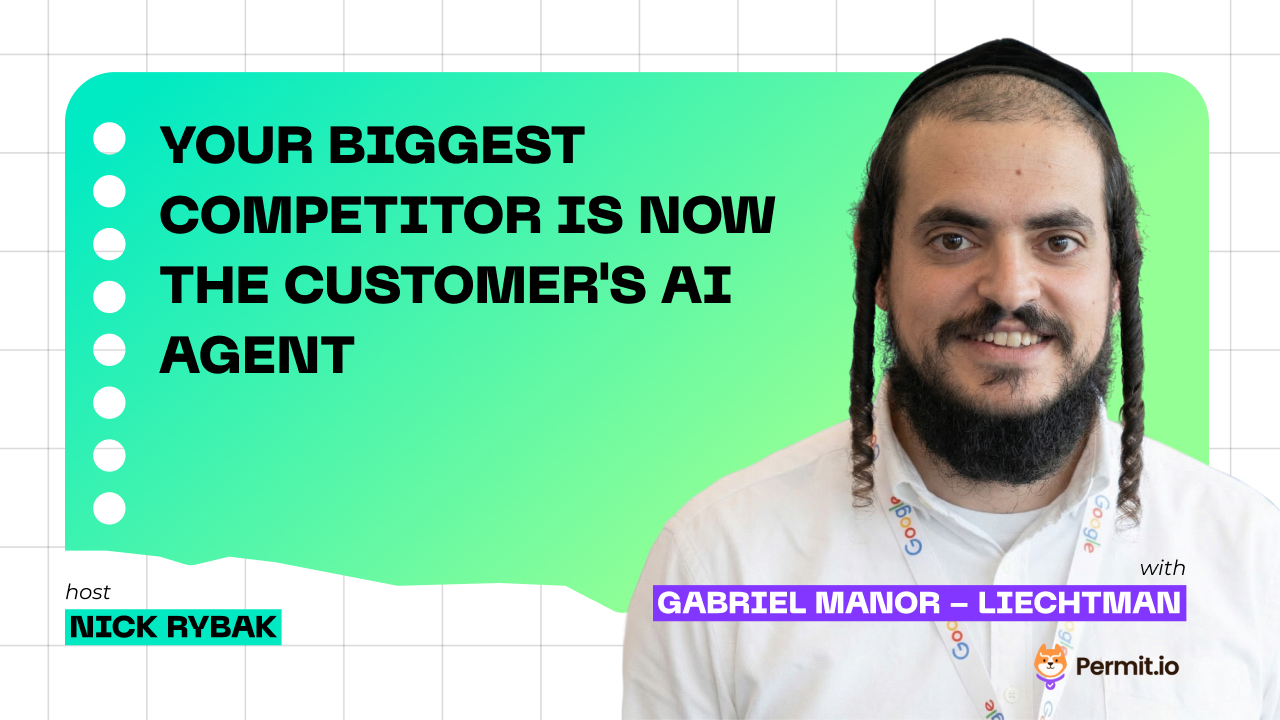
Nick Rybak (00:00)
Gabriel, thanks forjoining. Really happy to have you here. Could you please introduce yourself abit? So for people that don't really know you yet.
Gabriel (00:08)
Yeah, so my name isGabriel. I'm in software engineering for ⁓ 15 years now and for the last three years Imade it mostly into the go to market field calling myself go to marketengineer. I'm leading the everything go to market in permit IO startup thatcreate an execution layer for everything.
authorization andpermission. yeah, I really love the cross point between engineering and go tomarket and how can we shape marketing using engineering techniques.
Nick Rybak (00:42)
Not really a popularsituation where like an engineer switches to a marketing side. So I think thatthat's going to be the interesting conversation here. And actually the firstquestion would be like, what's the most expensive mistake you've made that permit⁓ in time, money or missed opportunity. And I'm asking about like whenyou actually became an go-to-market specialist already, not as an engineer.
Gabriel (01:09)
Yeah, think the mostexpensive one, and I think many SaaS and developer companies have it, is treatconferences as a lead gen platform. Conferences are great, but the developerconferences never built for being lead generated. They built to be a brand awarenessplatform and create your funnel into your lead generation efforts.
For us, it permit thefirst conferences we did. We just did what everyone do. We have a booth and wetry to do sales call, hey, you need this product, maybe, maybe your teamneeded. And I tried to sell at the conference. got 30 meetings, two showed uplike the same ratio in all the industry. And we've been really frustrated. Andthen we sat and thought, how can we improve our conference presence? We built aframework on how to do.
conferences that arefirst very focused on measurable brand awareness and second create a funnelthat you can after measure attribute and ⁓ be more on the legion after I can say that weare meeting folks at a conference we didn't know that they've been in our boothbecause we are very in high volume of like hey let's do brand awareness doreally cool stuff really cool activities like in every conference we are peopleare come to see how we do and
Six months later, Iget a super friendly message on LinkedIn. Hey, we met at a conference and I'mlike, I'm not really remember, but I'm happy that I give you that hanging outfeeling that make you feel as a friend. So definitely the first two conferenceswe did at permit was the most expensive situation that we just throw money on.On the other hand, we learned a lot. So maybe that's a learned price that wehad to.
Nick Rybak (02:54)
Yeah, that's a great,great experience, I think. Two conferences, not that big amount to realizethat. And let's be a bit more specific. Like, what was the cost of thatmistake? And like, let's say money for these two conferences.
Gabriel (03:08)
I think usualconferences like all in all when you're not investing like the biggest bookthat I reinvent around 50 grand both conferences, know, with all travels andpeople and booth and everything like that. So I can count on I think 50 K.
Nick Rybak (03:27)
Got it. Thank you forsharing. you also mentioned the measurable brand awareness. So I'm curious,what did you mean by that? How do you measure that?
Gabriel (03:35)
So ⁓
the thing that make mea lot of heart when I'm in conferences is to see the companies that gives youlike, I don't know, yeti cups that cost 20 bucks each, just if you're, ifthey're scan your badge. Scanning badges are kind of attribute. You buy an email,but you can buy this email from Apollo and any other intelligence platform. Andpeople are not really remembering you because of your
because of the copthey get. Maybe they are, but you have zero connection with them. In theframework we had in Permit, the baseline was an online activity that we areasking people to participate in. It can be a simple one, like start our GitHubaccount, which many do, but it can be also a complex one, like a quiz game orsomething that they need to watch, something they need to play, something theyneed to do, some mission to accomplish, something like that.
The benefits of havingactivities like that is that you can attribute folks. If you're, for example,having a quiz game and then you ask people to log in with their GitHub, sofirst you get their GitHub account, which is a profile that is way more enrichedthan the email 1.1.1 at something.com. You get the real profile of the person,so that the first. And second is that you
Actually get on theirphone so you get like of course you need to get a consent for that andeverything and we did we did it all but you can start attributing person andthen you can have a pixel on their phone and if they'll visit your website thenyou know about them and if they're for example, then you can retarget them withpaid campaign, etc, etc, so
The more onlineconnection you get with the people at the booth, you get more attribution thatyou can track after and you can measure the brand awareness. Another measurableaspect is the fact that many companies spend a lot of time at the booth for irrelevantpeople. So not every person that stopped by our booth is a relevant ICP. Theymight be correlated with your ICP. So for example, someone who can tell afriend or an engineer that can tell their manager.
But your booth effortneeds to be cascade or adopted or responsive to the person that is just nowvisited your booth. So the way we built our ⁓ booth funnel was in a waythat we have the just visitor ones. They are getting a very cheap swag and weare asking them something that I don't know, like a post, star on GitHub,something like that.
They are not relevantnow, but they are somehow developers and would like to keep their details, butwe also don't want to spend our time on them. So we give them a self-serviceexperience at the booth to get something, remember us and go forward. Then wehave the folks that are worth personal touch, that they might be sometime withsome pain. And this is where our mid-level booth folks...
trying to detectpeople that are kind of relevant, to be more friend with them, to give thepersonal connection. That after, if at some point they will need something,they remember, hey, I know someone from this company. They will visit yourwebsite and they will correlate it with your face. Hey, I'm friend. This is theexample I gave earlier. A person I met at the booth, we just have a veryfriendly discussion and he'll remember me because this discussion has, youknow, it might be the option that he saw retargeting ads online.
It might be the optionthat he get a swag. It might be the option that he play a quiz and now we knowreally well the permit materials, but he wasn't an ICP at the conference. So wespent just the time we need, you know, to give them the personal touch. Then wehave the backend of the booth, the people that are actually, you know, can givea long demo, can give a long shot. They would never be at the front of thefunnel. They would never be at the top of the funnel. So the time will bemanaged by what they really need to do.
And this is the job ofthe top of funnel representative, to filter the people to the middle of thefunnel or the bottom of the funnel so you can manage your time well at theboot.
Nick Rybak (07:54)
Got it. Thank you forexplanation. All right. speaking of the company you're working at, so you'vementioned the developers and for people who don't know that your targetaudience is developers and you basically sell development tools. That's why youmentioned GitHub. so the question I had is that every developer now is usingCloud Code or Courser.
or like basically anyother AI based tool like Copilot for coding. And a lot of them are probablythinking that they could just build something similar like your softwarethemselves. And how do you actually sell something to people that are likehalfway convinced that they don't really need any developer tools anymore?
Gabriel (08:43)
Yeah. Well, a coupleof months after I started to work as a marketer or go to market person, Iunderstood the most fundamental part of marketing for developers. Your biggestcompetitor when you're selling to developers, the developers themselves, you'realways like, it is not like they will choose an alternative product. Theyalways are. But why, why wouldn't I build it myself? Like when you meet people,the yeah, the most reaction
Nick Rybak (08:59)
Yeah, yeah, for sure.
for two months insteadof paying $9 per month.
Gabriel (09:11)
Yeah, the mostreaction that people give you is like, okay, I don't think I need it. I'llbuild it myself. It is not new with Cloud code with cursor and cursor. The newthing with coding agent is that they are convinced people they can build itthemselves. And for some cases that true. The thing with developer tools and Ithink is general now is the suspocalypse and the fact that you need to
emphasize yourinfrastructure capabilities. Even Nata Developer Tools today has the problem ofI'll build it myself. And especially for, for example, like product that we sawdropped in the last couple of months, task management, to do applications, calendars,I don't know, whatever it is, they're getting like dropped because Claude orEntropiq said, hey, we are shipping the cohort.
Right? So this is aproblem now of every, every single company in the market that they had theproblem of, we are competing ourselves, to say, and, with that, think thatdevelopers again are not alone with that. thing that you need to do as amarketer is first emphasize the infrastructure aspect of you. And second,having the.
there is in AI andLLMs there is the term of harness the software on top of the LLM that do thestuff, right? Let's say for example that if you are using Claude Opus 4.6 as amodel you'll see a completely different result in Claude code and when you're workingwith cursor although they are the same models because they are both builtdifferent harnesses to
make the LLM work foryou, make the LLM code for you. And when you are understanding better thelayers of what make Cloud Code or Cursor build the right thing for you, thenyou can understand better how to market the layers that they couldn't replace.So for example, if your software do very highly deterministic policyevaluation,
You might want to say,hey, you can do that with cursor, that for sure. But you probably want cursorto use our product because you want our harness to be the one that do thepolicy evaluations. And there is two sides of how to excel with this approach. Thefirst one is being machine first product. It's super relevant now for developertools.
AI agents cannotcreate account in your product and if AI agent cannot work well with yourproduct. So you need to develop skills and you need to develop CLI and need todevelop API so AI agents can open accounts in your product. And then you justgive the AI, the coding agents the capability to think, hey, why we shoulddevelop that if I can more easily integrate it with the product. When you workwith coding agent, they also
provide you an offersfor products and stuff that you can use for that. So the first thing is havingyour ⁓ infrastructure ready for coding agent. And the second is when you docontinue the relationship part with your audience. So make them love you, makethem think that, hey, we might use Cloud Code for that, but the tool that CloudCode use is this product because it gives me trust. It gives me like,
I can sleep quietly atnight because I know everything work for me. know it work well in production. Iknow it work well in architecture, et cetera, et cetera. So this is ⁓ thethings that you need to emphasize more than just here is the easiest way toachieve something, which is was, it was the way we did messaging. Like fouryears ago, we were like, okay, you can save six months and do it in one only ina month, which is irrelevant anymore.
because if I can do itin a month with you, I can do it in two weeks with Cursor. So now the messagingis shifted into, you can do it in two weeks and you can do it with us, but youget better values. You get more trust, you get more scale, you get more speed,you get more time to develop things that are more important for your business.
Nick Rybak (13:33)
So it's basicallydifferentiator here is the like level of execution for them, right? So how,how, how better you are doing what you are doing or how fast you are doingthat. Is it worth to like developing that ourselves or like, it's just easierto use your solution.
Gabriel (13:42)
Mm-hmm.
Yeah, absolutely. Soagain, I think that the fact here is that it is not faster. It is not maybeeven not better because better is kind of vague thing. It's kind of somethingthat, what is better? What is robust? You need to be very specific, very technicalon what is the achievement of using a product instead of let coding agents justdo that for you in your product.
Nick Rybak (14:21)
OK, and you've alsomentioned the interesting here thing is that you have you've said somethinglike that you have to prepare the infrastructure for AI agents. And do thinkit's relevant for only like when your ideal customer is a developer or likebasically everyone in the future?
Gabriel (14:42)
Absolutely not. Not inthe future. Actually now. I'll tell you the way I see it. So at some point oftime, let's say between start by 2010, let's SaaS became a thing. And then yoursuper app to run your software was the browser. We never, I mean, if you metanyone in between 2010 to our days and ask them, Hey, can you build a productor
Nick Rybak (14:56)
Yeah.
Gabriel (15:09)
Is there an option tobuild a product without a web interface, a web app, a website or something? Imean, this is the way people are running apps. This is the way people arerunning apps today. When you're thinking SaaS, you are thinking a web app thatyou're logging in and do something in the browser. So the browser became thesuper app, something that is very interesting in China for years now.
the chat applicationsare super apps for everything. You do everything via chat interfaces. So nowthe super apps for every software around there are agents. So if you're notbuild your apps to work well with the super app of agent, then it will be irrelevant.And the most baseline stuff, maybe it's not the most basic baseline, but it'ssuper important that also the exploration will be part of it. And explorationis not just about
Nick Rybak (15:38)
Yeah.
Gabriel (16:02)
have ChatGPT to offeryou for forks is have ChatGPT integrate and make thing for you when you're justworking. One of the thing that is super for me, like it's really changed theway I work with AI. So back then I used to have a planning sessions with myselfor with the team, know, you're sitting, you're saying, what is the task that Ihave to do in this week, et cetera.
Today with agent, theway that you are doing tasks, are already, you are do task and you already givean agent to work on that. Right. So instead of like plan a strategy for alaunch, you're not writing it in a task, no matter what the platform you work.But for me, I'm not work with any special software, but when I'm doing myto-dos, I'm already starting chat with agents on how this to-do should be done.Right. So if I'm writing like,
have a plan for alaunch, I'm not only writing it in my to do app, I also start a thread with anagent to consult, to brainstorm, to understand how to do stuff. And the resultof that is that instead of just thinking, you start by doing. Agents helps youto do a lot, to do many things, to do stuff. And if you want people to workwith your product, you don't have the bandwidth between find me on the websiteand sign up, which is
something that youknow, the old exploration phase is that someone is looking for a product andthey are going to Google and they Google it and okay, I'll read this one. Fine.I'll go to other website. Fine. I'll do the comparison and then I'll sign up toone of the product. In today's play, the player that will win this game is theone that will have the doing aspect.
And the main baselinedoing aspect when people are exploring for a new product, for a new service isthe agent to start the thing for them. The agent to do the onboarding, theagent to do the initial skeleton, the agent to do the sign up and, you know, creatingthe baseline account. So if your product, no matter if that's for developer ornot, is not exposing interfaces that agents feel comfortable to work with, then
you're losing theexploration because people will lose their focus and would never come back tosign up. They expect the agent to do the first doing step in your product.
Nick Rybak (18:35)
Do you think that wewould even need like interfaces then? I mean, in the classic model of SaaS islike you have, as you said, like you have a web app, you log in, you basicallywork with some data there, you see some reports or like you create ones, yougenerate something there and so on and so forth. But at the end of the day,
Now, like it turnedout, it's not the best way to work with your data, especially if, for example,if you need to marry two data points in some way. I mean, if you're a marketer,you probably need to see like Google Analytics with Google Search Console, withMeta ads, with LinkedIn ads all together and make some different comparisonsand like basically
see all the datatogether and the interface doesn't seem like the best option to do that.
Gabriel (19:40)
I think it is a greatquestion. I'm not thinking that I can see the future. I'll do well, I wouldn'tbe here now. But I think I would like to split it into two niches. So the firstone is about the orchestration of data. The thing that agents open for you isthe companies that try to encapsulate their interfaces to give you the mode oftheir product.
So for example, youmentioned something that the marketer pay attention a lot is that now I don'tneed to manage campaign in meta ads, campaign in Google ads and try to ship theretargeting from Google to meta, cetera, et cetera. I can have one interfacethat is orchestrating everything for me and do this stuff. This is somethingthat we already saw the disruption. I haven't visited, I think, GoogleAnalytics. was like I had daily.
time in GoogleAnalytics for at least 20 minutes a day a year ago. I haven't visited theGoogle Analytics interface for a year now. Why? Because I'm orchestrating itwith tools and do all the intelligence analysis on another interface. But thatdoesn't mean that I don't want to work with an interface. I work with adifferent interface. Specifically, this is a chat interface, but to some sort,your focus is trying to get
more into monitoring,into dashboarding, et cetera, et into the UI thing that is easy for our brainto get. A chat is a good medium, but first it costs a lot of time because chatis something that you need to write, you need to be proactive, you need to readtons of text that they are returned to you. And it probably is not the mostefficient use of your time to chat with someone for the whole day.
And as an anecdote,there's something that I feel is like when you are chatting, it being verypersonal, you never tell to a dashboard, Hey, you're a bad dashboard. I hatethis personality. Do something better. Right. So it costs you an emotionalthing that is not, I think it's not smart to have only chat interface foreverything we need here. And probably there are some interfaces. So there, Ithink it's called the, um,
I can't remember nowthe standard that Anthropic launched in Claude. So now Claude can answer youwith interfaces that you can keep as an artifact and then they will know tosync and they will know to do everything. So on the orchestration side, yes,there is a big advantage now to the LLM providers like OpenAI and Anthropicbecause they have the chat interface that creates the interfaces. But
We will not use onlychats. It will take some time until people will deep breath and understand thatnot everything you should do is Claude and so on, and that you should do some,you know, better experiences in other agents that give you the right interface.So the interface will completely change the way that we know them, but it willnot be only chat interfaces that I don't think it will never happen.
Nick Rybak (22:57)
All right, so let'sget back to like more marketing stuff, let's say. And I actually had a questionso that everyone right now clearly uses lots of AI workflows in contentproduction. And I've noticed that this is the part of your GTM at permit aswell, like a content marketing.
And I had a question.So what is the actual workflow or maybe a playbook for you that works? How toproduce a valuable content? And do we create valuable content for AIsummarizers only in 2026 or people still read some content? What is youropinion on all this content thing?
Gabriel (23:42)
I'll say first thatfor sure people are still consuming content. To some sort everyone consumecontent, I think it's related also to the interface discussion. You're speakingwith agents, you do that a lot. Some people do it 90 % of their day, but still everyone of us consume content. It can be video, is, I mean, I don't know a personin my life that did not consume at least an average 10 minutes videos a day.
to some sort can be TVbut most of the folks are just I don't know stories, ⁓YouTube, whatever it is. Still many people even with all everything AI watchvery long video YouTube videos or educational videos to do stuff. So video isstill a platform that from our brain the way that we learn thing, the way thatwe consume thing many folks works very well with videos.
So videos isdefinitely something that not dramatically or drastically change because of weare working with AI. Of course, there are some medias that changed a lot. Theinternal blog of the company, think we maintain the blog was our biggest top offunnel engagement with users. had tons of organic SEO, we still do have some.
And yes, people arereading less and less blogs, but the agents still reading docs. So you need tomaintain your content or your context layer of your content public in theinternet because the agents need to think about it. With that, we need tounderstand what AI changes in the layer of content. When we are thinking ofcontent the way that I like to imagine it, we have four layers.
The first one, whichis the bottom one, is the context. It's what our company doing, what is theproblem of the customer, how we solve that, how our product work, all ourdocumentation, everything. This is the context, and this is the first, thebaseline layer. Without this context, you cannot create any kind of content. Ontop of that, you have a layer that is production and repurposing. You're takingthis content and you create stuff from it. It can be blog posts.
It can be videos andcan be docs in your website. It can be Reddit sub Reddit. It can be Redditposts. It can be social posts. can be whatever it is, you're product you do alot of the layer that do production and repurposing. On top of that, you havethe distribution layer that you need to be smart when you distribute. And thisis also a task that is taking the time. You need to build your channels. Youneed to build your organic growth. You need to build your
even performancegrowth. So you have the distribution layer that you need to do. And on top ofthat, you have the signaling and prioritization. So you, for example, there aretrends at the internet and trends are great way to be bold organically, becauseif you're detecting a trend and you repurpose some of your context and youdistribute it right, then people will read your content because people areconsuming still Twitter feeds.
People are consumingLinkedIn feeds, are consuming social media feeds, and I don't think it willdisappear. Maybe the content will be more AI generated. Maybe the algo will bemore AI generated, but people will need to consume content, right? They need tobe passive and consume content. And I think that what AI did is having thelayer of production and repurposing that was the most expensive one. If we arejust looking two years ago,
Most of the contentwork you did was about production and repurposing. You never disconnect betweencollecting the context and writing stuff, right? So the way that content writerwork two years ago, they listen to someone, they build an outline from theoutline, they build an article or something like that. That effort need to bedecoupled.
need to be decoupledfor a continuous context layer that you take everything you do to. So you canwork with ready-made product like Octave, or you can build your own layer. you,for example, develop a product, a very easy way to do that is to have agentsthat document everything that is going in your product. And you can takecustomer meetings for that. You can take a lot to build your context layer.
When you have stablecontext layer, then you can very easily repurpose and product every type ofcontent you want. And then you can use the distribution and a signal andpriority layers to make sure that you are already reacting just in time withthe content that is really made a difference now and push into where people arenow. I think with that, that investing in log long time content repurposing andcontent distribution now.
So for example, do SEOeffort is not the smartest way, maybe I'm wrong, but this is not the smartestway to utilize your content because the way that people consuming content andthe way that content is pushed into people's mind is changing every day. Likeif you'll go to all these AEO and GEO companies,
every two weeks theyfound a new method that charge GPT ranking stuff and they will try toprioritize you better there and if all your effort will still be on producingand repurposing content then you will not stand at the pace of that so thelong-term shot that you need to do now is to build a super stable context layer
that it always havethe content so you can very easily repurposing or producing some sort ofcontent for me because AI made it easy and build a stable signaling layer thatyou'd always know what is the right content for me to produce now and whereshould I distribute it.
Nick Rybak (29:53)
Got it. So Idefinitely think that with AI it becomes more like it becomes harder every dayto get the attention of people because the level of content is like an insaneon a daily basis.
Gabriel (30:05)
Absolutely.
Nick Rybak (30:09)
All right, Gabriel. Sonow it's time for the flywheel five. Basically same five questions I ask everypodcast. And the first one is what's one channel you would bet everything onright now? And...
the one that you wouldkill,
Gabriel (30:26)
Yeah, I think thissuper interesting one and as I said, it is changed daily. What I say now, maybetomorrow, everything will change. For now, I really adopt X because with theagents, I can have automation that tell me what is the hot topics on X on Twitter.They have now this recommended news for you, which is super important becausethen you can immediately think, OK, I'll generate now a post about this one.
and it will really getgood engagement. And agents can just scrape Twitter and do something with it.The one I kill, I think Instagram. I think the repurposing is really hard forus now and the cadence is really hard to be bold. So in terms of organic, definitelyInstagram. think meta is a great opportunity for performance, but if we'respeaking organic, I think Instagram is getting really hard to win.
Nick Rybak (31:22)
Alright, so, and whattool are you using or recommending that most B2B marketers have never heard of?
Gabriel (31:32)
I would say cloudcode, but I think it's so pathetic now. And I actually, actually not using thatmuch cloud code. I'm using a lot of codecs and cursor for some reason. I don'tknow why, but this is me. I think I recommended Octave. I'm not using it personallybecause I built myself a context layer, but I think definitely a context layeris something that every marketer should do now and should.
invest now in and frommy onboarding I thought I think Octave is a really good one and I think I knowit I'm already count on three but you can choose after if you want to bring allthree I think my my my love choice will be clay I do a lot of clay I'm verydata oriented person so doing automations that are data oriented and notautomation that are workflow oriented
It's very easy for me,so I'm a heavy user of Clay. Like I'm taking every month I'm using all my 50Kcredits there.
Nick Rybak (32:34)
Some people aretelling that Clay is going to die due to a clot caught. What do think aboutthat?
Gabriel (32:42)
There's a greatexample of interfaces. I work with clay, although I can do everything withcloud code. That's the fact that I have everything organizing tables that theycan understand and manage and visualize and monitor and dashboard. It make itvery easier for me because as I said, my brain worked this way. I'm seeing atable, I'm getting ordered. I know what I need to do it. Get me focused. Withcloud code is really hard for me to focus on intelligence and personalizations.
Nick Rybak (33:11)
Yeah, I actuallyagree. you, I personally don't want to like, set up all these API integrationsand everything myself, or when you can like one click and it's done.
Gabriel (33:19)
Yeah, this isactually,
yeah, that's also a ofa mod. For me, that's not a mod because I'm good with doing it with Cloud Code.But on the other end, the interface is the thing for me. I don't think toolswill be that we need to adopt, that we need to be responsive to the market. AndI think KLEI do it quite nice.
Nick Rybak (33:43)
at it. What's the mostoverrated marketing device you keep hearing?
Gabriel (33:49)
Ugh.
I don't think it's anadvice, but it's really hard now to track. when you visit LinkedIn, everysecond post is about a new tool or a new AI method or this gated content orsomething. I would avoid any kind of post like that. Give me find the toolsmyself. I can hear recommendation. I saw a nice post on Twitter of a friendthat she said that instead of telling people use cloud code, tell them I usecloud code because X and Y.
and let them choose ifthey need to use Cloud Code. So I think like all these tooling advice that manyof them are paid promotions, right? But even the organic one, they just createnoise and move your focus from the important stuff is super important to try toignore the most.
Nick Rybak (34:42)
What's your North Starmetric and the one number you actually run toward all your marketingactivities?
Gabriel (34:51)
I don't have one.think marketing and go to market engineering is built on top of funnels andevery stage of the funnel has a different Northstar and every platform have adifferent Northstar. It is not that I maybe have Northstar matrix and notNorthstar metric. And I think it's really depend and adapt and every day youfind thing new. Of course, like the Northstar is having money.
Right? Is having thesales, delivering money out of your marketing activities. If that's not yourNorth Star, then you do it wrong. But I don't think that I have, I think, Ithink this is really affected by my engineering background. There is a joke. Ifyou have been to developer conference, you probably saw that joke. At least twospeakers at every conference has a slide that said that developer answer everyquestion with it depends.
So I think like theengineering approach is that you never see one North Star. You're adopting,you're doing the right thing for the moment and to deliver the value. And thevalue is again, have more incomes and growth to your.
Nick Rybak (36:05)
And the last one, whatdoes a great B2B marketer know that a mediocre one doesn't?
Gabriel (36:13)
I think I'm still amediocre. I'm new to that. I'm not that new. feel like today I can be, I canspeak marketing fluently, but yet there are a lot of things that I'm notspeaking the language. I'm not speaking like the thing. And so I wouldn't callmyself a great B2B marketer. I can say that a great go-to market engineer.
What makes thedifference is always remember what is your goal. And again, the goal is tocreate growth and to create revenue for the company. I saw many not that seniorprofessionals that are getting excited about creative, getting excited aboutcopywriting, getting excited about, see what cool website we created, butforgetting what's really important and forgetting how they really need to
how they need toutilize their time with things that actually drive growth and drive a go-tomarket.
Nick Rybak (37:17)
Alright, so could yougive me your most controversial B2B marketing opinions or something that youwould say out loud at a conference and watch people either nod or just walkaway?
Gabriel (37:32)
I'm very comfortableperson, I'm trying not to make people... to annoy people. I'm trying to thinkwhat is my anti-pattern advice.
Is not my anti partand advice but i think this is a good anecdote that i can share that correlatewith it. There is the cyber security entrepreneur near sook who is the cofounder of palo alto networks and you know. Just found another company and ithink palo alto network the name the level of creativity at the name of faloalto network is like.
This is a name of, Idon't know, like a printing utilities. Like Palo Alto is a city. It's likeyou're opening an advice for Palo Alto citizens to create networks. Like it'slike you call your city, I don't know, New York engines. It's very, the mostunderrated level of creativity. And yet it did great stuff. And Palo Alto isdefinitely the largest cybersecurity company at the world today.
And you are createdanother company and you visit the website and the website looks like someoneprompted base 44 with something like create me a website that look exactly howcybersecurity websites were looking 2015. And yet they do a lot of customers. doa lot of activities. So my point of that is that your creativity is not, wouldnot your, would not make your marketing great. What make your marketing greatis always remember.
what you need to do,create revenue, create growth. And of course, creativity is a great tool, is agreat means to get to that end. But many marketers and that remember to theMediocre ones, many marketers focus on the means instead of the end, especiallywith like you can do everything with AI. So, hey, you you saw what I, what Idid with Cloud Code in just five minutes, it drove nothing. It didn't took youfive minutes, it took you five whole days. So let's like,
you know so i think alot of if i have something controversial it will be around people that payingattention to the means instead of to the end
Nick Rybak (39:39)
Okay, and what issomething you had completely wrong about marketing three years ago when youwere a software engineer and that you now believe is true? So what's changed inyour opinion?
Gabriel (39:54)
I thought marketing
is fun. Now Iunderstand that it is super hard work. When I look for the job, for the firstjob, I have a good friend who she's a very known go-to-market person at theworld. She wrote books, cetera, et cetera. And we had, we still had a meetingevery couple of months. And every time she said, I'm still amazed that you'resurviving, surviving go-to-market. I would think like six months after you'llgo back and never go.
But yeah, I thoughtmarketing will be more fun. Now I found it's fun, but it still needs to greetand it still needs. And as I said, I said to myself to the cool stuff of likedo creative thing and getting compliments on your brand and creativity and so onis maybe 10%. The other 90 % is super hard work demanding and really not alwayspaying like not not paying money, but many times, you know, when you domistakes,
People will forgeteverything you achieved earlier and it will be just the face of everything. Soit's not easy. knowing how to celebrate small wins, cliche does it sound, andhaving yourself leave from the wins that you did is super important.
Nick Rybak (41:14)
Yeah, and I think theanswer, it depends, doesn't really work here when you report to the board ofdirectors or to CEO.
Gabriel (41:19)
Yeah.
Absolutely.Absolutely. think, I think like you talk about, I've been principal engineer,so I really know how to work with board of director. I know how to write decks.I know how to do strategy. I know a lot. And still, I think I'm like 20 % indelivering a strategy marketing strategy deck to a board. Like it's completelydifferent the way that you speak, the way you put things on the table. It isvery like.
When you do marketingwell and you celebrate your wins, you learn how to do it more constant and youlearn how to do it, but it's super different than do engineering strategy thantraditional marketing strategy.
Nick Rybak (42:07)
All right, so thankyou for being here. It was Gabriel and thank you for sharing your knowledge.Subscribe on the podcast and where do you think people should follow you? Wheredo you share your knowledge and wisdom online?
Gabriel (42:11)
Thank you.
I'm
mostly on LinkedIn, alittle bit on Twitter but I write on Twitter mostly in Hebrew so LinkedIn isthe place where they can follow it, they want to get some more
Nick Rybak (42:33)
Okay, so followGabriel on Twitter and LinkedIn and on Twitter if you speak the same language.
Gabriel (42:39)
actually LinkedIn
do, Twitter do a verygood auto translation so you can follow there too but I'm sharing there notonly on marketing, I'm showing there on coffee, books, whatever it is but yeahsee you there
Nick Rybak (42:54)
Thank you
for being here.Subscribe on the podcast and see you in the next one.
Gabriel (42:58)
Yeah, was super fun tochat and I thank you Nick.






.avif)
.avif)


.avif)