Nick Rybak (00:00)
George, thank you for joining. Really happyto have you here. Could you please introduce yourself for those who don't knowyou yet?
Joshua Schwartz (00:06)
Sure, so I'm Dr. Joshua Schwartz. I'm theVice President of Marketing and Demand Generation for LN 451. We are anAI-powered CRM platform for higher education. And in my role, we know we areabout demand gen, everything that you can do to top a funnel and mid funnel togo into the journey of higher education and bringing in a CRM platform that'sAI-powered. So the world of AI in higher education.
Nick Rybak (00:33)
Sounds interesting. and let's actuallystart with the bold question. So what is your biggest marketing fact up andwhat did it cost you in money, time, or what did you learn from it? Not only onthis current job, but maybe in the entire career.
Joshua Schwartz (00:50)
Yeah, great question. So everyone has oneof those fucked up moments in life. And I'll tell you, mine was when I was aninterim CMO for an international company based out of Africa. And we, did bothB2B and B2C marketing. And when I went in there, I was like, okay, you know, weneed to align like all of our processes. We need to standardize how we go inand communicate to both B2B and B2C markets. And when you do that,
Like, you look at that paper and you see,okay, this region's doing it this way, this region's doing it that way. I waslike, no, it's just so messy on the paper.
I was wrong. And here's why I was wrong.When we standardized everything, we start to see numbers from certain regionsdrop. And I was like, what the hell's going on? Like, why is this happening?And it's because when you look at the regions that you're in between NorthAmerica, Europe, parts of Asia and Africa, how you go to the population and howyou reach the consumer is so different. In North America, I learned that, youknow, they wanted to do the research on their own.
Like they were okay going to the gatedcontent and going through and doing the research in parts of Africa and Europe.Absolutely not. They wanted somebody on site. They wanted personalization, likewhere they're feeling involved with a human touch. Like they wanted people tobe in person. They wanted that relationship building and that cost us. And inthe long run, when I made that decision to just bring everything together, Istill think there needs to be standardized processes, standardized branding,standardized messaging, standardized reporting.
But how you go out into the market, likethat was my biggest mess up for the company. And were we able to pivot? Yes,because I think in anything in the world of marketing, you can easily pivot andquickly realign in a matter of days rather than weeks and months. But that costus, you know, from a revenue perspective, I'm going to say maybe two or threedeals before I realized something was wrong. And I had to listen to the market.I had to listen to my sellers and say, okay, like they didn't feel heard. Theydidn't feel that
they
were aligned to what was happening in themarket and that cost us. So from a dollar perspective, wouldn't say it wasaround.
$2, $2.5 million that we potentially lost.And I say potentially lost because we connected right back. I let the team godo what they needed to do and we were able to save some of those deals. Theturnaround time, what would have been 30, 60, 90 days, in that case turned 120to 150 days because we had to make up for some work. And it cost me more moneyto re-nurture them. I had to do a little VIP work for them, a little whiteglove service for them to really make
Nick Rybak (03:00)
Already?
Joshua Schwartz (03:26)
them feel okay you know what we messed upbut here here's what we can do and here's how we are as a company and that madethe difference but that came with again sales loss at the start and then havingto bring in additional spend to make up for the mistake.
Nick Rybak (03:40)
And what did it teach you? This mistake.
Joshua Schwartz (03:42)
to listen
to your sales team and when you're goinginternational and you're really working on the international side is everycountry is different, every market is different, every segment in the market,even regional perspectives are different. You can go to one side of the coastfor Africa to first the other side of coast to Africa and how they want to beengaged with is very different. You need to know your market, you need to knowyour personas, you need to be able to speak to them in a way that they wouldn'tbe spoken to and that was the biggest takeaway, especially against
when you're going on four differentcontinents and you're trying to do cross network marketing and branding, it wasan eye-opener.
Nick Rybak (04:17)
Yeah, thank you for sharing that story. So2.5 million. Yeah, that's impressive mistake. Really. I mean, everyone,everyone did some so that that's okay. And you work mostly in B2Bpersonalization. So that that's going to be the topic for today. And for someonewho's never actually seen B2B personalization done well, could you tell like,what does it look like in practice, especially in 2026?
Joshua Schwartz (04:23)
Yeah, yeah, yeah.
Yep.
Nick Rybak (04:44)
And what is like happening on the websitein Paydas and other channels? So what is the B2B personalization?
Joshua Schwartz (04:51)
Yeah, great question here. And I thinkpeople need to look at the big idea for this, personalization, it's notbehavior-based. And I think in the past it was. It's not demographic in anyperspective. And you have to look at that website-based, the email, and theads, and how that really aligns.
If I can give one big point to this, thatthe best personalization isn't demographic, it's behavioral. Think of it thatside. Websites. Good personalization when you look at the website, what itlooks like. Are you returning visitors seeing something different? So ifthey're coming there for the first time, if they're coming back in a month orso, is there something different? What are they going to see different therefor you? Is it industry specific? If you're going to two different markets andindustries, make sure it's very easily aligned. For us, we have higher edged
We have four-year institutions and two-yearinstitutions. They're very different in how they work. So for Element 451, wetry to push through and have a page that's dedicated to the two-year side. Thenwe have a page that's dedicated to the four-year. And then you have privateversus public institutions. You have to have industry-specific perspectivesthere. You also have to think about your high-intent visitors. They need to seethe case studies. Everybody loves data. Everybody loves to see an ROI. I thinkthat's super important for your website to be able
to show right from the start. If I can tella case study and I can say here's the results that clients had and here's thelogos for them, for my market in higher education, it's a small tam. So peoplewill go from one place to the other. They can go from one institution and threeyears later be in another institution. So word of mouth is so, so, so valuable.And hearing and seeing those ROI numbers and case studies on a website makethat for those high intent buyers to understand, yes, let me go call that school.
I
know somebody there.
Email, I think when we look at the email,it adjusts based off the behavioral signals. So what are they doing? Do they goto a webinar? If they attended the webinar, they get a different follow-up anda different nurture. If they're downloading an e-book, they get a differentperspective. They want educational content. That's where they're coming infrom. If someone's viewed the product page or they're looking at pricing, younow want to start communicating them with product emails. So you have to narrowbased off their behavior and what they were looking at and what they were
engaging from your website or from theirinteractions as well. Ads, I think personalization shifts when you look on theengagement depth.
For example, if you're looking ateducational content, or like what I like to call my thought leadership, youthen need to move it into proof. And then you need to go back to that ROI andreally narrow the ROI from it. So start with the thought leadership if that'swhere they're coming in from, but then show the proof of how that happened.What made that work? And then what was the final ROI in there? So you have topersonalize that journey for the ads perspective as well. It takes a lot ofstrategy to make that work. talks about like it takes a lot of personalization
make that work. But I think that's whatwe're seeing in 2026 that's very, very much been different in the past.
Nick Rybak (07:43)
⁓ All right.And is there any specific tool set or playbook that you can recommend? let'ssay, so you've said that personalization based on geography is not the best oneand behavioral is much better. So how does it actually look in practice? Imean, for example, on landing pages,
And how do you, how you nurture yourprospects ⁓ down thefunnel? So how does it work in practice?
Joshua Schwartz (08:11)
Yeah, so again, you have to have thatsimilar, that personalization. There's some, I'm jumping the gun here by sayingthis a little bit. Personalization can work, but personalization can fail. Andwhy I say that is because when you look at the personalization, if you'repersonalization and personalizing too much,
Right from the start, it's creepy, it'sodd. Like, how did you know certain things like this? Like, how did you knowabout that? So when you come to a landing page and it's completely filled outwith all of their information already, that there's a form on there, that'skinda creepy. Like, how do know which email I wanna put in there? How do youknow how to align that? So when you're looking at like a playbook, it goes off,you have to create that playbook. And if I can give the best advice I can sayis,
know your audience, know your ICP, knowthose industries, and know what they like. I know I can't go to a president ofa college and university and have their full form completed for them. They'regonna be like, what the hell?
How did this happen? How do they know allof this information? But if I went into another B2B market outside of highereducation, absolutely, they'd be okay with that. They're like, great, this justsaved me some time. So you have to know your industry. When you're going intothat landing page and you're creating that strategy for that landing page,again, be very specific for it. When you're completing that form and you'renurturing with the follow-up email.
Yes, it's okay to say in the subject linetheir first name. But yes, it's okay to even say inside the email nurturing,hey, we saw you went to this page, like thank you for filling out this form.Here's your content. Make sure the content in that message is narrow to themand the insides personalized for them. And then when you get to that middlepart of the funnel, personalize the hell out of it. Because if they got thatfar into that funnel, and they're now a more of an intent, they want that VIPservice, they want that white
glove service. want to see that you knowwho they are, what their pain points are. So at the top of the funnel, likedon't personalize as much. When you get into that mid funnel,
dive in with their first name, dive in withwhatever you can to support them in that process because that's your market.That's the time that you want to get them in the sales funnel to reallynavigate the conversation and get them to know that you know who they are andlet them learn who you are. So that would be like, there's no set playbook. Ican only give what I think is the best strategy for that.
Nick Rybak (10:24)
And they're talking about this mid-finalpersonalization. From which angles do you personalize any activity? So you'vementioned like a first name obviously, and basically all the information theyshared with you, but can you use anything rather than just their like firstname, last name, email, maybe phone number, other information?
Joshua Schwartz (10:47)
Yeah, absolutely. They're pain points. Youknow what they're searching on your website. You know what webinar theyattended, which means there's probably a pain point that you can actuallytailor it to. When I'm looking at, and I'm going to just use higher ed becausethat's in the top of my mind right now with higher education.
I know the seasonality of what's happeningin higher ed. For our U.S. clients, FAFSA is huge. Application timelines areset. We're getting narrowing down to the end of the semester is happening in amatter of like six to eight weeks. So what are they trying to do? They'retrying to make sure the seniors are set to graduate and make sure that thecurrent students are going to move to next year are registering. That's a painpoint. So if they're coming to a webinar that's talking about application andgetting those decisions made, that's how I want to
narrow that perspective down. You can alsouse tools to help you in doing this. When I look at narrowing an email with apain point, can say, you went, like we'll say David, David, thank you forcoming to our website or to our webinar. As you heard, So-and-so College, know,saw this return on investment based off these pain points. Tailor it to them.If you can make it regional, based off institutions for us or companies withintheir region, and show that
that,
it narrows it even more.
But then again, it's telling their painpoint, putting their pain point in the email, putting their pain point in aphone call. If you're using AI, you have AI agents, let your AI agents takethose phone calls. If you have a BDR team, make sure your BDR is utilizingthose pain points and understanding what's happening in that market. For US,what's happening in higher education in Pennsylvania can be very different thanwhat's happening across the country in California. You need to know thatmarket.
need to know what's happening in thoseareas and those pain points because that's how you can personalize everything.
Nick Rybak (12:32)
Well, honestly, think for many peoplepersonalization sounds.
like some sort of a bullshit alreadybecause the first thing I think of when I see, when I hear personalization isthat like, you know, these cold emails you get on the email that are tellingyou like, Hey Nick, great post on LinkedIn, like such an interestingperspective, blah, blah, blah. And that's basically how you know that people,this person never ever heard about yourself.
Joshua Schwartz (13:01)
Yeah.
Nick Rybak (13:04)
and never looked at your LinkedIn. So it'sjust a general like AI automation that like somehow personalizes the email. Butin reality, I don't think it's like a personalization at all because it hasnothing to do with the offer, with my situation. I could literally post likeabout my cat yesterday and how does it make it.
Joshua Schwartz (13:09)
Yep.
Nick Rybak (13:27)
my life somehow related to your product,for example.
Joshua Schwartz (13:30)
Yes.
Yeah, no, that's what I call the creepypersonalization. Like, it's like the big brother of personalization. Like, itis creepy and I'll give you a story. Like, you know, a few months ago,unfortunately, we lost my mom. I put a post on my LinkedIn about losing my momand going through that process. And I had some, like two different companies,like salespeople, message me on LinkedIn, talking about how great my post was.And I was like, did you read my post?
Nick Rybak (13:34)
Yeah, for sure.
I'm sorry to hear that.
Joshua Schwartz (13:59)
Like that was like it was and right. I waslike like and they're like, so sorry. was like, I know the power of AI know howyou can utilize AI like we are an AI driven company. That's what we we help ourclients utilize to speak to the students. But you still have to add that humantouch to it. I constantly get emails that come from like within LinkedIn thatsay, hey Josh, I'm going to be in your town. I'm like,
Nick Rybak (14:00)
That's the worst example in the world.
Joshua Schwartz (14:25)
how do you know what my town is? Why areyou gonna be in my town and why are you reaching out? And then when I look atit and I read it, yeah, because it caught my attention. Those are folks thatI'm gonna actually, on subscriber, disconnect from because I don't thinkthey're genuine. And I felt that was super, super creepy. So I agree with youthat there's a lot of bullshit out there on how that's being utilized, butthat's where it comes to that strategy of utilizing AI features and tools inthe most effective way.
has to be, you can't just go out there andutilize AI. You have to have a strategy around AI and you have to have ahumanized approach to utilizing AI.
Nick Rybak (15:04)
Absolutely.
So it's basically personalization in yourperspective. It's more about knowing your ICP and their pain points andpersonalizing like their experience with your company around their situationand pain points rather than collecting some weird data about them and writingsome weird emails.
Joshua Schwartz (15:21)
Yeah.
Yeah, don't tell me that you're gonna be inmy town and call out my town in an email. That's creepy. It's creepy.
Nick Rybak (15:25)
You
Yeah, the best response could be like,thank you for information, right? Because it doesn't give me anything, anythingvaluable. All right, so let's imagine like two marketing managers, same stack,same budget. Let's say in 90 days to build a working personalization system.One marketer succeeds and one doesn't. What's the difference between them?
Joshua Schwartz (15:31)
Yes, yep.
I'm going to say that first and foremost,the difference isn't going to be about the tools, it's going to be about theclarity of the buyer signals. I talked about the buyer signals before. Asuccessful team, if you have these two teams doing that, they know who theirbuyer is. They know that pain point, that problem that they're trying to solve,and they know what signals indicate buyer content. So again, knowing your ICP,knowing what's happening, knowing what's happening in their market. Again, thatcan be a seasonality piece of their market. That can be very different fromNovember.
to March. So you need to know that buyercontent and a successful team built what we call the signal map. You knowexactly what one pain point is going to lead to another pain point and youbuild that full workflow. Examples of you know those signals again webinarattendance. My team loves webinars. We're seeing webinars for whatever reasongrow in B2B. Like normally let's say a year or so ago maybe two three hundredpeople would register.
We just did a webinar for the, like a weekor so ago, over 700 people.
I'm like, wow, and it's growing from onewebinar to the next. Is it how we're doing our strategy? Yes, because we'relooking at that signal mapping that we're putting in there. We're now beingvery reactive to what's happening in the market. The topic is on spot. So weknow if they come to that webinar, great, benchmarks for webinar to attend,maybe 35%. We're seeing 47%. So nearly half of the people that register areactually still showing up to the webinar, which is phenomenal. That's a hugebuyer signal for us.
Nick Rybak (16:49)
Now that's what.
Joshua Schwartz (17:16)
Repeat.
Nick Rybak (17:17)
Do you think it's
related more to the hot topic and thesituation so that the topic is really, really interesting for them right now orany other idea?
Joshua Schwartz (17:25)
Yep. No,
it's because the topic is so...
point on it's hitting the pain point inthat market and that seasonality piece. And I know it keeps saying seasonality,but in higher ed, like that's how it works. I mean, but if I'm looking at likean ice cream shop, I'm not going to push in the winter months, huge piece oflike focusing on ice but you come spring and summer. Absolutely. We have RIDA'sin the U S and on the first day of spring, what do they do? They give freegelatos away to everybody that comes to their stand. Everybody knows it. It'syear after year, they do this.
Their lines are outside, down the streetfor that opening day. That's like repetitive marketing that they now don't evenhave to market to. People just know the first day of spring, this is happening.It's they knew their buyer signal. They knew it was great weather. They knewlike this was gonna, they knew the pain point. They knew what would happen andhow it would market that. So even outside of them, like the B2B side, it alignsto B2C too. But from the B2B world, you wanna focus on that.
Nick Rybak (18:12)
you
Joshua Schwartz (18:25)
You want to look at your repeat websitevisits as well. There's tools that are out there in that track it. We utilizesome at our company as well. And I can see who's coming to the website how manytimes. I can see what pages they're coming to on our website. I'm not going tobe creepy and say, hey, I saw you come to my pricing page at 914 at PM lastnight. No, I'm going to be strategic in how I market and message andpersonalize that. Same thing with demo engagement. If they're starting toattend the demo, we move them into
from an MQL into a new business meeting orSQL. And they're aligning in that perspective and they're showing up for thedemo and then they're coming through. That's a huge intent to say, okay,there's an interest there. Sometimes you can do those gift cards and say, hey,come to the demo, complete the demo, great. But if you're doing the demo welland you personalize that demo, again, that personalization, you're now at thatmid-funnel section of the sales funnel and you personalize that to them.
they're more likely to come back for thatsecond demo or they're more likely to add more expression and more intent tobuy. So it's really, really knowing that that's where team one like doesreally, really well. You need to look at the automation without looking at thesignal strategy. It just noise at scale. If you're looking at the signalstrategy and you're just pushing out messaging and messaging, that's noise.You're not going to get anything out of it. You have to make sure it allaligns. And that will be the difference between the two teams.
Nick Rybak (19:43)
Got it. And all right, so we've figured outwhat the personalization is and basically how what are the keys to make itright. So without that, I have a next question. How do you know when thepersonalization is actually can be the solution? For example, I guess thatthere are plenty of situations where that that won't help you at all.
And you would probably just spend like ⁓ your resources and time onsomething that doesn't move the needle. So how do you actually understand whereit's time to start personalizing?
Joshua Schwartz (20:18)
Yep. My key moment here, this is why I tellmy teams is don't personalize traffic. Personalize intent. If you're looking atpersonalizing everything in a reference report, that's a mistake.
personalize what's best, which is in thatmiddle of the funnel. People want useful content. We know that at the top ofthe funnel, they want the personalization that has minimal impact. It's notgoing to do much for them. They just want that content. They just want to go tothat webinar. when you get to that middle part of the funnel, which I also callthe consideration side of the stage, it's, know, where you want to personalizeand what we're seeing, like it's not just like I'm giving the strategy and saying,here's doing, we're actually seeing the results of personalization working inthat middle side.
the funnel, looking at the industry casestudies, the relevant proof points, the messaging tied to their problem. That'swhere the conversion starts to increase. And again, data is showing that notjust for our company, but for multiple companies. When you do thatpersonalization in that perspective and in that point in the market is whereyou're getting the most results.
So I would say, you as you're looking tomove the needle and you're looking to align, that's what's working. That middleside of the funnel and personalization there. Don't over personalize. You haveto use it with strategy.
Nick Rybak (21:31)
What's the over personalization here? Canyou give us an example?
Joshua Schwartz (21:35)
Yeah, first name, last name in the subjectline. Just use the first name maybe if you want, if you feel like you have to.When you're looking at the start of the content, and they're doing it, say, agated content from the landing page, it's okay to just say, hey, in the subjectline, here's your gated content. Download now. You don't have to have theirfirst name in there. When you're looking at the email messaging for thatdownload, they're not gonna read your entire email. They just want the darn download.So, two sentences.
Thank you for like coming visiting ourwebsite. Thank you for requesting this info. Here's your content to download.We'll follow up in the coming days. That's completely, that's all they want.They don't want to read a whole thing that's personalized with them with alltheir pain points in that top of the funnel perspective. That'sover-personalizing it. Just give them what they want. Give them the contentthey want. Give them the link to the webinar they want to attend and call it aday. Don't over-personalize that approach.
Nick Rybak (22:25)
Got it. All right, so let's move to theflywheel five section where I ask the same five questions to each guest. Andthe first one is what's one channel you would bet everything on right now andone that you would kill? Marketing channel.
Joshua Schwartz (22:39)
Yeah, email. think email is one that Iwould actually put everything on right now. Some people would say, what thehell, no, that's spam, like you're spamming. No, email. People are connecting.If you can do the right subject line and you can connect to the right point init, that's your best bet. You're gonna see the more open rates and we'restarting to see that. Do A-B testing with your email. Like come up with thatstrategy, but email is still the key to getting in to the person's mindset.
Excuse me if I had to kill something. I-I'm good.
Nick Rybak (23:07)
Do you mean
cold outreach or just a regular email dripcampaigns?
Joshua Schwartz (23:12)
Both.
Both. Both. Like, don't be creepy about it.
Nick Rybak (23:14)
⁓ actually like
I've had Michael Maximoff here, who is likethe master of outreach. And he said that like one, one single channel outreach,like email doesn't really work anymore. So do you disagree?
Joshua Schwartz (23:28)
Yeah.
I would disagree if it's one singleoutreach. I mean if you're looking at one Email or two email you have to havethat pain point you have to know your market It's okay to say in that emailsubject line against and it could depend on the industry for higher ed if I cansay hey fast for application changes happening now I Guarantee you a lot of myfolks will open that because that's my market and that's subject line Likethey're gonna they're gonna be like what the hell's happening with fast for uslike that's financial aid for their institutions
financial aid for their students. If youcan tie in that subject line to be their pain point at that seasonality,absolutely. If I was looking outside of higher ed, if I was going back to myold CMO times where I was looking at that and I was looking at the industrybetween Africa and North America and Asia, I would totally agree with him.Absolutely agree with him. But within the in the industry, higher education,that would work.
Nick Rybak (24:22)
Got it. Yeah, that makes sense if you knowyour market. So I also think that one channel could work really well. So thenext question is what tool are you using or recommending that the most BTBmarketers have never heard of?
Joshua Schwartz (24:35)
Yeah, so I hope if you're in the world ofAI and you're doing the world of marketing right now, you know this tool, butit's clay.
Clay is a great enrichment tool. It doesyour data enrichment. It can do automation. It can help you build out singledriven outreach. What I love about it, it can do my lookalikes. So I can say,hey, run this through. I'm looking for vice presidents of an institution at afour year institution. Here's similarities to it. And it can pull me a wholelist of enriched contacts to say, yep, these are folks that are very similar tothat. So that's knowing my ICP, knowing their pain points. Clay helps us get that.
like it helps us make sure that like youknow if my BDR team is going to out do outreach and cold call the emails arecorrect the phone numbers are correct so clay is the tool if you're not usingclay you need to get clay and this is not an endorsement for them I'm notgetting paid for that I just truly love clay
Nick Rybak (25:27)
You
Yeah, I use that as well. can I agree withyou? And what's the most overrated marketing advice you keep hearing?
Joshua Schwartz (25:35)
⁓
chat GBT.
I mean, and I know that's so controversial.Yeah, chat GBT. If you don't know how to code and you don't know how to promptyour chat GBT, it's not going to work for your messaging. It's not going towork for how you're trying to create your content.
Nick Rybak (25:39)
like using it.
Joshua Schwartz (25:52)
you need to know the basics of AI and howto use ChatGPT to make it work for you. You can't just go in there and say,hey, I'm going to send an email to 10 people or to 100 people or to 1,000people about my new product launch that I'm pushing out there or about my newcompany.
touchy-be-tees pulls from so many differentsources. It's great if you're trying to narrow something down, but if you'retrying to do a strategic marketing campaign or strategic messaging and you'relooking at your content being driven, it doesn't know your brand, it doesn'tknow your tone, your voice. You have to prompt it to do that. So right now, doI think it's completely overrated and how people are utilizing it? Because Idon't think they're utilizing it efficiently. If you're able to create your ownagent, which can take five to 10 minutes to do, and you prompt it and you tellit, hey, here's my brand, here's the tone that we like,
here's the style that we like and thenyou're using your agent that way, yes, it will work effectively. But if not,it's not valuable for you.
Nick Rybak (26:45)
Yeah.
Joshua Schwartz (26:45)
Yo, you're questioning that one. You'requestioning that one.
Nick Rybak (26:48)
⁓ Not really.just remember the quote
from Alex Hormozi who said like, you haveto be AI driven and AI driven doesn't mean like, ⁓ HRGPT write me an email. So it's not enough.
Joshua Schwartz (26:58)
Yes, yep, that's so true.
So true.
Nick Rybak (27:02)
Alright, so what is your North Star metric?So the one number you actually run toward.
Joshua Schwartz (27:09)
Yep, pipeline creation. Like, what was thepipeline created? I can look at what's happening at the top of the funnel and Ican move it forward, but if it's not bringing me a revenue generation at all,it's not working, it's not successful, my campaign failed. So it's definitelypipeline.
Nick Rybak (27:23)
Yeah, boring answer, but true too.
Joshua Schwartz (27:26)
Yep, I know, I know. can't,
can't, I cannot make that any more fancierthan what it is. Yeah, it's pipeline.
Nick Rybak (27:32)
So what does a great B2B marketer know thata mediocre doesn't?
Joshua Schwartz (27:37)
Yeah, I think a great marketer understandstheir buyer psychology. And an average mediocre marketer just knows andunderstands marketing tactics.
Nick Rybak (27:49)
What do mean by my syntax?
Joshua Schwartz (27:51)
You know the basics, you know how to run acampaign, you know how to create a drip campaign and nurturing, you know how todo social ads, you know how to do paid marketing in the Google search, you knowthe basics of marketing tactics. But if you don't know that buyer psychologyand how that buyer is thinking, those tactics aren't gonna get you anywhere.It's just that noise, that large-scale noise without strategy.
Nick Rybak (28:15)
So no URLCP again, right?
Joshua Schwartz (28:17)
Yep,
yep, I tried to rephrase it so it wasn'trepetitive, but yes, exactly, now you're ICP.
Nick Rybak (28:22)
Got it. So give me your most controversialB2B marketing opinion. Something you would say out loud at a conference andwatch people either nod or walk away.
Joshua Schwartz (28:32)
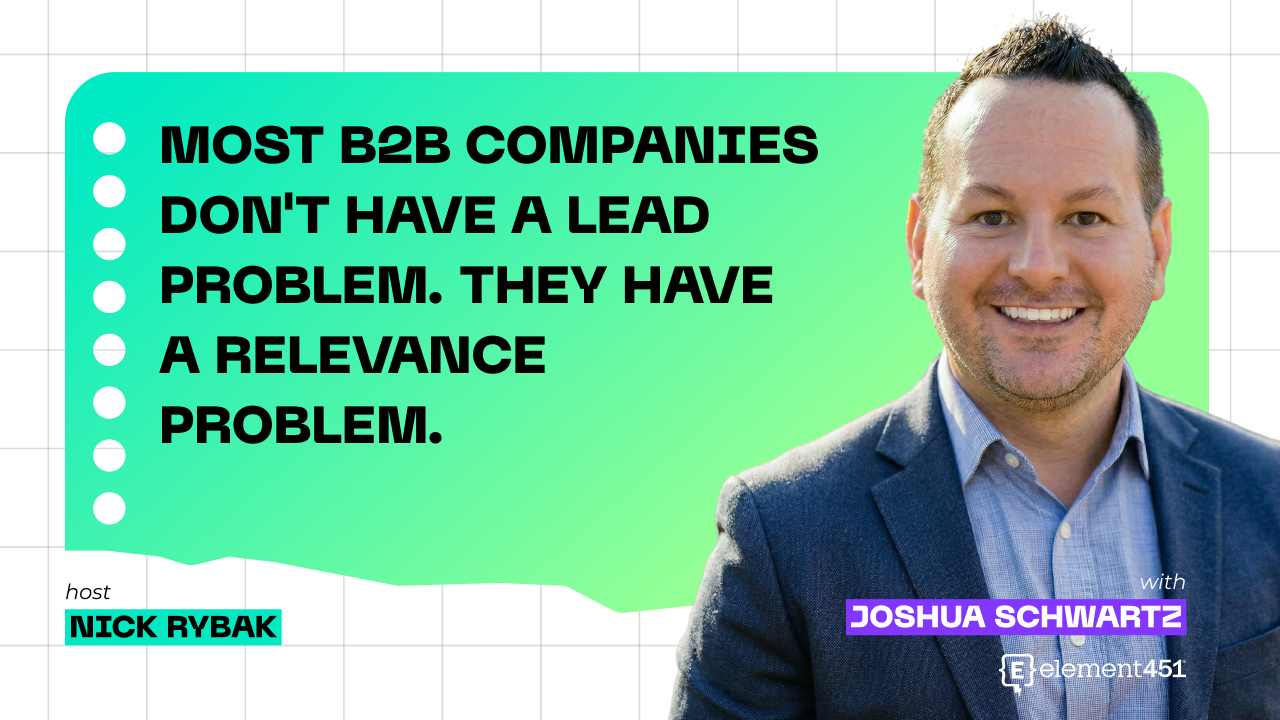
I think most B2B companies don't have alead problem. They have a relevance problem.
And I think that probably the mostcontroversial thing I can say, because everyone will align to it and say, no,we have a lead gen problem. Something's happening in the lead gen side. No,look at your product, look at what you're positioning. You probably have arelevance problem. You're probably not positioning your product or yourplatform the way it needs to be. And have I said this at conferences? Iabsolutely have. So I know it's controversial in that perspective. Do peopletake offense to it sometimes? They're like, yeah, my product is the bestproduct in the
world or our solution is the best solutionwe know it is. Well then why are you having lead gen problems?
Nick Rybak (29:13)
Yeah, it
sounds weird. But you know, about theproduct market fit, I've read a documentation by some venture fund a couple ofyears ago. And I remember how they describe product market fit is thatsomething that you would definitely know what it is when it's happening. So youwould never like...
Joshua Schwartz (29:35)
Yes. Yep.
Nick Rybak (29:39)
question if you found that, you willunderstand that like right now, immediately. So that's why I think people whohave lead gen problems with their products, yeah, that's kind of, as you callit, relevance problem.
Joshua Schwartz (29:52)
Yep.
I think that that's spot on. And that's whyas a company, have to be innovative. You have to be fast. You can't be sixmonths behind because you're actually two years behind when you think you'resix months behind, because it's going to take you that timeframe to build yourproduct the way it needs to do to test it. You're now solving a past problemwhen you need to be innovative, know your market and produce for your marketwhat they need in the end and be able to communicate to that saying, Hey, we builtthis.
We know you need it now, but we built itbetter because we know what you're going to need in the future. And I'll say,and I'm not giving kudos to my company for this one because I am giving kudosto my company, but Elevent 451 is really, really good at doing that. Ourproduct team knows our market, knows our industry, and it pushes out theproduct to be that effective. They're really, really good with that, whichmakes it easy for me from a lead side perspective for the demand gen.
Nick Rybak (30:47)
Yeah, it's, you know, there's always adebate between product and marketing teams like...
It's ⁓ like how it was in the Silicon Valley TV show, like when theytalked about sales reps, like why do we need the best sales reps that can sellour product? And he was like, because your product is not that good. Yeah, butthey are the best ones. They should probably sell that if they're the best.Yeah, I love that.
Joshua Schwartz (31:09)
Yep. Yep.
Yep, sell the story.
If you can sell this sometimes, folks, sellthe story and not the product. And you gotta sell both. You gotta sell both.
Nick Rybak (31:23)
Love that. yeah, and the last question,what's something you've had completely wrong about three marks, like threeyears ago about marketing and that you now believe is true.
Joshua Schwartz (31:35)
Yeah, three years ago I believed moremarketing technology would make both small and large teams more effective. Idon't know if that's true anymore. You look at more tools, which means moreautomation, which means bigger stacks, I believe the opposite now. I think thebest marketing today is simplifying your tech stack.
Utilizing it and strategizing it looking atthe same signal quality looking at messaging Understanding the buyer going backto those three areas that kept saying throughout this whole chat today Like youdon't need 20 different tools and processes to utilize those tools think of theintegrations that are gonna have to occur I think of like the time your yourrev ops teams are gonna have to Take this tool and integrate it into this tooland integrate it into this tool and enrich it through this tool and put it intoyour CRM by the time it gets to
CRM, like it can take a day or two andyou're now stalling in your messaging. Keep it simple. know in high school andcollege my dad always said my best way to do the best work is to keep it simplestupid. I'm coming back to that basic now in marketing. Keep it simple. Don'tbe
over personalized. Don't be over dramaticwith it. Just keep something simple. And that's aligning to me now even fromthe tech stack side. And we did cut our tech stack down here at Element. Welooked at what tools we were utilizing and we've narrowed them down so we'rebeing more effective in utilizing the tools and the features they have moreeffectively.
Nick Rybak (33:01)
Thank you for being here. It was JoshuaSchwartz. Thank you for your wisdom. yeah, make sure to follow Joshua onLinkedIn and please subscribe to the podcast and see you in the next one.
Joshua Schwartz (33:10)
Thank you everyone.








.avif)

.avif)


.avif)