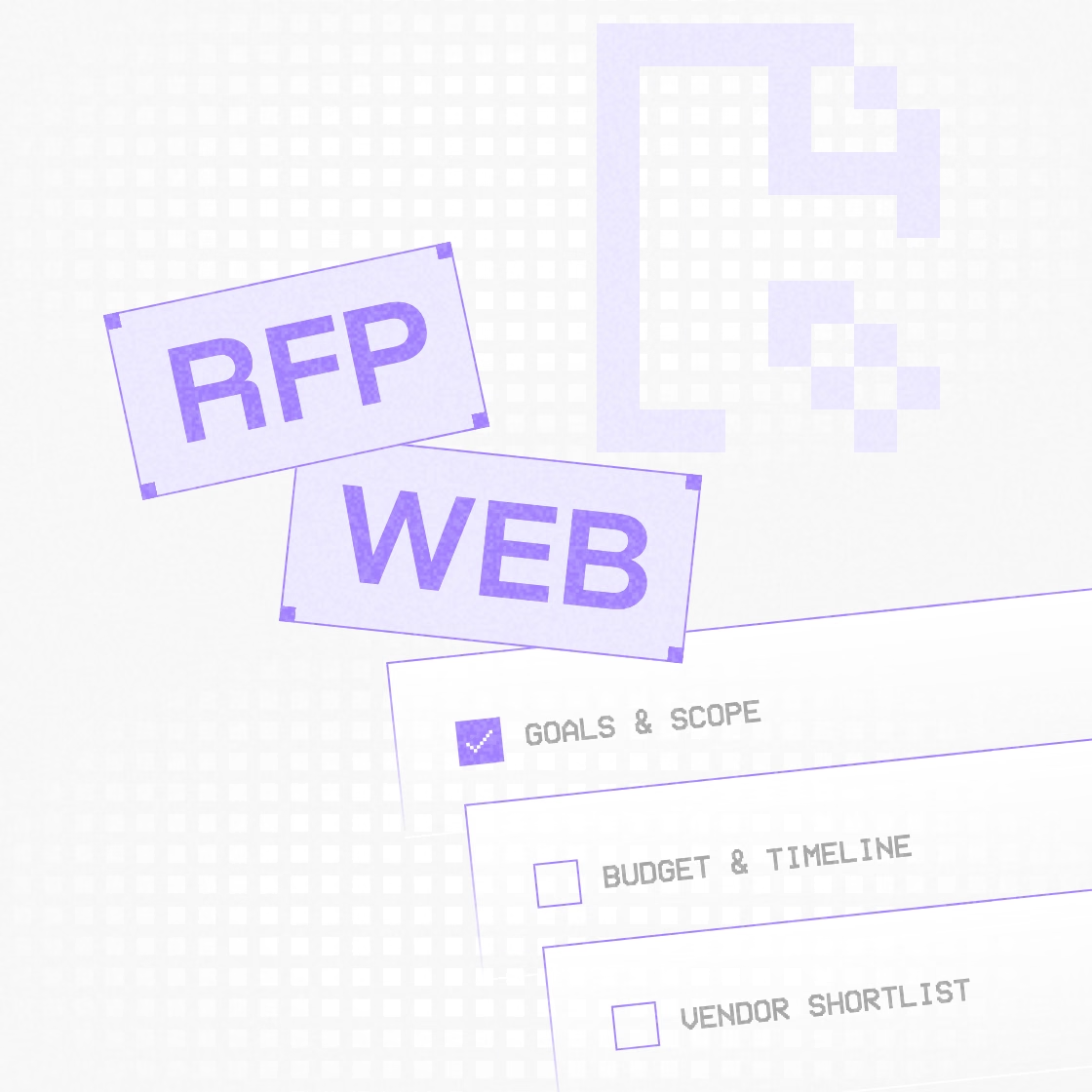
You've decided the website needs a rebuild, and three agencies are waiting for a brief. This website RFP template is the request for proposal you send them. Thirteen sections and a filled sample, plus an optional block for a move to a new platform. Each agency answers the same questions, so the proposals land in a shape you can put side by side.

Used by marketing teams at:
OUTCOMES
What you’ll walk away with

A request for proposal that covers the whole project
Thirteen sections, from the project summary to how agencies respond. Goals with today's numbers, the audience, the current site, scope, tech, design, dates and budget. An agency reading it can price the work without a discovery call first.

Proposals you can compare line by line
Each agency sends the team, similar projects with results, pricing by phase, support after launch and what's out of scope, in that order. You read three proposals in an afternoon, in one format.

A migration block for a website redesign RFP that changes platforms
Moving off WordPress or a custom CMS is where sites lose organic traffic. The optional block asks who builds the redirect map, which pages bring traffic today, what has to carry over for SEO and when content freezes.

A sample RFP for website design filled in end to end
Acme Ledger, a fictional B2B SaaS company, moving from WordPress to Webflow. Real-looking numbers, dates and a budget range in every section. Copy the level of detail, then swap in your own.

Evaluation weights your buying group agrees on before proposals arrive
Experience, approach, price, team, timeline and support, weighted to 100. Your CFO and your head of product sign off on the weights first, so the decision meeting argues about agencies.

An RFP for website design and development you can send today
A branded Word file. Grey fields for your answers, example answers under every question, and a one-page summary at the front for the agency partner who reads only that.
PROCESS
DAY 1
Agree on goals, budget and who decides
Get marketing, sales and finance in one room. Settle three goals with numbers, a budget range and the two or three people who pick the agency. Write all of it into sections 1, 3 and 10.
DAY 2
Fill in the template
One day for one person. Replace the grey fields, delete the example answers, and keep section 6a only if the site is moving to a new platform.
DAY 3
Send it to three to five agencies
Five proposals is the most a team can read properly. Pick agencies that have built sites like yours, and send each one the same file on the same day.
DAY 6
Answer questions and copy the answers to the whole list
Good agencies ask questions in the first days. Copy each answer to the whole list, so the agencies price one and the same project.
DAY 10
Score the proposals against your weights
Each person scores alone first, then you compare. The weights in section 12 keep the loudest voice from deciding.
DAY 12
Call the two or three agencies at the top
Meet the people who would work on your site, along with the sales lead. Ask each agency to walk you through a project like yours. Our guide on choosing a web designer covers what to check in the portfolio.
DAY 14
Pick the agency and sign
Check two references from the winner, agree the start date, and send a short no-thank-you to the rest. They answered your RFP for free.
NUMBERS
We answer website RFPs from B2B marketing teams. The template asks the questions we need answered before we can give an honest price and timeline.
500+
Page website migrations executed with full URL restructuring and no loss of organic traffic.
100+
Clients served.
50+
B2B marketing teams trusted us with their websites.
25+
Countries served, from the US and Australia to the UK and Germany.
96.8%
On-time delivery rate since 2021.
13
Industries served.
PROBLEMS > SOLUTION
Five lines we see in RFPs, and what the template asks for instead.
Challenge
"Budget TBD. Send us your best price." Every agency guesses a different project.
"We need a modern, user-friendly website." Three agencies read three different scopes.
"Increase engagement and brand awareness." You can't tell whether the site worked.
"Must be built on WordPress with Elementor." You pick the tool before anyone hears the problem.
"Migrate the existing content." The redirects, metadata and forms go unpriced until launch week.
Our Solution
Section 10 asks for a range and a separate support budget, so each agency proposes the best version it can deliver for that money.
The scope table lists every piece of work as in scope, out of scope or agency to propose, with page types and counts.
Section 3 asks for today's numbers and a target per goal, such as demos a month or days to publish a page.
Section 7 asks for the goal behind the platform, so agencies can propose the stack that meets it.
Section 6a asks what moves, who owns the redirect map, which pages bring traffic and when content freezes.
BEFORE & AFTER
From a blank page to an RFP agencies can price


AWARDS
Every question in the template is one we ask before we price a redesign or a migration. The badges below are the receipts.

The board wants the new site by spring, and you have three agency names in a spreadsheet. Download the template, fill it in over a day, and send every agency the same questions. A week later you're scoring proposals.

FAQ
A website RFP, or request for proposal, is the document a company sends to agencies to get comparable bids for a website project. It describes the business, the goals, the scope, the dates and the budget, and asks every agency for the same answers. An RFQ asks only for a price on a fixed specification. An RFP asks how the agency would approach the work.